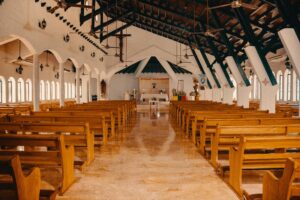
Photo by Oscar Ivan Esquivel Arteaga
As you enter the house of God,
keep your ears open and your mouth shut.
It is evil to make mindless offerings to God.
Ecclesiastes 5:1 (NLT)
A question has been burning in my spirit for some time: How mindful are we as Christians? And yes, I mean we. I mean me.
I discovered this verse a few years back after I’d begun supporting a ministry with an automated monthly gift. Now, there is nothing at all wrong with automated offerings, so don’t think I’m going there. What was wrong with my automated offering—and I realized it the instant I read this verse and really heard what it had to say—was that I’d literally put this offering on autopilot and hardly ever thought about it again.
Yes, I took it out of my checkbook when it came through, but that was it. I never thanked God for prospering me so that I could give it. I never consciously counted it as seed and prayed that God would bless it and bring increase. I never used that monthly gift as a reminder to pray for that ministry.
Nothing.
I did nothing.
And as loving and gracious and merciful as my God is, I could not ignore the import of these words: “It is evil to make mindless offerings to God.”
My approach to giving changed that day. Be it tithes, offerings, support for a missionary—whatever it is—I give it mindfully now. I thank God that I have it to give. I pray over it. I often ask God for souls to be saved directly as a result of my giving. I choose to bring my offering, to bring my worship, mindfully.
I’ve lived with this knowledge for a while and have been grateful that God opened my eyes to my inattentive giving. Then, some months back, He showed me more.
It wasn’t me this time, though I know it had been me many times in the past—so know that I’m not pointing fingers.
Worship had been amazing. I was at the altar with many others, and you could feel God’s presence. It was as if He was right there and preparing to move. And then the music stopped.
There was nothing wrong with the music stopping. The song had come to an end, but many of us continued to worship for a few seconds before…
Everyone started clapping.
I felt like I’d been on a mountaintop and was suddenly yanked back down into a valley. It was abrupt. It was spiritually painful. God and I talked about it a lot after that service—okay… during that service, even. I can’t guarantee how much of Pastor’s message I caught because I couldn’t let go of what had occurred.
God pointed out to me that we do it “all the time.” Not literally all the time, of course, but enough of the time that once He’d opened my eyes, it became glaringly obvious.
The problem, as He explained it to me, is that too often during worship we fall back on habit rather than worshipping intentionally—bringing that offering mindfully. We may even make it through the worship service without realizing what we’ve been singing. And the instinctive thing to do at the end is clap.
So we clap.
Clapping is not bad, but it’s out of place when God is drawing us into stillness.
The problem is that our worship prepares the atmosphere. Psalm 22:3 (NLT) says, “Yet you are holy, enthroned on the praises of Israel.” Our praise provides a resting place for God, an invitation for Him to be right there in our midst.
And if we go back to Solomon’s Temple, in 2 Chronicles 5:13–14, we get this glorious picture:
“The trumpeters and singers performed together in unison to praise and give thanks to the LORD. Accompanied by trumpets, cymbals, and other instruments, they raised their voices and praised the LORD with these words: ‘He is good! His faithful love endures forever!’ At that moment a thick cloud filled the Temple of the LORD. The priests could not continue their service because of the cloud, for the glorious presence of the LORD filled the Temple of God.”
The priests couldn’t continue their service because of God’s holy presence.
I’ve heard many pray that we be able to experience this today, and I’ve heard reports of such things happening—but it can’t if we don’t worship mindfully. When we stop being mindful and fall back on going through the motions, worship can become reflexive instead of intentional. We respond out of habit rather than out of an awareness of God’s presence.
When we fail to be aware of God’s presence, and that lack of awareness leads us to rush past a holy moment, changing the atmosphere…
We experience what I did that night at the altar.
I’ve wondered, ever since, what God had been preparing to do. I’ve never actually asked Him because, to be honest, I’d rather not know what we missed out on. And yes, it’s happened many times since then—but at least I am aware of my own mindfulness now. There is that.
What would happen if we all consciously focused on bringing our offerings mindfully?
Celebrating Jesus!
Tammy C
Scripture Focus:
Ecclesiastes 5:1 (NLT)
Psalm 22:3 (NLT)
2 Chronicles 5:13–14 (NLT)