I Gave God One Day… And Got More Done

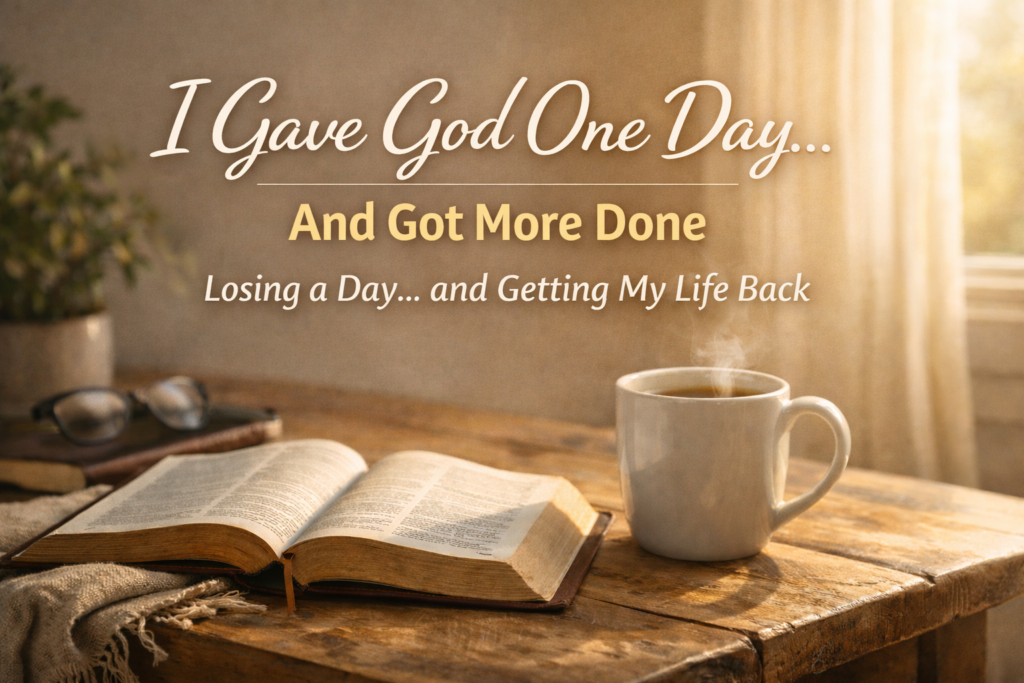
Open Bible and coffee on a wooden table in soft sunlight representing Sabbath rest and peaceful reflection

What do you do when you hear God say,
“Start keeping Sunday as a rest day.”?

I knew it was God speaking, because the thought had never even crossed my mind. As an author and blogger with a full-time job, I’ve pretty much been working 7 days a week for years.

And God was asking me to give up a whole day?
Yes. Yes, He was.

But here’s the surprising thing: It’s been amazing!
I’m talking life changing amazing.
So much so that I had to share what I’ve been experiencing.

Interestingly, when I mentioned this to a friend, she told me God had recently given her the same instruction. As we compared notes, we realized we’re seeing many of the same results.

In “losing” that workday, setting Sunday afternoon and evening aside for rest, we’re both getting more done.

It’s easier to avoid putting things off when you know a full day is coming when you won’t be working. It’s also easier to stay focused when you realize your time is limited.

On Saturday evenings, even when I’m tired, I’ll push through to finish something I might have previously left for “tomorrow.” Because now tomorrow isn’t an option. And there’s something about knowing tomorrow isn’t an option that is very motivating.

In the past, if I took a day off just for me, I’d feel guilty about everything I wasn’t getting done. As a result, my “day of rest” was never truly restful.

Guilt can be exhausting.
There is no guilt on Sunday.

Once I get home from church, I am “off” in a very real way. I might toss in a load of laundry… maybe. But I don’t go near my laptop or anything that might pull me into work. The closest I come to working is talking to God. And even then, He’s been known to gently shut me down when my thoughts stray into “unrestful” territory.

Another unexpected result? I look forward to Mondays.

I’ve never hated Mondays, but there have been many when I felt the weekend was too short and I was too tired.

This doesn’t happen now.

When I head to bed on Saturday night, I’m satisfied. I’ve accomplished more than I expected, and I know a true day of rest of coming. After that rest, I’m ready to go again.

I’m less fatigued. Mentally, I feel better than I have in years. My patience is higher, even during one of the church’s busiest seasons. I’m not overwhelmed by everything on my plate.

This has been a complete shift.

Growing up, I had a friend whose family strictly observed the Sabbath. I even remember hearing her dad explain to mine, “You know I don’t do any work on Sunday.” At the time, I thought it a little odd even though I vaguely knew it was one of the Ten Commandments.

I mean, God did say in Exodus 20:9-10 (NLT):

You have six days each week for your ordinary work,
but the seventh day is a Sabbath day
of rest dedicated to the LORD your God.
On that day no one in your household may do any work…

I suppose I assumed it didn’t really apply to modern life—if I thought about it at all.

But it turns out that the need for a regular day rest very much still applies.
And not just because God said so.

There’s a growing body of research suggesting our bodies are literally designed to function best with regular rest.

A regular rest day can:

  • reduce chronic stress (cortisol levels)
  • improve sleep quality
  • help prevent burnout and fatigue
  • allow physical systems to repair and reset

Without it, you don’t just get tired—you get worn down

On the other hand, when you truly step away one day each week, it can:

  • restore joy
  • increase patience
  • stabilize your mood
  • lift mental fog 
  • increase creativity
  • improve decision making
  • reduce irritability
  • dissipate anxiety

And that’s just a start.

You stop simply reacting and start thinking clearly again. You remember what matters, who matters, and why you’re doing what you’re doing.

And you remember Who’s really in control.
(That would be God.)

As a mostly-recovered control freak, I find that especially important.

It turns out God knew exactly what He was doing when He established the Sabbath.
And He knew exactly what He was doing when He told me to start keeping it.

God didn’t command us to rest to slow us down—He commanded it because He designed us to need it.

Have you ever considered setting aside a true Sabbath—one full day to rest with God?
You might be surprised what happens when you do.

Celebrating Jesus!
Tammy C

The Hidden Meaning Behind “The Joy of the Lord is Your Strength”

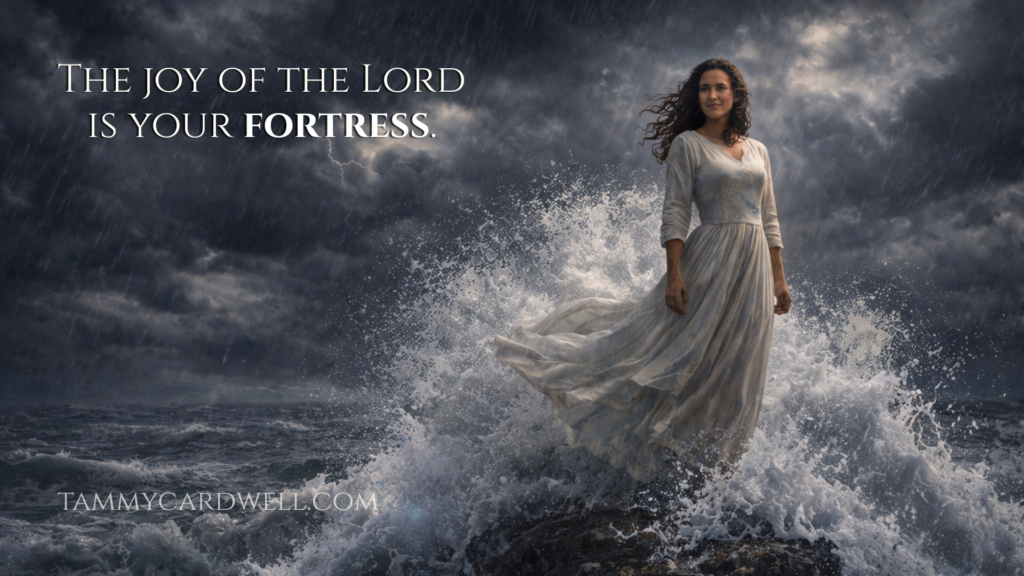
Woman standing on a rock in a storm representing God’s protection and the joy found in His presence

“It’s good to see you like this,” she said. “It’s not normal for anyone to be happy all the time.”

I had thought she was my friend. Her delight in my pain—during what I’ve since recognized as a nervous breakdown—left me stunned.

The truth is that until that season of my life I had always been a happy person. Even though my husband’s behavior was becoming increasingly destructive, I walked in joy most of the time. All of that changed when God gave me a direct command…

and I told Him, “No.”

It wasn’t until recently—while reading The Force of Joy by Alexandria Flint—that I began to understand what had really happened.

We’ve all heard the phrase “the joy of the Lord is your strength” from Nehemiah 8:10. Nehemiah is encouraging Jerusalem’s inhabitants as they grieve over how they’ve sinned against God. He’s assuring them that there is hope.

Alexandria, in the very first pages of her book, digs into the Hebrew words that have been translated as “joy” and “strength.” And these words don’t mean what you probably think they mean!

Multiple Hebrew words are translated as joy in the Old Testament, but this word, chedvah, is special. It’s only used three times: In 1 Chronicles 16:27, Nehemiah 8:10, and Ezra 6:16. Unlike the other Hebrew words that refer to outward expressions of joy, Chedvah refers to the overflowing delight that comes only from being in God’s presence.

I love the way Alexandria explains it:

Think of it like this: chedvah is a deep root system buried in the richness of God’s character, and all those other expressions of joy (simchahsassongil) are the flowers that bloom from that root. You can have beautiful flowers for a season, but if there’s no root system, the first storm that rages by will wipe them out.

The more I thought about chedvah, particularly in reference to that horrible season of my life, the more I understood why 1) I’d always been such a happy person and 2) I suddenly was not.

I’d always been happy because I intentionally lived close to God. I stayed in His presence through prayer, reading my Bible, worship… And being constantly in His presence—the very source of joy—I lived joyously.

But, on the day I refused to obey God’s clear and direct instructions regarding my involvement in a specific ministry, I did what we all instinctively do. I stepped back.

I couldn’t stay in His presence while choosing disobedience. The conviction would have been too much. I didn’t want to hear what He had to say… so I turned away.

I was no longer anchored in that flow of joy—and I was no longer protected by it. While living in God’s presence, with my focus on Him, I was able to handle my husband’s behavior, but suddenly I saw everything… every… little… thing that he did.

I couldn’t handle it.
And I started to spiral.

“The joy of the Lord is your strength.”

I had no strength, which is hardly surprising, but in losing that joy I lost more than strength. Much more!

The word translated as “strength” is ma’owz, and although it appears 37 times in the Old Testament this is the only place it appears as “strength.” In other locations, it’s translated as “stronghold,” “refuge,” “fortress,” and “protection.”

It’s a military term.

The joy of the Lord, that joy that comes from being in God’s presence, is your stronghold, your refuge, your fortress, and your protection!

That is what I stepped away from when I backed away from God!

I’ve spent days talking to God about this.

Think about Psalm 91 and all it promises to the one who dwells in the secret place of the Most High. When you grasp the truth of the joy of the Lord being your “strength,” this psalm becomes even more significant.

Even now, I’ve been literally sitting here with my head in my hands as I work to absorb all of this. And I’m reminded of a vision God gave me when our oldest was a baby.

At church, during worship, God showed me a woman
standing on a rock in the middle of a stormy sea.

Although her dress was wind-blown and waves beat against the rock, she stood confidently. God told me then that I could be that woman, one who could stand strong through any storm.

He didn’t tell me how to become that woman. He just told me to stay close to Him.

And, as it turns out, that is exactly what it takes.

As I live in God’s presence, I live in joy that can only be found in Him, and that joy protects me in ways I may never recognize.

And what about that friend, you ask? As I recall, we parted ways not long after. But I will say this; her heartless words were part of what woke me up. God used them to get my attention and draw me back to Him—back into obedience and back into His presence, His joy, and His protection.

There’s no place I’d rather be than in His presence, His joy, and His protection.

Celebrating Jesus!
Tammy C

The Force of Joy: A Journey from Discovery to Deployment of Your Spiritual Weapon, by Alexandria Flint, is available on Amazon. I will publish a review once I finish, but I had to stop right now and share what I’ve learned just from pages 5-8.

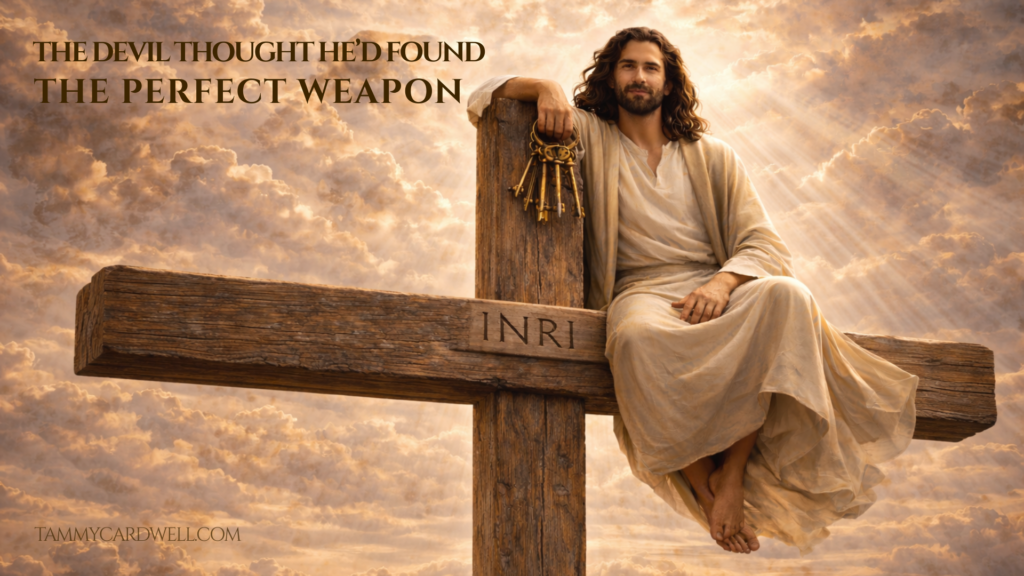
The Devil Thought He’d Found the Perfect Weapon

Jesus seated on a cross holding keys, symbolizing victory over death and Satan, with golden light breaking through clouds

What was meant for destruction became the symbol of ultimate victory.

Satan’s plan looked genius. Don’t just kill the Son of God. Kill Him in the most brutal, agonizing, publicly humiliating way possible, branded as a criminal. Make a public spectacle of Him so that all who follow Him will be shamed and run for cover.

As far as the devil was concerned, there could be no better weapon than a Roman cross.

Except…

The devil knows the Word of God and knows it well. He’s been twisting it since the beginning as he’s tried to lead astray everyone he possibly can—including Jesus. (That attempt failed gloriously.)

But knowing the Word isn’t the same as understanding it. He missed a world of clues. Let’s take a look.

The Bronze Serpent — Lifted Up

The Lord told him, “Make a replica of a poisonous snake
and attach it to a pole.
All who are bitten will live if they simply look at it!

Numbers 21:8 (NLT)

Jesus directly connects this to Himself:

And as Moses lifted up the bronze snake
on a pole in the wilderness, so the Son of Man
must be lifted up, so that everyone who
believes in him will have eternal life.

John 3:14–15 (NLT)

This imagery? Being lifted up on a pole—that’s crucifixion. And Jesus told everyone it was going to happen.

Cursed Is Everyone Hung on a Tree

Anyone who is hung on a tree is under God’s curse.
Deuteronomy 21:22–23

Paul makes the connection explicit:

But Christ has rescued us from the curse
pronounced by the law. When he was hung on the cross,
he took upon himself the curse for our wrongdoing.
For it is written in the Scriptures,
“Cursed is everyone who is hung on a tree.”
Galatians 3:13 (NLT)

Jesus going to the Cross for us was all about taking the curse. He had to be hung on a tree in order to take our place.

Pierced Hands and Feet

…They have pierced my hands and feet.
Psalm 22:16 (NLT)

David wrote this psalm long before crucifixion like this was practiced. Beheading was more common in his day, and that doesn’t involve pierced hands and feet.

Public Exposure and Mocking

Everyone who sees me mocks me.
They sneer and shake their heads, saying,
“Is this the one who relies on the LORD?
Then let the LORD save him!
If the LORD loves him so much,
let the LORD rescue him!”

Psalm 22:7–8 (NLT)

Public ridicule was part of the plan, and the cross fit it perfectly.

Bones Not Broken

For the Lord protects the bones of the righteous;
not one of them is broken!

Psalm 34:20 (NLT)

This was fulfilled in:

When they came to Jesus,
they saw that he was already dead,
so they didn’t break his legs.

John 19:33 (NLT)

In Roman crucifixions, the criminals’ legs were often broken to speed death. But they did not break Jesus’ bones, and this connects to the Passover Lamb from Exodus 12:46 (NLT) where they were commanded, “…and do not break any of its bones.”

Jesus IS the Passover Lamb, the Final Sacrifice. (1 Corinthians 5:7)

Dividing Garments / Casting Lots

They divide my garments among themselves
and throw dice for my clothing.

Psalm 22:18 (NLT)

This is an oddly specific crucifixion detail that was fulfilled in John 19:23–24.

“Lifted Up” = The Means of Drawing All People

And when I am lifted up from the earth,
I will draw everyone to myself.

He said this to indicate how He was going to die.
John 12:32–33 (NLT)

He made it clear how he was going to die.

Yes, the Roman cross seemed to be the perfect weapon. But the devil was, as Shakespeare so elegantly put it, “Hoist with his own petard.” Satan’s plan blew up in his face—and Jesus was left holding all the keys.

And now the Cross is a beautiful thing, which brings me to the picture you see above. It’s an image that has lived as a concept in my head for a very long time, one in which our triumphant Savior uses what was meant to destroy Him as a place of rest—and a reminder of His ultimate victory.

It wasn’t just that Jesus had to die.
He had to be lifted up.

As my Resurrection Sunday gift to you, here are two versions of this image:

Download The Perfect Weapon Web Header

Download The Perfect Weapon Wallpaper

They are AI creations (Thank you ChatGPT), so I claim no copyright, but I would appreciate it if you would keep my watermark should you choose to use or share them.

Sunday is on the way!

And remember, Jesus is too. If you haven’t already, now is the time to accept Jesus as your personal Lord and Savior. He died so that you could truly live, and at some point in the (I believe) very near future He will return to catch us away to be with Him forever.

The other option—choosing Hell over Him—is unthinkable. Don’t go there.

Celebrating Jesus!
Tammy C

The Dating App I Never Wanted… and What God Showed Me Through It

Woman sitting on a rock overlooking water at sunset, reflecting quietly

This piece is even more transparent than what I usually write, but sometimes it’s the things written in the trenches that God uses most. And, frankly, I felt God leaning on me to share. So let’s go.

After a few years of widowhood, I’ve reached the point where I’m seriously considering the possibility of getting married again. Getting here has taken time and many counseling sessions with God as my therapist.

He’s even told me I’m ready to meet someone, which is remarkable. Marriage to a narcissist leaves you carrying a lot of baggage that can be very hard to get rid of. It feels like it’s taken a piece of forever to get where I am today.

So, on a random day not long ago, God decided it was time to take a step.

He told me to set up a profile on a specific dating site.

His instructions made no sense to me. This dating app is so expensive there was no way—even for Him—that I would willingly consider that kind of commitment.

Judge me if you will, but I have an aversion to the whole idea of dating sites—for me. Still utterly confused by His insistence, I signed up for the free plan and determined to cautiously dip my toes in the water.

The extensive profile questions proved truly educational. They forced me to consider how I really feel about certain things. I had to ask myself, “Am I answering based on who I’ve always been, or who I’m becoming?”

But the real education came when I started getting matches. All I could do with the free site was look at their profiles, which I did. I rejected one after another, only “liking” one because I wanted to see what happened when you liked someone—and he was safely located several states away. Why was I rejecting these men? Honestly, for stupid reasons. Except… 

God called another counseling session in which He showed me just how much fear still hid in my heart, and it wasn’t fear of the men.

I wasn’t rejecting them; I was rejecting me.

Bottom Line: I was afraid of hurting someone. The thought of potentially holding someone else’s heart in my hand, not knowing if I had what it took to make him happy, doubting that I would be enough…

Frankly, it scared me—and I hadn’t even realized it until God made it clear.

I felt such shame. I’ve really thought I was trusting God completely where potential relationships are concerned. I have faith in God!

But, as He’s reminded me a few times through the years (because I need reminders), when I fail to have faith in myself, when I let that fear settle in, it affects my ability to trust Him. Fear pulls the rug out from under our faith, so we must seek it out and cast it away.

I repented of course; I’ve learned that much for sure! I started actively casting down those doubts when they arise and have renewed my commitment to trust Him without reservation.

If God wants me to get married again, He will bring the right man and we’ll be blessed. It’s inevitable. Never in my life has He failed me, and He won’t fail me now. And if I’m not meant to marry again? That’s cool too. I love the life I’m living.

Getting back to the counseling session, in the end God told me to cancel my membership, that the app had served its purpose. Being who I am, I asked Him to clarify what He meant.

His answer didn’t surprise me. He knew what was hidden in my heart and chose to use the dating app like a mirror so I could see it for myself.

Psalm 139:23–24 (NLT) says:

Search me, O God, and know my heart;
     test me and know my anxious thoughts.
Point out anything in me that offends you,
     and lead me along the path of everlasting life.

I want this. I pray this prayer with the psalmist because only when my heart is cleansed and my anxious thoughts are conquered can I truly stop doing things that offend Him. 

Walking the path God has laid out for me is vitally important to me. I never want to risk veering from it even a little bit, and certainly not because of anxious thoughts.

And the beautiful thing? God is always faithful to answer this prayer! When I’m not quite right, He lets me know.

It’s generally God’s own Word that He uses as a mirror, to help me see where I’m missing it. Honestly, this is one of the best reasons for reading the Bible; it has unique power to open our eyes to see things in ourselves we may prefer to ignore.

God also speaks to me personally, gently showing me where I’ve disappointed Him or when I could have behaved in a more godly way.

And then there are the surprising times, like this one, when He tells me to do something that seems utterly ridiculous or follow a path I find completely incomprehensible. I’ve learned to obey anyway, because I know He doesn’t do anything without a purpose.

In this case, that purpose wasn’t meeting someone.

It was revealing something.

God knew exactly what was hidden in my heart. He simply used the dating app as a mirror so I could see it too.

God will use the most unexpected things to help us see what’s hiding in our hearts.

Celebrating Jesus!
Tammy C

PS: If you, too, are recovering from a narcissistic relationship, you are enough! Even if you’re carrying baggage like I have been, God can help you deal with it, unpack it, and kick it to the curb.

But Even If He Doesn’t: Faith That Refuses to Bow

Silhouette of three men standing before a fiery background with the words “But Even If He Doesn’t,” representing unwavering faith during trials.

Have you ever struggled with God after losing someone you love? Many have—especially when they’ve prayed, believed, and stood for healing. And yet, Scripture says something that often goes unnoticed.

Good people pass away;
the godly often die before their time.
But no one seems to care or wonder why.
No one seems to understand
that God is protecting them from the evil to come.
For those who follow godly paths
will rest in peace when they die.
Isaiah 57:1-2 (NLT, emphasis mine)

“No one seems to understand that God is protecting them from the evil to come.”

One day, the Holy Spirit lit up this verse for me. Given how evil the world has become since my mother passed, I’ve wondered if, in His mercy, He spared her from the horrific shift in culture that was coming.

Then there’s my husband, whose on-again-off-again relationship with God was “on” when he passed away. I believe God, in His kindness, let Jack go home at a time when his heart was right with Him.

These are my theories anyway.

But what about the rest of those who go before their time? I don’t know.

What I do know is that, while God can certainly handle our anger when we lose someone, being angry with God wounds our own hearts and strains our fellowship with Him. I’ve found a better way to handle the battles we fight, not just things like cancer and death, but everything. And that way requires being proactive.

The way the three Hebrew boys were proactive in Daniel 3:16-18 (NLT):

Shadrach, Meshach, and Abednego replied, “O Nebuchadnezzar,
we do not need to defend ourselves before you.
If we are thrown into the blazing furnace,
the God whom we serve is able to save us.
He will rescue us from your power, Your Majesty.
But even if he doesn’t,
we want to make it clear to you, Your Majesty,
that we will never serve your gods
or worship the gold statue you have set up.”

Here, In Daniel 3, Shadrach, Meshach, and Abednego declared, “But even if He doesn’t…”

For years, these five words confused me. I’ve tried to watch what I say because I know our words have power—power for good and power for evil—and the last thing I want to do is empower the enemy. But I’ve realized something.

These words? They don’t empower the enemy at all. They strip him of his power.

Think about it.

But even if He doesn’t.

These three young men weren’t telling Nebuchadnezzar they doubted their God’s ability or willingness to save them. They were informing him that they would continue to serve their own God faithfully—unconditionally. There was zero chance that they would worship the king’s gods or bow before his idol.

Nebuchadnezzar had used the only threat he had, and it had proven worthless.

I assume you know this part of Israel’s history but if not, I encourage you to open the book of Daniel and read it—especially to see how their experience changed things for everyone. These three boys were, indeed, sent into the furnace. But instead of being incinerated like the soldiers that threw them in, these three were set free to hang out in the furnace with Jesus.

With Jesus.

When they finally came out, which didn’t happen until Nebuchadnezzar called them, they didn’t even smell of smoke.

But even if He doesn’t.

We can, and should, use these words in all our battles.

But even if He doesn’t heal our friend, we will not bow to you, Anger!
But even if our baby doesn’t make it, we will not bow to you, Doubt!
But even if we lose everything, we will not bow to you, Despair!

Devil, no matter what, you will not win!

When we choose ahead of time to hold fast to our faith in God no matter what, the situation may not seem to change, but we do.

  • Rather than being weakened victims, we become victorious warriors.
  • Instead of reacting to our situations, we hold our ground and actively fight the devil on a whole new level.
  • Even when we don’t get the answers we want, we stand strong.

Whatever we face, no matter how dire it is, having the attitude, “Our God is able, but even if He doesn’t…” puts the enemy on notice from the start.

Celebrating Jesus!
Tammy C

Ten Minutes in Light of Forever

“When God gave me a revelation of forever,
of eternity, everything changed.”

After sending this message to a group of friends, I sat back and thanked God, for perhaps the thousandth time, for giving me a revelation of forever, for helping me grasp eternity. That moment of thankfulness led to a conversation about the difference between understanding and revelation.

You can have both.

We gain understanding in many ways— through study, through logic and reason… We gain understanding of God’s Word through spending time with it, meditating on it, digging into it, leaning on the Holy Spirit as our teacher…

Revelation is something different: It comes directly from God, and it bypasses the requirement for understanding. Where understanding acquaints you with truth, revelation confronts you with it.

One day at church camp I was in chapel listening to the minister and came to that moment. I’d heard enough about salvation that I knew the basics, but I didn’t really understand it. Nonetheless, in an instant the conviction settled in my soul.

Without a doubt, I knew I needed to be saved so I stepped into the aisle. It wasn’t an emotional thing; it was more a logical reaction to sudden knowledge. I didn’t even comprehend the magnitude of my decision until I saw my camp counselor crying.

Much later, I came to the realization that what I’d experienced was revelation knowledge. It was communication straight from God that convinced me of my need for salvation. I didn’t have to understand it. I didn’t even have to feel anything. I simply knew the truth, acted on the truth, and my life changed in an instant. There have been several times in my walk with God that He has given me such revelation and changed things instantly.

There have also been at least two times I specifically asked God for revelation on things I was desperate to comprehend. The first was the Rapture of the Church. Witnessing was hard for me and I felt that if I could just grasp the truth of the Rapture, and the reality of people missing it, I would be more driven to witness.

After a time, God gave me that revelation. And after the revelation, as I studied, I also gained understanding.

The same happened with forever. I’d had my blog “Eternally Planted” for years. The title is based off part of Ecclesiastes 3:11 in the NLT: “…He has planted eternity in the human heart…” Eternity is planted inside us even if we fail to recognize it. I think that’s why so many believe in reincarnation—because man has an instinctive knowledge that this life isn’t everything.

When I named my blog what I did, I had some understanding of forever, but at some point I realized I needed revelation. So I asked God for it. It didn’t come instantly, but one day God dropped it into my spirit in a way that lit up my world—and it changed everything about the way I saw my life.

I’d been married to my narcissistic husband for decades and was now responsible for keeping him alive and healthy, or as healthy as I could when he seemed intent on destroying his body. Every day was a struggle and my stress level stayed dangerously high. So this wasn’t a theoretical lesson. It came in the middle of a very real, very heavy season.

But then there was that day. In an instant, I suddenly had it. I knew in my innermost being that this life is nothing compared to the life I will have in eternity. That very hour, I told God that, if I had to live the rest of my life as I had been, it was ok. Because in light of eternity, this life is only ten minutes—and I can do anything for ten minutes.

Life didn’t get easier, but my focused changed. I was no longer looking at what was directly in front of me, but at what is waiting down the road. When you suddenly see a broad, beautiful vista ahead, walking becomes less frustrating and more of a challenge you’re willing to face.

We need understanding, obviously. But we also need revelation, and the beautiful thing is that God is ready and willing to give it. For me, it normally comes after He’s highlighted something I’m reading in the Word, after I’ve taken time to meditate on it, mull it over, and spend time talking to Him about it as I grow increasingly hungry for answers.

And sometimes I just ask.

Celebrating Jesus!
Tammy C

Potiphar’s Trust: Proof that Letting Go is Possible

An open hand symbolizing trust and release, paired with the words “Learn from Potiphar,” reflecting the lesson of letting go and trusting God.

Have you ever considered looking to Potiphar as an example of how you should walk as a Christian?

Neither had I—until recently.

I’ve been reading The Master’s Indwelling, by Andrew Murray, and in one of the essays he pointed out something I’ve seen probably a hundred times, but never really SAW.

Genesis 39:1-6 NET
“Now Joseph had been brought down to Egypt. An Egyptian named Potiphar, an official of Pharaoh and the captain of the guard, purchased him from the Ishmaelites who had brought him there. The LORD was with Joseph. He was successful and lived in the household of his Egyptian master. His master observed that the LORD was with him and that the LORD made everything he was doing successful. So Joseph found favor in his sight and became his personal attendant. Potiphar appointed Joseph overseer of his household and put him in charge of everything he owned. From the time Potiphar appointed him over his household and over all that he owned, the LORD blessed the Egyptian’s household for Joseph’s sake. The blessing of the LORD was on everything that he had, both in his house and in his fields. So Potiphar left everything he had in Joseph’s care; he gave no thought to anything except the food he ate.”

Potiphar saw the evidence of God’s hand on Joseph’s life, and as a result…

“Potiphar appointed Joseph overseer of his household and put him in charge of everything he owned.”
“So Potiphar left everything he had in Joseph’s care”

AND

“he gave no thought to anything except the food he ate”

Even though I’ve been thinking about this for days, meditating on it, mulling it over, I’m still sitting here with my mind blown. Potiphar was a heathen. As far as we know, he knew nothing about Joseph’s God beyond the evidence of his own eyes.

But he had enough trust in Joseph and the God Joseph served that he literally trusted Joseph to take care of everything. As Joseph later explained to Potiphar’s wife, she was the only thing Joseph didn’t have access to and power over.

Take a minute to really think about this. I’m serious. I’m encouraging you right now to pause your reading and actually consider what we’re seeing here. This article will still be here when you get back.

[pause]

I’m honestly hoping you’re coming back to this with your own thoughts as I type mine.

This man was almost surely a heathen. He couldn’t have known anything about Joseph’s God. Who would have taught him? Yet he had enough faith in Joseph that he totally stopped worrying about what surely had to be significant wealth?

No wealthy man I know of has ever handed the entirety of his estate over to the care of someone else, to live the rest of his days not worrying about any of it.

I look at Potiphar and I think about how much worry Christians tend to live in. We know intellectually that God has promised to take care of us as long as we follow His lead, doing as He says, but how often do we instinctively try to take back control from the very God we claim to trust?

We’re not alone. Abram did the same thing; he and Sarai ran ahead of God and, by having Ishmael, made things a lot harder on themselves.

So we might be tempted to give ourselves an out. After all, if Abram/Abraham and so many other heroes of the Bible failed to truly trust God then surely God knows I’m just as weak as they were. Right?

But then I look at Potiphar and I have to answer, “Wrong.”

It’s been staring me in the face all this time and I’ve only just seen it. If Potiphar, who knew nothing of the God I serve, was able to fully put everything into Joseph’s hands, then I am capable of putting everything into the hands of the God I know and love. And leave it there!

And not worry about anything except what I want to eat for dinner.

Potiphar is proof.
It can be done.

Celebrating Jesus!
Tammy C

Mindful Offerings

Empty church sanctuary with wooden pews and an altar at the front

Photo by Oscar Ivan Esquivel Arteaga

As you enter the house of God,
keep your ears open and your mouth shut.
It is evil to make mindless offerings to God.
Ecclesiastes 5:1 (NLT)

A question has been burning in my spirit for some time: How mindful are we as Christians? And yes, I mean we. I mean me.

I discovered this verse a few years back after I’d begun supporting a ministry with an automated monthly gift. Now, there is nothing at all wrong with automated offerings, so don’t think I’m going there. What was wrong with my automated offering—and I realized it the instant I read this verse and really heard what it had to say—was that I’d literally put this offering on autopilot and hardly ever thought about it again.

Yes, I took it out of my checkbook when it came through, but that was it. I never thanked God for prospering me so that I could give it. I never consciously counted it as seed and prayed that God would bless it and bring increase. I never used that monthly gift as a reminder to pray for that ministry.

Nothing.

I did nothing.

And as loving and gracious and merciful as my God is, I could not ignore the import of these words: “It is evil to make mindless offerings to God.”

My approach to giving changed that day. Be it tithes, offerings, support for a missionary—whatever it is—I give it mindfully now. I thank God that I have it to give. I pray over it. I often ask God for souls to be saved directly as a result of my giving. I choose to bring my offering, to bring my worship, mindfully.

I’ve lived with this knowledge for a while and have been grateful that God opened my eyes to my inattentive giving. Then, some months back, He showed me more.

It wasn’t me this time, though I know it had been me many times in the past—so know that I’m not pointing fingers.

Worship had been amazing. I was at the altar with many others, and you could feel God’s presence. It was as if He was right there and preparing to move. And then the music stopped.

There was nothing wrong with the music stopping. The song had come to an end, but many of us continued to worship for a few seconds before…

Everyone started clapping.

I felt like I’d been on a mountaintop and was suddenly yanked back down into a valley. It was abrupt. It was spiritually painful. God and I talked about it a lot after that service—okay… during that service, even. I can’t guarantee how much of Pastor’s message I caught because I couldn’t let go of what had occurred.

God pointed out to me that we do it “all the time.” Not literally all the time, of course, but enough of the time that once He’d opened my eyes, it became glaringly obvious.

The problem, as He explained it to me, is that too often during worship we fall back on habit rather than worshipping intentionally—bringing that offering mindfully. We may even make it through the worship service without realizing what we’ve been singing. And the instinctive thing to do at the end is clap.

So we clap.

Clapping is not bad, but it’s out of place when God is drawing us into stillness.

The problem is that our worship prepares the atmosphere. Psalm 22:3 (NLT) says, “Yet you are holy, enthroned on the praises of Israel.” Our praise provides a resting place for God, an invitation for Him to be right there in our midst.

And if we go back to Solomon’s Temple, in 2 Chronicles 5:13–14, we get this glorious picture:

“The trumpeters and singers performed together in unison to praise and give thanks to the LORD. Accompanied by trumpets, cymbals, and other instruments, they raised their voices and praised the LORD with these words: ‘He is good! His faithful love endures forever!’ At that moment a thick cloud filled the Temple of the LORD. The priests could not continue their service because of the cloud, for the glorious presence of the LORD filled the Temple of God.”

The priests couldn’t continue their service because of God’s holy presence.

I’ve heard many pray that we be able to experience this today, and I’ve heard reports of such things happening—but it can’t if we don’t worship mindfully. When we stop being mindful and fall back on going through the motions, worship can become reflexive instead of intentional. We respond out of habit rather than out of an awareness of God’s presence.

When we fail to be aware of God’s presence, and that lack of awareness leads us to rush past a holy moment, changing the atmosphere…

We experience what I did that night at the altar.

I’ve wondered, ever since, what God had been preparing to do. I’ve never actually asked Him because, to be honest, I’d rather not know what we missed out on. And yes, it’s happened many times since then—but at least I am aware of my own mindfulness now. There is that.

What would happen if we all consciously focused on bringing our offerings mindfully?

Celebrating Jesus!
Tammy C

Scripture Focus:
Ecclesiastes 5:1 (NLT)
Psalm 22:3 (NLT)
2 Chronicles 5:13–14 (NLT)

Prepare for Surprises

If you read my post from yesterday, From Perseverance to Prepare: My Word for 2026, you know that the word God gave me for 2026 is PREPARE. So you can imagine my reaction when I received Rick Renner’s newsletter today and the subject line was “Prepare for What’s Ahead.”

If you are not familiar with Rick Renner, I strongly suggest you check him out. He has a lot available on YouTube, has tremendous resources at Renner.org, has written I have no idea how many books, and every year God gives him a word that proves true.

I wish I could share the newsletter with you, but it’s copyrighted. So instead I urge you to check out this video in which he reads the word God gave him. It is very much in line with what God has been speaking to me, which is always exciting.

I love it when God confirms what He’s already spoken to me!

Celebrating Jesus!
Tammy C

From Perseverance to Prepare: My Word for 2026

Field of stars with the word Perseverance and its definition

I’m not one of those who intentionally comes up with a theme or word for the coming year, but for the past several years God has given me one, and last year’s was perseverance.

Oh my, did it apply!

In 2025, I got to exercise perseverance in ways I’d never have expected. One of the biggest involved self-education. They say it’s important to keep learning new things if you want your mind to stay sharp, and I have been – or I’ve been attempting to.

Learning Spanish hasn’t been easy. In fact, I gave myself a break last month, though I fully intend to pick it back up this week. No, I don’t have a literal need to learn Spanish, but we have a large Hispanic population in our area and in my church, and I want to be able to talk to them in their language. It’s been a struggle, and those who are helping me are having to be very patient, but I’m trying.

And then there is technology and apps. I do not like learning new technology; it’s why I keep my cell phones until I have no choice but to upgrade. But this year?

Whether I’ve been at work or at home, I’ve had a list of things I need to learn. I’m making progress in all areas, including surprising progress in TikTok, which is an app I never even remotely intended to use for more than scrolling.

And then there are finances. I want out of debt! I’m working on it, intentionally making good choices as much as I can. I got slammed financially a few times this year, but I’m still persevering and am determined that the day will come when I will be able to say I’m completely out of debt.

So yes, perseverance is still a word I’m leaning on, reminding myself of. It’s like learning a new language – once you learn the word you keep it in front of you, continue using it so you don’t lose it.

I did learn perseverance in a whole new way in 2025, and I plan to keep on walking in it.

And what, you ask, is my word for 2026?

God gave it to me at the last minute, so to speak, in our New Year’s Eve service at church. It’s prepare. I know part of what God meant in giving me this one. We’ve talked about it and He’s told me to prepare both to level up spiritually and to share Jesus more. There’s more coming, I know, but He’s gracious in that He only tells me what He knows I can handle hearing. He’s good about that. In the meantime, I’m leaning on Proverbs 16:3 for this one. In the NLT, it reads:

Commit your actions to the LORD,
and your plans will succeed.

I’m looking forward to great things in 2026. I hope you are too!

Celebrating Jesus!
Tammy C