Why the Word? Light for the Next Step

Open Bible with ribbon bookmark, titled “Why the Word? Light for the Next Step,” representing a Christian teaching series on staying in Scripture.

Your word is a lamp to my feet
And a light to my path.
Psalm 119:105 (NASB2020)

I live on my sister and brother-in-law’s property and spend a lot of evenings in their home. If I forget to turn the porch light on when I head out the back door, I’m left either cautiously feeling my way or turning on my phone’s flashlight. It’s either that or risk a nosedive I don’t need.

Becoming a student of the Bible is like me turning on my phone’s light. If I didn’t realize my phone even had a light, I’d be stumbling around in the dark. If I know my phone has a flashlight and I choose not to turn it on, I may still be stumbling around in the dark!

It occurs to me that I may be “preaching to the choir” here, that you may love the Word of God and, like me, can’t get enough. Sadly, if that is the case, we’re in the minority. While over two thirds of American homes have a Bible, a little over half of America’s Christians hardly ever read it—if they read it at all. 

Which, of course, is why I’m doing this series.

Back to the point. If you’re not getting into the Word, you don’t know what you’re missing. I mean that literally. Going back to my phone as an example, there is a lot on that thing that I don’t know about, and I don’t care about what I don’t know about. But, every once in a while someone will point out something amazing that I’ve been missing and I get excited.

God’s Word is very much like that, except that it has worlds more to offer than my technological toy. This is one book that no one will ever fully grasp. Why? Because, as Hebrews 4:12 says:

For the word of God is living and active, and sharper than any two-edged sword, even penetrating as far as the division of soul and spirit, of both joints and marrow, and able to judge the thoughts and intentions of the heart.

The Word is alive, so every time I read through it (which I’ve done fifteen times if I remember correctly) I see things I’ve never seen before. This may mean I literally don’t remember having read them, or it may mean I see them differently, apply them to my life differently, find a deeper meaning than I was able to before. As I read, I grow, and as I grow, the light grows brighter.

And the brighter the light, the easier it is to see the right path.

I have no idea how many times God has used Scripture, either by reminding me of it or leading me to it, to help me navigate this life. He’s given me direction through the Word. He’s shown me clearly why I don’t need to see what’s lying in wait down the road and just need to trust Him. He’s constantly using the Word to help me grow closer to being the woman of God he has called me to be.

Have you heard the idiom about “seeing the light”?
Pull out your Bible. That’s where you’ll find it.

Stay in the Word—and let the Word stay in you.

Celebrating Jesus!
Tammy C

Mindful Offerings

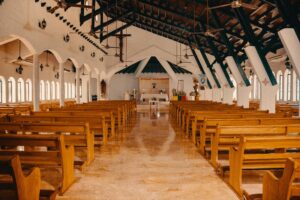
Empty church sanctuary with wooden pews and an altar at the front

Photo by Oscar Ivan Esquivel Arteaga

As you enter the house of God,
keep your ears open and your mouth shut.
It is evil to make mindless offerings to God.
Ecclesiastes 5:1 (NLT)

A question has been burning in my spirit for some time: How mindful are we as Christians? And yes, I mean we. I mean me.

I discovered this verse a few years back after I’d begun supporting a ministry with an automated monthly gift. Now, there is nothing at all wrong with automated offerings, so don’t think I’m going there. What was wrong with my automated offering—and I realized it the instant I read this verse and really heard what it had to say—was that I’d literally put this offering on autopilot and hardly ever thought about it again.

Yes, I took it out of my checkbook when it came through, but that was it. I never thanked God for prospering me so that I could give it. I never consciously counted it as seed and prayed that God would bless it and bring increase. I never used that monthly gift as a reminder to pray for that ministry.

Nothing.

I did nothing.

And as loving and gracious and merciful as my God is, I could not ignore the import of these words: “It is evil to make mindless offerings to God.”

My approach to giving changed that day. Be it tithes, offerings, support for a missionary—whatever it is—I give it mindfully now. I thank God that I have it to give. I pray over it. I often ask God for souls to be saved directly as a result of my giving. I choose to bring my offering, to bring my worship, mindfully.

I’ve lived with this knowledge for a while and have been grateful that God opened my eyes to my inattentive giving. Then, some months back, He showed me more.

It wasn’t me this time, though I know it had been me many times in the past—so know that I’m not pointing fingers.

Worship had been amazing. I was at the altar with many others, and you could feel God’s presence. It was as if He was right there and preparing to move. And then the music stopped.

There was nothing wrong with the music stopping. The song had come to an end, but many of us continued to worship for a few seconds before…

Everyone started clapping.

I felt like I’d been on a mountaintop and was suddenly yanked back down into a valley. It was abrupt. It was spiritually painful. God and I talked about it a lot after that service—okay… during that service, even. I can’t guarantee how much of Pastor’s message I caught because I couldn’t let go of what had occurred.

God pointed out to me that we do it “all the time.” Not literally all the time, of course, but enough of the time that once He’d opened my eyes, it became glaringly obvious.

The problem, as He explained it to me, is that too often during worship we fall back on habit rather than worshipping intentionally—bringing that offering mindfully. We may even make it through the worship service without realizing what we’ve been singing. And the instinctive thing to do at the end is clap.

So we clap.

Clapping is not bad, but it’s out of place when God is drawing us into stillness.

The problem is that our worship prepares the atmosphere. Psalm 22:3 (NLT) says, “Yet you are holy, enthroned on the praises of Israel.” Our praise provides a resting place for God, an invitation for Him to be right there in our midst.

And if we go back to Solomon’s Temple, in 2 Chronicles 5:13–14, we get this glorious picture:

“The trumpeters and singers performed together in unison to praise and give thanks to the LORD. Accompanied by trumpets, cymbals, and other instruments, they raised their voices and praised the LORD with these words: ‘He is good! His faithful love endures forever!’ At that moment a thick cloud filled the Temple of the LORD. The priests could not continue their service because of the cloud, for the glorious presence of the LORD filled the Temple of God.”

The priests couldn’t continue their service because of God’s holy presence.

I’ve heard many pray that we be able to experience this today, and I’ve heard reports of such things happening—but it can’t if we don’t worship mindfully. When we stop being mindful and fall back on going through the motions, worship can become reflexive instead of intentional. We respond out of habit rather than out of an awareness of God’s presence.

When we fail to be aware of God’s presence, and that lack of awareness leads us to rush past a holy moment, changing the atmosphere…

We experience what I did that night at the altar.

I’ve wondered, ever since, what God had been preparing to do. I’ve never actually asked Him because, to be honest, I’d rather not know what we missed out on. And yes, it’s happened many times since then—but at least I am aware of my own mindfulness now. There is that.

What would happen if we all consciously focused on bringing our offerings mindfully?

Celebrating Jesus!
Tammy C

Scripture Focus:
Ecclesiastes 5:1 (NLT)
Psalm 22:3 (NLT)
2 Chronicles 5:13–14 (NLT)

Why the Word? It Restores the Soul

Open Bible with ribbon bookmark, titled “Why the Word? It Restores the Soul,” representing a Christian teaching series on staying in Scripture.

The Law of the LORD is perfect, restoring the soul;
The testimony of the LORD is sure, making wise the simple.
Psalm 19:7 (NASB2020)

Your soul is what makes you you. Generally referred to as the “mind, will, and emotions,” your soul is one third of who you are: Spirit, Soul, and Body.

And I have a true example to share that illustrates just how well the Word of God restores the soul.

There is a man I’ve known about 40 years. I met him at church, and it became quickly apparent that he was quick witted and highly intelligent. In conversation, he once explained that this hadn’t always been the case.

According to him, when he got saved he’d been so destroyed by drugs that he didn’t have two brain cells to rub together. But he heard that the Word of God has the power to restore the soul and he took that promise literally. He dove headfirst into the Bible and has never left it.

The Word of God restored—repaired, revived, converted, refreshed, renewed (depending on your translation)—his soul. It also “made wise the simple,” as it declares at the end of Psalm 19:7.

His is a dramatic account, but yours can be too. If you feel like you’re not smart enough or don’t have the brainpower to read the Bible, remember that he didn’t either. Sometimes you simply have to step out in faith and ask God to teach you as you read.

It does help to find a translation you can relate to. I have sixteen Bibles in eleven different translations, and each of those translations serves a purpose.

  • Most of the scriptures I have memorized are from the King James Version, because its poetic nature makes memorization easier—for me anyway.
  • If I’m doing a straight readthrough, my go-to is the New Living Translation, because it’s the closest to the way I think and talk.
  • If I want a better grasp of how an Israelite would have read a passage, I grab either my Complete Jewish Study Bible or The One New Man Bible.

Intimidated yet?
Don’t be.

My first Bible, or the first one I really used, was a New American Standard, and I can tell you that the 2020 edition of that Bible (NASB2020) is one of the best. That might be the prime choice for you. 

My point is that, if you’re new to the Bible, you’ll find it easier to understand if you choose the right translation. With internet access, that’s a piece of cake. All you need to do is head to blueletterbible.org and use their tools to start comparing Bible translations.

It seems almost too simple to say the Bible restores your ability to think and reason, but I’ve seen proof of this truth time and time again. And it does a lot more, as we’ll see while working through this series.

Truly getting into God’s Word is a life-changing experience. The more time I spend with my Bible, the more I grow in every way—and the hungrier I get.

Stay in the Word—and let the Word stay in you.

Celebrating Jesus!
Tammy C

Why the Word? Series Introduction

Open Bible with ribbon bookmark, titled “Why the Word? Series Introduction,” representing a Christian teaching series on staying in Scripture.

Can we get real for a minute?

Most of us don’t have a problem with owning a Bible; we may even have several. What we can find challenging is making the time to actually open it up and dig in. 

I used the phrase “making the time” intentionally, because this isn’t about finding the time for something we want to do; it’s about intentionally setting aside the time for something that is essential to our spiritual health.

“I know I should, but…”

How many times have I heard a diabetic use these words in reference to watching their sugar intake? Eating excessive sugar could kill them, and yet many struggle to stop.

The same principle applies in all areas of life.
“I know I should exercise, but…”
“I know I should call my mom regularly, but…”
“I know I should study, but…”

Don’t exercise—hurt your body.
Don’t call your mom—hurt your relationship.
Don’t study—hurt your GPA.

Don’t spend regular, intentional time in God’s Word and you hurt your spirit man—the part of you that is meant to be alive and responsive to God. How can we expect to successfully fight our flesh (which, honestly, is our worst enemy) if we consistently starve our spirits?

I mean that seriously. If you wonder why you keep fighting the same old battles with your flesh, you need to take a good hard look at what you’ve been feeding your spirit. And if you’ve been thinking sitting in a church pew was enough to keep your spirit man alive, you are sadly mistaken.

And I am officially at risk of launching into the series right here and now. I can’t do that, but I will do this. There are myriad scriptures that talk about the importance of being in God’s Word and having it live in you, and there’s no time like the present to get started.

You can study up on why you should be studying.
And here’s a list of pertinent references to get you started.

You don’t need to read these all at once.
Choose a section, read thoughtfully,
and ask God to speak to you through His Word.


The Value & Power of God’s Word
Psalm 19:7–11
Psalm 119:105
Psalm 119:160
Proverbs 30:5
Isaiah 55:10–11
Hebrews 4:12


Loving, Meditating on, and Delighting in the Word
Joshua 1:8
Psalm 1:1–3
Psalm 119:15–16
Psalm 119:97
Psalm 119:103
Colossians 3:16


Learning, Teaching, and Passing on the Word
Deuteronomy 6:6–9
Deuteronomy 11:18–21
Psalm 78:5–7
Proverbs 4:1–7
Matthew 28:19–20
2 Timothy 2:2


Hearing and Receiving the Word
Nehemiah 8:1–3, 8
Matthew 4:4
Matthew 11:15
Luke 8:15
Romans 10:17
1 Thessalonians 2:13


Abiding, Remaining, and Staying in the Word
John 8:31–32
John 15:7
Acts 2:42
1 Timothy 4:13
2 Timothy 3:14–17
1 John 2:14


Obeying and Living Out the Word
Deuteronomy 30:14
Psalm 119:9
Matthew 7:24–27
Luke 11:28
James 1:22–25
1 John 5:3


The Word as Protection, Guidance, and Strength
Psalm 119:11
Psalm 119:130
Proverbs 2:1–6
Ephesians 6:17
Colossians 1:9–10


Warnings Against Neglecting the Word
Hosea 4:6
Amos 8:11
Matthew 13:19–23
Hebrews 2:1
Hebrews 5:11–14
2 Timothy 4:3–4


Scripture About Scripture
Psalm 119 (entire chapter)
Romans 15:4
1 Corinthians 10:11
2 Peter 1:19–21
Revelation 1:3


I’ll see you next week with the next installment!

Stay in the Word—and let the Word stay in you.

Celebrating Jesus!
Tammy C

Prepare for Surprises

If you read my post from yesterday, From Perseverance to Prepare: My Word for 2026, you know that the word God gave me for 2026 is PREPARE. So you can imagine my reaction when I received Rick Renner’s newsletter today and the subject line was “Prepare for What’s Ahead.”

If you are not familiar with Rick Renner, I strongly suggest you check him out. He has a lot available on YouTube, has tremendous resources at Renner.org, has written I have no idea how many books, and every year God gives him a word that proves true.

I wish I could share the newsletter with you, but it’s copyrighted. So instead I urge you to check out this video in which he reads the word God gave him. It is very much in line with what God has been speaking to me, which is always exciting.

I love it when God confirms what He’s already spoken to me!

Celebrating Jesus!
Tammy C

From Perseverance to Prepare: My Word for 2026

Field of stars with the word Perseverance and its definition

I’m not one of those who intentionally comes up with a theme or word for the coming year, but for the past several years God has given me one, and last year’s was perseverance.

Oh my, did it apply!

In 2025, I got to exercise perseverance in ways I’d never have expected. One of the biggest involved self-education. They say it’s important to keep learning new things if you want your mind to stay sharp, and I have been – or I’ve been attempting to.

Learning Spanish hasn’t been easy. In fact, I gave myself a break last month, though I fully intend to pick it back up this week. No, I don’t have a literal need to learn Spanish, but we have a large Hispanic population in our area and in my church, and I want to be able to talk to them in their language. It’s been a struggle, and those who are helping me are having to be very patient, but I’m trying.

And then there is technology and apps. I do not like learning new technology; it’s why I keep my cell phones until I have no choice but to upgrade. But this year?

Whether I’ve been at work or at home, I’ve had a list of things I need to learn. I’m making progress in all areas, including surprising progress in TikTok, which is an app I never even remotely intended to use for more than scrolling.

And then there are finances. I want out of debt! I’m working on it, intentionally making good choices as much as I can. I got slammed financially a few times this year, but I’m still persevering and am determined that the day will come when I will be able to say I’m completely out of debt.

So yes, perseverance is still a word I’m leaning on, reminding myself of. It’s like learning a new language – once you learn the word you keep it in front of you, continue using it so you don’t lose it.

I did learn perseverance in a whole new way in 2025, and I plan to keep on walking in it.

And what, you ask, is my word for 2026?

God gave it to me at the last minute, so to speak, in our New Year’s Eve service at church. It’s prepare. I know part of what God meant in giving me this one. We’ve talked about it and He’s told me to prepare both to level up spiritually and to share Jesus more. There’s more coming, I know, but He’s gracious in that He only tells me what He knows I can handle hearing. He’s good about that. In the meantime, I’m leaning on Proverbs 16:3 for this one. In the NLT, it reads:

Commit your actions to the LORD,
and your plans will succeed.

I’m looking forward to great things in 2026. I hope you are too!

Celebrating Jesus!
Tammy C

New Year, New Bible Habit-Experiencing the Bible eBook on Sale

Experiencing the Bible is available in
print, eBook, and audiobook.

A new year is the perfect time to build a fresh Bible habit—but it doesn’t have to be overwhelming.

Experiencing the Bible was written to help everyday believers move beyond “checking a box” and into truly engaging with God’s Word in a meaningful, sustainable way.

For a limited time, the eBook is on sale for just $2.99 (regularly $4.99).

If you’ve been longing for a deeper, more consistent time in Scripture, this is a great place to start.
New year. New habit. Same faithful God.

Grab your copy today!

Celebrating Jesus!
Tammy C

Trust the Process

DIY shelving unit reminding us to trust the process step by step

Sometimes things don’t look right mid-process,
but that doesn’t mean they won’t fit in the end.

Have you ever assembled a piece of boxed furniture?

I have, several times. It’s amusing, I suppose; I don’t have the patience required to refinish the beautiful wood pieces I instinctively love, but I can sit down with a couple screwdrivers and “build” these pieces without a problem.

The funny thing is that, with pretty much everything I’ve ever assembled, I’ve hit a spot where I honestly thought it wasn’t going to come together right. It happened again yesterday, while building the unit in this picture. I sat staring at it, debating whether I could safely move ahead.

I was following the instructions to the letter (and the diagrams). I even went back through to ensure I’d not skipped something somewhere, but it looked like the next step was going to throw off the fit.

And I heard God whisper, “Trust the process.”

So that’s what I did. I chose to trust that I’d done everything correctly and what I saw as an issue would correct itself when I made the next move. It did, of course, and now I have better organization in my makeup area as well as room for more books in my primary bookcase.

And I have another object lesson to add to my collection–another reminder that all I have to do is follow the directions God gives me, step by step, and trust the process. Proverbs 3:5-6 has served me well for years.

Trust in the LORD with all your heart, and do not rely on your own understanding. Acknowledge him in all your ways, and he will make your paths straight.

We instinctively want advance warning about what’s around the next corner, detailed directions from our current location to our destination. But God isn’t like GPS apps, and our ultimate destination is so far down the road that we’d be overwhelmed.

The most important part of our relationship with Him is trust (AKA faith), and He will allow us to go through various experiences so we can build our faith and come out stronger. Our spiritual growth is a process, and as His kids we need to trust Him–and trust that process.

When we do, everything fits together perfectly. The final product may not be what we were expecting, but it will always be what He wanted for us.

Trust the process. Trust Him.

Celebrating Jesus!
Tammy C

Disciple Math

A pathway leading forward, symbolizing the journey of discipleship and following Jesus

Sometimes following Jesus begins with one step—one invitation
Photo Credit: Judy Keenan

I recently realized something interesting while reading John’s account of how Jesus called His first disciples. Check it out.

  • Andrew and most likely John, the son of Zebedee, were essentially sent to Jesus by John the Baptist (John 1:35-37)
  • Simon Peter was brought to Jesus by Andrew (John 1:40-42)
  • Philip was called by Jesus (John 1:45-48)
  • Nathanael (Bartholomew) was brought to Jesus by Philip (John 1:45-48)
  • John (who had likely already met Jesus) & James, the sons of Zebedee, were officially called by Jesus (Matthew 4:22)
  • Matthew was called by Jesus (Matthew 9:9)

I’m visual and love lists, so now let’s look at how the disciples came to Jesus another way.

Sent to Jesus

  • Andrew
  • John, the son of Zebedee (probably)

Brought to Jesus by another disciple

  • Simon Peter
  • Nathanael

Called first by Jesus

  • Philip
  • James, the son of Zebedee
  • Matthew

We always refer to Jesus calling the disciples, which He obviously did. But when you look at it broken down like this you see something we tend to overlook. Two men were sent to Jesus by John the Baptist. Two others were brought to Jesus by someone who had already met Him.

Only three of the first seven disciples were first approached by Jesus Himself.

Think about that for a moment.

Of the first seven disciples, only three weren’t either sent to Jesus or brought to Jesus by someone else.

That matters.

As Christians, we tend to think of soul winning, witnessing, and sharing the Gospel as the minister’s job. As a whole, we’re pretty slow to reach out—to invite people to come to know our Jesus, to experience this miraculous relationship.

We pass the buck.

But when you look at this “disciple math,” it’s clear we’ve got it all wrong. From the very beginning, God used people to bring people. John the Baptist sent two of his own disciples to Jesus. Andrew went and found Simon. Philip sought out Nathanael.

They didn’t wait for someone else to do it.

They went to those they cared about and shared what they’d found.

We should follow that example. More than that, we should be so excited about this new life we live that we can’t wait to share it, especially with those we care about, but really with whomever God puts in our path.

But if I’m honest, we often don’t.

We know time is short. Whether it’s because all the signs say the Rapture is imminent, or because we understand that no one is guaranteed tomorrow, we know the time is short. And when I look at myself, I see a failure you may recognize in your own life.

My relationship with God is something I say I want to shout from the rooftops, but do I? Really? Not like I should.

I look at the importance of these men drawing others to Jesus and I know I’ve fallen short. Good intentions are great. Failing to follow through on good intentions is not.

It’s time to be like Andrew and find our Simons.

Oh wow. Think about that.

What would early Christianity have looked like if Andrew hadn’t gone to Simon? Would we have been without the Apostle Peter?

Maybe it starts small, with one conversation, one invitation, one name God brings to mind. But it needs to start.

Let’s get out there and find our Simons.

Celebrating Jesus!
Tammy C

The Jack I’ll Meet in Heaven

I recently had the most amazing revelation!

My story: I spent over 40 years married to a narcissist who, although I didn’t realize it, was abusing me in one way and another much of the time.

I loved him: It was emotion-based love in the beginning. But by the time he’d killed the emotion I’d learned to love him by choice.

Here’s the thing:

He was a Christian. Yes, I understand the contradiction. How could someone who had accepted Jesus as Savior ever abuse another person, especially their spouse and kids? They do it, I believe, by accepting Jesus as Savior, but not as Lord.

Jack told me once, when I was talking about seeking God’s will on something I wanted to do, that he believed we were to make our own decisions and God would bless them. I was stunned, left totally speechless. I didn’t even try to argue with him both because I’d already learned that there was no arguing with him and because I was so completely blown away by his… Hubris is an old-fashioned word that applies well here.

To me, that one statement best illustrates that he, while accepting Jesus as Savior, was determined to be lord of his own life.

He served God. He did all the right things. I believe he actually spent several seasons being right with God – as much as he could be while not being right with me. Our friends and his co-workers thought they knew Jack. Over the years, more people began to see through the cracks in his carefully crafted image, but not many.

After he died, you could tell who had a clue and who didn’t by how they reacted – not just to his death, but to my decision not to have a memorial service, and to my lack of reaction. What few tears I did cry in those first days were based mostly on the sudden release from bondage. More tears did come later, though.

He was a gifted photographer, and while going through his photographs in the next few weeks I found myself truly crying, bawling, for the first time. I wasn’t crying over the man I’d been married to for 41 years. I was crying over the man I’d thought I was marrying, the man I’d seemed to catch glimpses of on occasion. I was crying over the man God had intended for him to be.

Which brings me to the revelation that hit me out of the blue at some point in the last few weeks.

I know Jack was right with God when he died. Based on things that happened in the months leading up to his death, I know God was dealing with him. For instance, he went to the altar more times in those months than he had in the entire time we’d been married. That sudden humility and hunger was noticed by more than just me.

Then there came the day he asked me to pray the prayer of salvation with him. He’d spent years making it clear that he knew more than me about everything. Any time I shared something exciting God had shown me, of course he already knew it and it was no big deal. His ego was huge. For him to come to me for that prayer was a bigger deal than even I understood.

While lying in the ER for the last time, he broke the silence to say, “I don’t want to be here.” I reassured him, told him we hoped it wouldn’t be long. But I’ve since come to believe I misunderstood what he was really saying. 

I think he meant he was ready to put off this life and go home. I think he’d decided he would rather leave while he knew he was right with God than fight for a life in which he would most likely fail again.

I asked God once, and He assured me that yes, Jack is in Heaven.

Do you know what that means?

It means that, when I get there, I will get to know the real Jack Cardwell – the man God had intended him to be. I WILL know Jack.

That’s the revelation. I will one day get to know the Jack Cardwell we were all supposed to have, and we’ll be friends for eternity. That makes me very happy.

Celebrating Jesus!
Tammy C