Years ago, I learned that my stepfather was… Maybe not afraid of the Rapture, but definitely concerned about what it meant for the world. His words were, to the best of my knowledge, “That will be the end of everything.”
More recently, I heard a young mother tell someone else that the Rapture wouldn’t be happening any time soon because God had told her that her newborn is going to be a preacher.
Recently, I realized both speakers were operating under the same assumption: That the Rapture is the end.
But it’s not.
It’s the beginning.
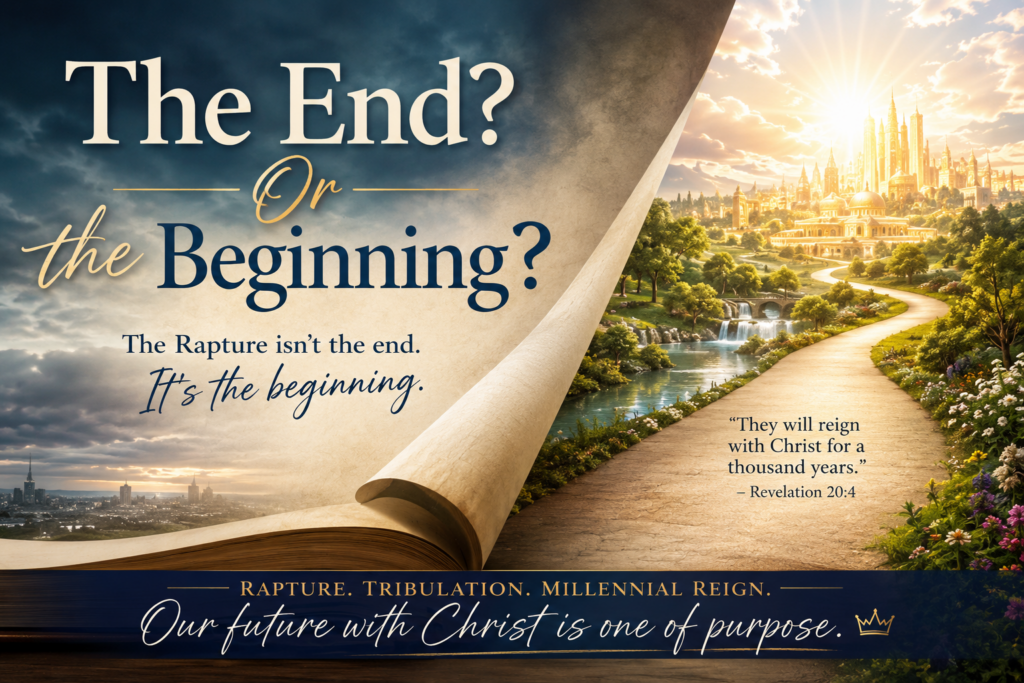
For believers, the Rapture isn’t the end of God’s work—or of ours. It’s simply the turning of a page, the beginning of a new chapter. You have the Rapture, then the Tribulation, and then one thousand years of Jesus Christ reigning on earth—and us reigning with Him.
It seems most people think we’ll just be hanging out once we get to Heaven. Or, more likely, they’ve not even thought about it. The truth is, Scripture doesn’t in any way indicate that we’ll be floating around on clouds playing harps, as the stereotype would have us believe.
Adam and Eve had responsibilities in the Garden of Eden, and in many ways God is restoring that kind of intimate and unhindered relationship with Him that sin destroyed. Just as surely as Adam and Eve had purpose, so will we. We were created to serve and glorify God and that fact won’t change just because we’ve received our glorified bodies. If anything, our lives will have even more purpose because we’re not limited by human flesh.
So yes, the Bible makes it clear that we will reign with Christ and have responsibilities in His Kingdom. And it’s easy to see where those responsibilities could line up with the gifts God has been developing in us in this life.
Which brings me to this thought, and it’s one I’ve shared before. We will live by the Word of God forever, and it will figure in our eternal lives every bit as much as it ought to be ruling our lives today. So every effort we put into getting to know God and His Word, every lesson we learn today is preparing us for our eternal responsibilities.
For my part, knowing that the gifts and callings of God are not revoked (Romans 11:29), I believe God will continue to use the gifts He’s given me during those thousand years just as surely as He uses them today.
Have you ever thanked God for letting you walk through Hell?
While praying for some friends who seem to be stuck where spiritual maturity is concerned, I was drawn to reassess my own spiritual journey. I was saved at 13 (or thereabouts) and I loved God, but my progress toward spiritual maturity was more of an amble than a walk until I began attending church regularly as an 18-year-old.
Even then, it was a fairly leisurely walk until my husband had the first affair that I know of. At that point, in the midst of the spiritual fight of my life, everything changed. Driven deep into the arms of God by my desperation, I found my priorities shifting and He truly became my primary focus. I clearly remember telling Him at one point that I wanted the season to end, but I didn’t want to ever let go of the close relationship with Him that I’d developed in it. It was as if a switch had been flipped and a light I’d not even realized was available suddenly flooded my soul. Having gained that light, I was determined not to lose it.
So, as I thought about these people that I was praying for, I asked God what made the difference, why I’d been unable to reach that place of intimacy before being thrown into the spiritual battle. His answer was instant—and humbling.
“You were caught in complacency.”
I’ve advised many people that, when making important decisions, you should follow peace because God is the author of peace. God is the only one who can give it; the closest the devil can come is complacency. With that in mind, you’ll understand why God’s answer paused my prayer and set me back a bit.
Because He was right.
Before the affair, my whole life was one of complacency. Yes, my marriage was not what it should have been, but I convinced myself that it could be worse. After all, he didn’t beat me like my stepfather had beaten my mother, so I could live with it. I was okay. It was just my “cross to bear.”
Back then, I would never have used the word, but with 20-20 hindsight, I see it clearly. I was complacent. Worse, I was complacent about my relationship with God. I was an active church member. I served. I took Bible classes when they were available and I read my Bible on my own—sometimes. I prayed—when I thought about it. I was satisfied that, as Mick said in Crocodile Dundee, “Yep, me and God, we’d be mates.” Mind you, I knew his view was unscriptural, but I was saved. Yep, I was saved, serving, and satisfied. And that’s exactly where complacency had trapped me.
Even as I write this, I just had to put the pen down and walk away for a minute, take a breather.
Complacency is so dangerous and so very easy to get caught up in, to stay trapped in.
What would have become of my family if the affair hadn’t happened, if I’d not been driven into God’s arms? How would things have developed if I’d failed to wake up, if I’d continued in my meandering spiritual journey instead of diving into true intimacy with God and developing a genuine hunger for His Word?
If I had remained that spiritual teenager forever, how completely would I have failed my kids? I failed in many ways as it is. How much worse would it have been?
And again, I had to put the pen down and step away for a minute.
Two of my greatest treasures in this life are my boys. I love them both with everything I have and am more proud of them than words can express. To think of the damage I would have done to them if I’d failed to mature spiritually, if I’d continued in my complacently casual walk with God, is painful.
I would not wish the hell I lived through during that season on anyone, but now more than ever, I thank God for walking me through it. Yes, the devil meant for it to destroy me. That’s obvious, and as my pastor would say, he did it because he knew my potential and wanted to stop me from reaching it. Instead, God used the devil’s weapon as a tool to jumpstart my journey and teach me lessons that would prove invaluable over and over again.
My heart is racing even now as thoughts of what could have been and what is rush through my mind, and I am grateful. Yes, I am genuinely grateful for that season. That experience being what it took to finally kick me out of being satisfied with my inadequate spiritual life and into true hunger for the things of God, I thank God for it!
What do you do when you hear God say, “Start keeping Sunday as a rest day.”?
I knew it was God speaking, because the thought had never even crossed my mind. As an author and blogger with a full-time job, I’ve pretty much been working 7 days a week for years.
And God was asking me to give up a whole day? Yes. Yes, He was.
But here’s the surprising thing: It’s been amazing! I’m talking life changing amazing. So much so that I had to share what I’ve been experiencing.
Interestingly, when I mentioned this to a friend, she told me God had recently given her the same instruction. As we compared notes, we realized we’re seeing many of the same results.
In “losing” that workday, setting Sunday afternoon and evening aside for rest, we’re both getting more done.
It’s easier to avoid putting things off when you know a full day is coming when you won’t be working. It’s also easier to stay focused when you realize your time is limited.
On Saturday evenings, even when I’m tired, I’ll push through to finish something I might have previously left for “tomorrow.” Because now tomorrow isn’t an option. And there’s something about knowing tomorrow isn’t an option that is very motivating.
In the past, if I took a day off just for me, I’d feel guilty about everything I wasn’t getting done. As a result, my “day of rest” was never truly restful.
Guilt can be exhausting. There is no guilt on Sunday.
Once I get home from church, I am “off” in a very real way. I might toss in a load of laundry… maybe. But I don’t go near my laptop or anything that might pull me into work. The closest I come to working is talking to God. And even then, He’s been known to gently shut me down when my thoughts stray into “unrestful” territory.
Another unexpected result? I look forward to Mondays.
I’ve never hated Mondays, but there have been many when I felt the weekend was too short and I was too tired.
This doesn’t happen now.
When I head to bed on Saturday night, I’m satisfied. I’ve accomplished more than I expected, and I know a true day of rest of coming. After that rest, I’m ready to go again.
I’m less fatigued. Mentally, I feel better than I have in years. My patience is higher, even during one of the church’s busiest seasons. I’m not overwhelmed by everything on my plate.
This has been a complete shift.
Growing up, I had a friend whose family strictly observed the Sabbath. I even remember hearing her dad explain to mine, “You know I don’t do any work on Sunday.” At the time, I thought it a little odd even though I vaguely knew it was one of the Ten Commandments.
I mean, God did say in Exodus 20:9-10 (NLT):
You have six days each week for your ordinary work, but the seventh day is a Sabbath day of rest dedicated to the LORD your God. On that day no one in your household may do any work…
I suppose I assumed it didn’t really apply to modern life—if I thought about it at all.
But it turns out that the need for a regular day of rest very much still applies. And not just because God said so.
There’s a growing body of research suggesting our bodies are literally designed to function best with regular rest.
A regular rest day can:
reduce chronic stress (cortisol levels)
improve sleep quality
help prevent burnout and fatigue
allow physical systems to repair and reset
Without it, you don’t just get tired—you get worn down
On the other hand, when you truly step away one day each week, it can:
restore joy
increase patience
stabilize your mood
lift mental fog
increase creativity
improve decision making
reduce irritability
dissipate anxiety
And that’s just a start.
You stop simply reacting and start thinking clearly again. You remember what matters, who matters, and why you’re doing what you’re doing.
And you remember Who’s really in control. (That would be God.)
As a mostly-recovered control freak, I find that especially important.
It turns out God knew exactly what He was doing when He established the Sabbath. And He knew exactly what He was doing when He told me to start keeping it.
God didn’t command us to rest to slow us down—He commanded it because He designed us to need it.
Have you ever considered setting aside a true Sabbath—one full day to rest with God? You might be surprised what happens when you do.
“It’s good to see you like this,” she said. “It’s not normal for anyone to be happy all the time.”
I had thought she was my friend. Her delight in my pain—during what I’ve since recognized as a nervous breakdown—left me stunned.
The truth is that until that season of my life I had always been a happy person. Even though my husband’s behavior was becoming increasingly destructive, I walked in joy most of the time. All of that changed when God gave me a direct command…
and I told Him, “No.”
It wasn’t until recently—while reading The Force of Joy by Alexandria Flint—that I began to understand what had really happened.
We’ve all heard the phrase “the joy of the Lord is your strength” from Nehemiah 8:10. Nehemiah is encouraging Jerusalem’s inhabitants as they grieve over how they’ve sinned against God. He’s assuring them that there is hope.
Alexandria, in the very first pages of her book, digs into the Hebrew words that have been translated as “joy” and “strength.” And these words don’t mean what you probably think they mean!
Multiple Hebrew words are translated as joy in the Old Testament, but this word, chedvah, is special. It’s only used three times: In 1 Chronicles 16:27, Nehemiah 8:10, and Ezra 6:16. Unlike the other Hebrew words that refer to outward expressions of joy, Chedvah refers to the overflowing delight that comes only from being in God’s presence.
I love the way Alexandria explains it:
Think of it like this: chedvah is a deep root system buried in the richness of God’s character, and all those other expressions of joy (simchah, sasson, gil) are the flowers that bloom from that root. You can have beautiful flowers for a season, but if there’s no root system, the first storm that rages by will wipe them out.
The more I thought about chedvah, particularly in reference to that horrible season of my life, the more I understood why 1) I’d always been such a happy person and 2) I suddenly was not.
I’d always been happy because I intentionally lived close to God. I stayed in His presence through prayer, reading my Bible, worship… And being constantly in His presence—the very source of joy—I lived joyously.
But, on the day I refused to obey God’s clear and direct instructions regarding my involvement in a specific ministry, I did what we all instinctively do. I stepped back.
I couldn’t stay in His presence while choosing disobedience. The conviction would have been too much. I didn’t want to hear what He had to say… so I turned away.
I was no longer anchored in that flow of joy—and I was no longer protected by it. While living in God’s presence, with my focus on Him, I was able to handle my husband’s behavior, but suddenly I saw everything… every… little… thing that he did.
I couldn’t handle it. And I started to spiral.
“The joy of the Lord is your strength.”
I had no strength, which is hardly surprising, but in losing that joy I lost more than strength. Much more!
The word translated as “strength” is ma’owz, and although it appears 37 times in the Old Testament this is the only place it appears as “strength.” In other locations, it’s translated as “stronghold,” “refuge,” “fortress,” and “protection.”
It’s a military term.
The joy of the Lord, that joy that comes from being in God’s presence, is your stronghold, your refuge, your fortress, and your protection!
That is what I stepped away from when I backed away from God!
I’ve spent days talking to God about this.
Think about Psalm 91 and all it promises to the one who dwells in the secret place of the Most High. When you grasp the truth of the joy of the Lord being your “strength,” this psalm becomes even more significant.
Even now, I’ve been literally sitting here with my head in my hands as I work to absorb all of this. And I’m reminded of a vision God gave me when our oldest was a baby.
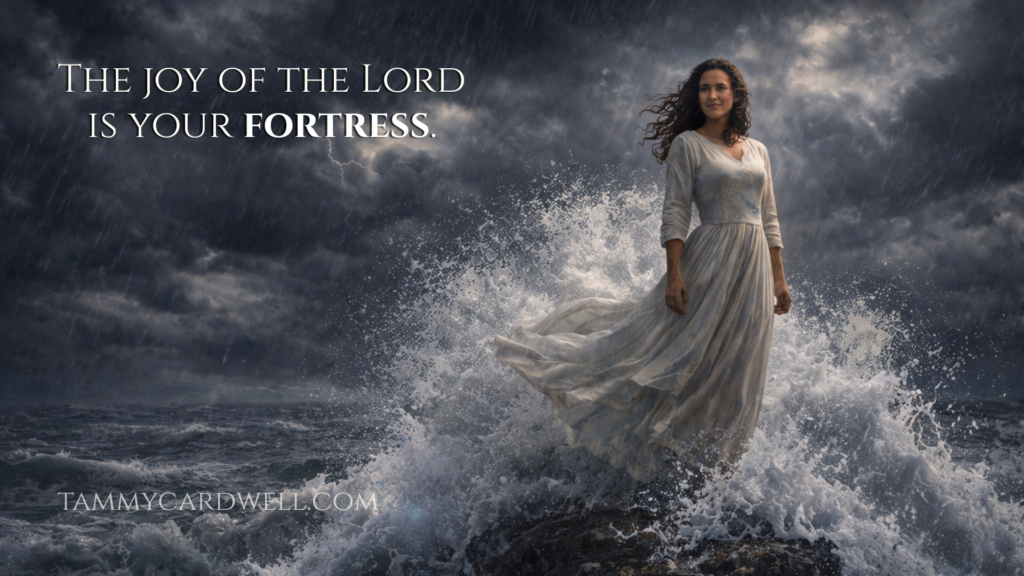
At church, during worship, God showed me a woman standing on a rock in the middle of a stormy sea.
Although her dress was wind-blown and waves beat against the rock, she stood confidently. God told me then that I could be that woman, one who could stand strong through any storm.
He didn’t tell me how to become that woman. He just told me to stay close to Him.
And, as it turns out, that is exactly what it takes.
As I live in God’s presence, I live in joy that can only be found in Him, and that joy protects me in ways I may never recognize.
And what about that friend, you ask? As I recall, we parted ways not long after. But I will say this; her heartless words were part of what woke me up. God used them to get my attention and draw me back to Him—back into obedience and back into His presence, His joy, and His protection.
There’s no place I’d rather be than in His presence, His joy, and His protection.
This piece is even more transparent than what I usually write, but sometimes it’s the things written in the trenches that God uses most. And, frankly, I felt God leaning on me to share. So let’s go.
After a few years of widowhood, I’ve reached the point where I’m seriously considering the possibility of getting married again. Getting here has taken time and many counseling sessions with God as my therapist.
He’s even told me I’m ready to meet someone, which is remarkable. Marriage to a narcissist leaves you carrying a lot of baggage that can be very hard to get rid of. It feels like it’s taken a piece of forever to get where I am today.
So, on a random day not long ago, God decided it was time to take a step.
He told me to set up a profile on a specific dating site.
His instructions made no sense to me. This dating app is so expensive there was no way—even for Him—that I would willingly consider that kind of commitment.
Judge me if you will, but I have an aversion to the whole idea of dating sites—for me. Still utterly confused by His insistence, I signed up for the free plan and determined to cautiously dip my toes in the water.
The extensive profile questions proved truly educational. They forced me to consider how I really feel about certain things. I had to ask myself, “Am I answering based on who I’ve always been, or who I’m becoming?”
But the real education came when I started getting matches. All I could do with the free site was look at their profiles, which I did. I rejected one after another, only “liking” one because I wanted to see what happened when you liked someone—and he was safely located several states away. Why was I rejecting these men? Honestly, for stupid reasons. Except…
God called another counseling session in which He showed me just how much fear still hid in my heart, and it wasn’t fear of the men.
I wasn’t rejecting them; I was rejecting me.
Bottom Line: I was afraid of hurting someone. The thought of potentially holding someone else’s heart in my hand, not knowing if I had what it took to make him happy, doubting that I would be enough…
Frankly, it scared me—and I hadn’t even realized it until God made it clear.
I felt such shame. I’ve really thought I was trusting God completely where potential relationships are concerned. I have faith in God!
But, as He’s reminded me a few times through the years (because I need reminders), when I fail to have faith in myself, when I let that fear settle in, it affects my ability to trust Him. Fear pulls the rug out from under our faith, so we must seek it out and cast it away.
I repented of course; I’ve learned that much for sure! I started actively casting down those doubts when they arise and have renewed my commitment to trust Him without reservation.
If God wants me to get married again, He will bring the right man and we’ll be blessed. It’s inevitable. Never in my life has He failed me, and He won’t fail me now. And if I’m not meant to marry again? That’s cool too. I love the life I’m living.
Getting back to the counseling session, in the end God told me to cancel my membership, that the app had served its purpose. Being who I am, I asked Him to clarify what He meant.
His answer didn’t surprise me. He knew what was hidden in my heart and chose to use the dating app like a mirror so I could see it for myself.
Psalm 139:23–24 (NLT) says:
Search me, O God, and know my heart; test me and know my anxious thoughts. Point out anything in me that offends you, and lead me along the path of everlasting life.
I want this. I pray this prayer with the psalmist because only when my heart is cleansed and my anxious thoughts are conquered can I truly stop doing things that offend Him.
Walking the path God has laid out for me is vitally important to me. I never want to risk veering from it even a little bit, and certainly not because of anxious thoughts.
And the beautiful thing? God is always faithful to answer this prayer! When I’m not quite right, He lets me know.
It’s generally God’s own Word that He uses as a mirror, to help me see where I’m missing it. Honestly, this is one of the best reasons for reading the Bible; it has unique power to open our eyes to see things in ourselves we may prefer to ignore.
God also speaks to me personally, gently showing me where I’ve disappointed Him or when I could have behaved in a more godly way.
And then there are the surprising times, like this one, when He tells me to do something that seems utterly ridiculous or follow a path I find completely incomprehensible. I’ve learned to obey anyway, because I know He doesn’t do anything without a purpose.
In this case, that purpose wasn’t meeting someone.
It was revealing something.
God knew exactly what was hidden in my heart. He simply used the dating app as a mirror so I could see it too.
God will use the most unexpected things to help us see what’s hiding in our hearts.
Celebrating Jesus! Tammy C
PS: If you, too, are recovering from a narcissistic relationship, you are enough! Even if you’re carrying baggage like I have been, God can help you deal with it, unpack it, and kick it to the curb.
Learning Spanish has been a wish…desire…of mine for many years. I live in southeast Texas and have many bi-lingual Hispanic friends. They’ve learned my language, and I want to understand theirs. This would help me communicate with others too, of course. About a year ago, I set learning Spanish as a goal, and I started studying.
It’s been a struggle, guys! In fact, I grew so frustrated at the end of last year that I stopped everything for two or three months. When I picked it back up recently, I figured I’d have forgotten all I’d learned and would have to start over.
I was delightfully surprised by what I recalled, and I’m slowly progressing again, praise God. I’m nowhere near ready to carry on even the most basic conversation, but I occasionally pick up on things my friends say and it’s encouraging.
Just this morning, I had an epiphany about something seemingly unrelated—the Bible.
I’ve known many Christians who said they wanted to read the Bible, but when they picked it up they didn’t understand it or get anything out of it. Is this you?
If so, consider this.
Well, I have more than one thing for you to consider and the first may seem confrontational, but I promise it’s not. Stick with me.
So, first, are you a Christian? By that, I mean do you believe that Jesus was born of a virgin, lived without sin so He would be an acceptable sacrifice for your sin, died on the cross to be that sacrifice, and rose again on the third day? Have you accepted Him as your Savior, the One who died for you, and your Lord, the One to whom you owe allegiance and obedience in every part of life?
I ask this question because, as I heard a minister say once, if you’re not a Christian, attempting to read the Bible is like trying to read someone else’s mail. Frankly, the Bible was written for God’s covenant people, and without the Holy Spirit you’ll have a hard time grasping much of it.
Or, to return to my history with Spanish, it’s like it would be if I were to pick up a textbook written in Spanish. I wouldn’t understand it, not because I’m stupid, but because my lack of fluency means I would only be able to grasp a word or phrase here or there.
If you answered that no, you are not a Christian, but you’re ready to accept Jesus, let’s pause a sec. If you believe this and are willing to accept Jesus as your Savior and Lord, it’s as easy as saying a simple prayer. You can pray this right now.
God, I come to you ready. I believe that Jesus was born of a virgin and lived without sin so that He could die for me, so He could pay the price for my sins. I accept that sacrifice! I also believe He rose again on the third day, was taken up into Heaven, and sits at Your side now. Jesus, I accept You as my Savior and my Lord, and I commit to live for You. In Your name, Amen!
If you just prayed that prayer, welcome to the family of God! Now let’s keep going.
When you receive Jesus as Savior and Lord, you also receive the Holy Spirit, and the Holy Spirit is the best Teacher of all. As Jesus said in John 14:26 (NET): “But the Advocate, the Holy Spirit, whom the Father will send in my name, will teach you everything, and will cause you to remember everything I said to you.”
Now let’s return to the very first thing I said. “Learning Spanish has been a wish…desire…of mine for many years.” It was a wish for many years but stayed a wish. Then it progressed to being a desire but stayed a desire. Nothing changed. I wanted to learn Spanish, but I didn’t learn Spanish. Why?
If wishes were fishes, no one would ever go hungry. (But they’d get terribly tired of fish.)
Yes, it’s a silly expression, but I think you get my point? I hadn’t learned Spanish because I hadn’t decided to learn Spanish. I didn’t follow through until I changed my mindset and made it a goal. For years, I’d consciously picked up words here and there, like many Christians pick up a Bible verse here and there. And, just like those random Bible verses, the words were tucked away in my brain, but without any context attached.
My point is that learning the Bible takes studying the Bible. It can start with “simply” reading the Bible, but as you read you should be listening for the voice of your Teacher, the Holy Spirit. As you do, you’ll see things you simply can’t catch on your own. Before you start to read, pray. As Him to teach you. He will!
And as you grow in your relationship with the Bible and with the Holy Spirit, you’ll grasp even more. But learning doesn’t happen without effort on your part. It takes an investment, just like learning anything else does.
And that investment is worth it.
Me learning Spanish can greatly help me and every Spanish speaker I meet, but that cannot even remotely compare to the value of me making God’s Word a part of my very being.
Fluency doesn’t happen by accident—not in language, and not in Scripture.
As I’ve heard it said, a man will invest years in becoming a lawyer, mechanic, accountant…whatever. And these are only careers that will help him in this life. The Word of God would help him in this life too, more than career training ever could, and…more importantly…it would prepare him for eternity.
“When God gave me a revelation of forever, of eternity, everything changed.”
After sending this message to a group of friends, I sat back and thanked God, for perhaps the thousandth time, for giving me a revelation of forever, for helping me grasp eternity. That moment of thankfulness led to a conversation about the difference between understanding and revelation.
You can have both.
We gain understanding in many ways— through study, through logic and reason… We gain understanding of God’s Word through spending time with it, meditating on it, digging into it, leaning on the Holy Spirit as our teacher…
Revelation is something different: It comes directly from God, and it bypasses the requirement for understanding. Where understanding acquaints you with truth, revelation confronts you with it.
One day at church camp I was in chapel listening to the minister and came to that moment. I’d heard enough about salvation that I knew the basics, but I didn’t really understand it. Nonetheless, in an instant the conviction settled in my soul.
Without a doubt, I knew I needed to be saved so I stepped into the aisle. It wasn’t an emotional thing; it was more a logical reaction to sudden knowledge. I didn’t even comprehend the magnitude of my decision until I saw my camp counselor crying.
Much later, I came to the realization that what I’d experienced was revelation knowledge. It was communication straight from God that convinced me of my need for salvation. I didn’t have to understand it. I didn’t even have to feel anything. I simply knew the truth, acted on the truth, and my life changed in an instant. There have been several times in my walk with God that He has given me such revelation and changed things instantly.
There have also been at least two times I specifically asked God for revelation on things I was desperate to comprehend. The first was the Rapture of the Church. Witnessing was hard for me and I felt that if I could just grasp the truth of the Rapture, and the reality of people missing it, I would be more driven to witness.
After a time, God gave me that revelation. And after the revelation, as I studied, I also gained understanding.
The same happened with forever. I’d had my blog “Eternally Planted” for years. The title is based off part of Ecclesiastes 3:11 in the NLT: “…He has planted eternity in the human heart…” Eternity is planted inside us even if we fail to recognize it. I think that’s why so many believe in reincarnation—because man has an instinctive knowledge that this life isn’t everything.
When I named my blog what I did, I had some understanding of forever, but at some point I realized I needed revelation. So I asked God for it. It didn’t come instantly, but one day God dropped it into my spirit in a way that lit up my world—and it changed everything about the way I saw my life.
I’d been married to my narcissistic husband for decades and was now responsible for keeping him alive and healthy, or as healthy as I could when he seemed intent on destroying his body. Every day was a struggle and my stress level stayed dangerously high. So this wasn’t a theoretical lesson. It came in the middle of a very real, very heavy season.
But then there was that day. In an instant, I suddenly had it. I knew in my innermost being that this life is nothing compared to the life I will have in eternity. That very hour, I told God that, if I had to live the rest of my life as I had been, it was ok. Because in light of eternity, this life is only ten minutes—and I can do anything for ten minutes.
Life didn’t get easier, but my focused changed. I was no longer looking at what was directly in front of me, but at what is waiting down the road. When you suddenly see a broad, beautiful vista ahead, walking becomes less frustrating and more of a challenge you’re willing to face.
We need understanding, obviously. But we also need revelation, and the beautiful thing is that God is ready and willing to give it. For me, it normally comes after He’s highlighted something I’m reading in the Word, after I’ve taken time to meditate on it, mull it over, and spend time talking to Him about it as I grow increasingly hungry for answers.
Have you ever considered looking to Potiphar as an example of how you should walk as a Christian?
Neither had I—until recently.
I’ve been reading The Master’s Indwelling, by Andrew Murray, and in one of the essays he pointed out something I’ve seen probably a hundred times, but never really SAW.
Genesis 39:1-6 NET “Now Joseph had been brought down to Egypt. An Egyptian named Potiphar, an official of Pharaoh and the captain of the guard, purchased him from the Ishmaelites who had brought him there. The LORD was with Joseph. He was successful and lived in the household of his Egyptian master. His master observed that the LORD was with him and that the LORD made everything he was doing successful. So Joseph found favor in his sight and became his personal attendant. Potiphar appointed Joseph overseer of his household and put him in charge of everything he owned. From the time Potiphar appointed him over his household and over all that he owned, the LORD blessed the Egyptian’s household for Joseph’s sake. The blessing of the LORD was on everything that he had, both in his house and in his fields. So Potiphar left everything he had in Joseph’s care; he gave no thought to anything except the food he ate.”
Potiphar saw the evidence of God’s hand on Joseph’s life, and as a result…
“Potiphar appointed Joseph overseer of his household and put him in charge of everything he owned.” “So Potiphar left everything he had in Joseph’s care”
AND
“he gave no thought to anything except the food he ate”
Even though I’ve been thinking about this for days, meditating on it, mulling it over, I’m still sitting here with my mind blown. Potiphar was a heathen. As far as we know, he knew nothing about Joseph’s God beyond the evidence of his own eyes.
But he had enough trust in Joseph and the God Joseph served that he literally trusted Joseph to take care of everything. As Joseph later explained to Potiphar’s wife, she was the only thing Joseph didn’t have access to and power over.
Take a minute to really think about this. I’m serious. I’m encouraging you right now to pause your reading and actually consider what we’re seeing here. This article will still be here when you get back.
[pause]
I’m honestly hoping you’re coming back to this with your own thoughts as I type mine.
This man was almost surely a heathen. He couldn’t have known anything about Joseph’s God. Who would have taught him? Yet he had enough faith in Joseph that he totally stopped worrying about what surely had to be significant wealth?
No wealthy man I know of has ever handed the entirety of his estate over to the care of someone else, to live the rest of his days not worrying about any of it.
I look at Potiphar and I think about how much worry Christians tend to live in. We know intellectually that God has promised to take care of us as long as we follow His lead, doing as He says, but how often do we instinctively try to take back control from the very God we claim to trust?
We’re not alone. Abram did the same thing; he and Sarai ran ahead of God and, by having Ishmael, made things a lot harder on themselves.
So we might be tempted to give ourselves an out. After all, if Abram/Abraham and so many other heroes of the Bible failed to truly trust God then surely God knows I’m just as weak as they were. Right?
But then I look at Potiphar and I have to answer, “Wrong.”
It’s been staring me in the face all this time and I’ve only just seen it. If Potiphar, who knew nothing of the God I serve, was able to fully put everything into Joseph’s hands, then I am capable of putting everything into the hands of the God I know and love. And leave it there!
And not worry about anything except what I want to eat for dinner.
The Law of the LORD is perfect, restoring the soul; The testimony of the LORD is sure, making wise the simple. Psalm 19:7 (NASB2020)
Your soul is what makes you you. Generally referred to as the “mind, will, and emotions,” your soul is one third of who you are: Spirit, Soul, and Body.
And I have a true example to share that illustrates just how well the Word of God restores the soul.
There is a man I’ve known about 40 years. I met him at church, and it became quickly apparent that he was quick witted and highly intelligent. In conversation, he once explained that this hadn’t always been the case.
According to him, when he got saved he’d been so destroyed by drugs that he didn’t have two brain cells to rub together. But he heard that the Word of God has the power to restore the soul and he took that promise literally. He dove headfirst into the Bible and has never left it.
The Word of God restored—repaired, revived, converted, refreshed, renewed (depending on your translation)—his soul. It also “made wise the simple,” as it declares at the end of Psalm 19:7.
His is a dramatic account, but yours can be too. If you feel like you’re not smart enough or don’t have the brainpower to read the Bible, remember that he didn’t either. Sometimes you simply have to step out in faith and ask God to teach you as you read.
It does help to find a translation you can relate to. I have sixteen Bibles in eleven different translations, and each of those translations serves a purpose.
Most of the scriptures I have memorized are from the King James Version, because its poetic nature makes memorization easier—for me anyway.
If I’m doing a straight readthrough, my go-to is the New Living Translation, because it’s the closest to the way I think and talk.
If I want a better grasp of how an Israelite would have read a passage, I grab either my Complete Jewish Study Bible or The One New Man Bible.
Intimidated yet? Don’t be.
My first Bible, or the first one I really used, was a New American Standard, and I can tell you that the 2020 edition of that Bible (NASB2020) is one of the best. That might be the prime choice for you.
My point is that, if you’re new to the Bible, you’ll find it easier to understand if you choose the right translation. With internet access, that’s a piece of cake. All you need to do is head to blueletterbible.org and use their tools to start comparing Bible translations.
It seems almost too simple to say the Bible restores your ability to think and reason, but I’ve seen proof of this truth time and time again. And it does a lot more, as we’ll see while working through this series.
Truly getting into God’s Word is a life-changing experience. The more time I spend with my Bible, the more I grow in every way—and the hungrier I get.
Most of us don’t have a problem with owning a Bible; we may even have several. What we can find challenging is making the time to actually open it up and dig in.
I used the phrase “making the time” intentionally, because this isn’t about finding the time for something we want to do; it’s about intentionally setting aside the time for something that is essential to our spiritual health.
“I know I should, but…”
How many times have I heard a diabetic use these words in reference to watching their sugar intake? Eating excessive sugar could kill them, and yet many struggle to stop.
The same principle applies in all areas of life. “I know I should exercise, but…” “I know I should call my mom regularly, but…” “I know I should study, but…”
Don’t exercise—hurt your body. Don’t call your mom—hurt your relationship. Don’t study—hurt your GPA.
Don’t spend regular, intentional time in God’s Word and you hurt your spirit man—the part of you that is meant to be alive and responsive to God. How can we expect to successfully fight our flesh (which, honestly, is our worst enemy) if we consistently starve our spirits?
I mean that seriously. If you wonder why you keep fighting the same old battles with your flesh, you need to take a good hard look at what you’ve been feeding your spirit. And if you’ve been thinking sitting in a church pew was enough to keep your spirit man alive, you are sadly mistaken.
And I am officially at risk of launching into the series right here and now. I can’t do that, but I will do this. There are myriad scriptures that talk about the importance of being in God’s Word and having it live in you, and there’s no time like the present to get started.
You can study up on why you should be studying. And here’s a list of pertinent references to get you started.
You don’t need to read these all at once. Choose a section, read thoughtfully, and ask God to speak to you through His Word.
The Value & Power of God’s Word Psalm 19:7–11 Psalm 119:105 Psalm 119:160 Proverbs 30:5 Isaiah 55:10–11 Hebrews 4:12
Loving, Meditating on, and Delighting in the Word Joshua 1:8 Psalm 1:1–3 Psalm 119:15–16 Psalm 119:97 Psalm 119:103 Colossians 3:16
Learning, Teaching, and Passing on the Word Deuteronomy 6:6–9 Deuteronomy 11:18–21 Psalm 78:5–7 Proverbs 4:1–7 Matthew 28:19–20 2 Timothy 2:2
Hearing and Receiving the Word Nehemiah 8:1–3, 8 Matthew 4:4 Matthew 11:15 Luke 8:15 Romans 10:17 1 Thessalonians 2:13
Abiding, Remaining, and Staying in the Word John 8:31–32 John 15:7 Acts 2:42 1 Timothy 4:13 2 Timothy 3:14–17 1 John 2:14
Obeying and Living Out the Word Deuteronomy 30:14 Psalm 119:9 Matthew 7:24–27 Luke 11:28 James 1:22–25 1 John 5:3
The Word as Protection, Guidance, and Strength Psalm 119:11 Psalm 119:130 Proverbs 2:1–6 Ephesians 6:17 Colossians 1:9–10
Warnings Against Neglecting the Word Hosea 4:6 Amos 8:11 Matthew 13:19–23 Hebrews 2:1 Hebrews 5:11–14 2 Timothy 4:3–4
Scripture About Scripture Psalm 119 (entire chapter) Romans 15:4 1 Corinthians 10:11 2 Peter 1:19–21 Revelation 1:3