The Victor’s Crown: Why Our Struggles Matter

“Why does life have to be so hard?”

Now there’s a question we’ve all asked more than once. Clearly, I don’t have the whole answer, but I saw something in the Word today that reminded me of one of the reasons life is hard.

Everyone goes through hard seasons. Mine may look different from yours, but they are hard nonetheless. This is a good fact to remember: Everyone around you is dealing with something, probably many somethings. Never assume your neighbor has it easy, because it’s highly likely they don’t.

Everyone goes through tests, trials, and temptations. How we respond to them matters. I’m speaking to Christians here, so I’ll leap right into temptation. Have you felt God prompt you to give up a habit and you’ve tried, but you just couldn’t do it – or did it for a time and then went right back to it?

I’m not even talking about outright sin here. My point is that any time God asks us to do something, or to stop doing something, and we are tempted to disobey, that is a test. Our flesh may be testing us, or demonic influences might be pushing the temptation our way. Regardless, it’s a test.

Now look at James 1:12 in the New Living translation:
“God blesses those who patiently endure testing and temptation. Afterward they will receive the crown of life that God has promised to those who love him.”

I went to the Renner Interpretive Version: James & Jude for Rick Renner’s notes on this crown of life and he explains that “crown,” the word James used here, referred to a victor’s crown such as those given to winning athletes. These crowns made of laurel wreaths marked them as people to be esteemed and honored; they also guaranteed the winner would be provided for for the rest of his life. 

But James didn’t stop there. He called it the crown of life or, properly translated, the victor’s crown of zoe life which, according to Renner, “brings a physical and spiritual reward, both in life now and for all eternity.”

This is clearly something that is not to be taken lightly!

But we have to remember where we started.
“God blesses those who patiently endure testing and temptation.”

Now let’s look at this verse in two other translations.

James 1:12 (NKJV) – “Blessed is the man who endures temptation; for when he has been approved, he will receive the crown of life which the Lord has promised to those who love Him.”

James 1:12 (NET) – “Happy is the one who endures testing, because when he has proven to be genuine, he will receive the crown of life that God promised to those who love him.”

How we deal with test/trials/temptations is what determines whether or not we are approved, whether or not we have proven ourselves to be true lovers of God.

Am I saying those who fail aren’t saved? Not necessarily, no. I’m saying that when a runner enters a race he goes in with his eyes wide open, knowing he will be tested to his limits. He may face distractions, bumps in the road, weather issues, interference by other runners, and major objections from his own body.

He will face the temptation to slow down, with a voice whispering that second or third place wouldn’t be so bad. He will face the temptation to throw up his hands and quit. But if he wants to win, he determines in his heart that we will press on through to the end no matter what obstacles are in his way.

This is what the Apostle Paul did. In 2 Timothy 4:7 he explains to Timothy that he knows his time is up, that he won’t be alive much longer, and he assures this one who was like a son to him that:

“I have fought the good fight, I have finished the race, I have kept the faith.”

We know from his own accounts and history that Paul faced more trials, tribulations, and temptations than most of us can conceive, but he ran his whole race determined that, no matter what he faced, he and God would win.

Those tests, trials, and temptations give us the opportunity to prove that our love for God is real, not just something we feel when life looks good. They also, according to James 1:2, help us grow into maturity.

Yes, life can be hard, but we can be strong. If Paul did it, we can too.

Celebrating Jesus!
Tammy C
The Weight of the Calling: A Reflection on James 3:1

Every time I read James 3:1, I pause and examine my heart and motives.

I’ve never claimed to be a teacher; I’m not one. I’m merely someone who shares what she learns as she learns it – what God shows me as He helps me understand it.

James 3:1 is a strong warning:

“My brethren, be not many masters, knowing that we shall receive the greater condemnation.” (KJV)

Most modern translations use the word “teacher” instead of “master,” which is another reason I don’t claim to be a teacher. I’ve certainly not mastered Scripture well enough to teach it!

This verse hits me harder now than it ever has. Reading Rick Renner’s Renner Interpretive Version: James & Jude has given me a deeper understanding of this verse than I anticipated.

The one verse warrants two whole pages in his book. He has a lot to say and it’s all important. For brevity’s sake, I’m limiting myself to sharing just two points here. They’re things we should already know, but still…

There is no room for ego and pride in ministry.
At any level.
Period.

Whether one is a Christian or not, ego and pride are the most common culprits when it comes to desiring labels, titles, and recognition. Actually, let’s get real; they are the culprits. Whether we admit it or not.

Renner writes, “Humility serves as an unmistakable hallmark of any great teacher, and all genuine ‘masters’ have first been mastered by their own submission to truth.”

I saw this humility in action once when a guest minister arrived early and saw us setting up tables in the foyer. He didn’t miss a beat but immediately jumped in to help in spite of our efforts to stop him. He was our special guest! That didn’t matter to him. I wish I could remember exactly what he said as he picked up his end of a table. All I can tell you is that it made a huge impact on us.

Like Jesus did when He washed the disciples’ feet, this man demonstrated true servant leadership. He wasn’t chasing acclaim – he was living his calling with humility. Even those who rarely see him could tell it, and you know God noticed! Because…

God is always watching.

If someone sets themselves up and declares, “I’m a Christian teacher,” they really need to consider the magnitude of their decision. God, who cannot be deceived, sees every word, every motive, everything we hide in our hearts. We may fool man, but we can’t put anything over on God.

James doesn’t pull punches. In the NET this verse reads:

“…because you know that we will be judged more strictly.”

That’s heavy! Imagine James – the brother of Jesus – saying, “If I mess this up God is going to come down on me – HARD.”

But James didn’t write this to scare his readers. He wrote it because he cared. He wanted to protect them from false prophets and teachers; he also wanted to protect them from the self-deception of pride. He was trying to help them count the cost of leadership.

Renner’s notes unpack what it meant, in that culture, to be a teacher, master, or revelator. It required a level of preparation and knowledge that few were willing to pursue – study that took years, even decades. It still requires such effort today.

Do you feel called to the ministry?

Then prepare your heart. Study like never before. Live close to Jesus. And check your pride at the door.

Celebrating Jesus!
Tammy C

If you haven’t read it already, you may want to check out my review of the Renner Interpretive Version: James & Jude.

Review: Renner Interpretive Version: James & Jude 

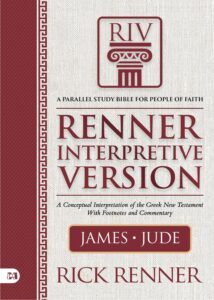
RIV: James & Jude Cover

I’ve been waiting years for Rick Renner to release his interpretive version of the Bible, and at last we have James and Jude. I am thrilled!

For those unfamiliar with him, Rick Renner is not only an anointed Bible scholar and teacher, but he also has a tremendous grasp of Koine Greek, which was the form commonly spoken pretty much everywhere in the Roman Empire in Jesus’ time. Add to this technical knowledge his understanding of the culture of the New Testament period, and you have someone uniquely poised to help readers better comprehend this part of the Bible as its original readers would have.

This isn’t a task he took on of his own volition. It developed out of him exegeting the Greek New Testament for himself so that he would understand it better. Not surprisingly, God didn’t let him stop there and even today he’s working on expanding on and sharing what he’s learned. The result, which we have a small part of here, is the Renner Interpretive Version (RIV). Here’s an excerpt from page 1 to help you better understand the book’s intent.

The RIV is a conceptual interpretation of the New Testament that draws on concepts in the Greek language and brings them into the text in a contemporary way to provide a broader comprehension of what is being communicated through Scripture. To be clear, the RIV is not meant to be viewed as a word-for-word translation, but, rather as a conceptual interpretation of the Greek text.

If you are one who generally skips all front matter in favor of leaping directly into a book, I highly suggest you alter your actions for this one. “A Word About the Renner Interpretive Version” not only shares the hows and whys, but also pulls together some facts I’ve never considered before. One paragraph I have highlighted, on page 6, points out that Jesus came at a unique time in history when the Gospel would be able to be preached with relative ease throughout the known world. Why? Because, thanks to the Romans, Koine Greek was spoken by pretty much everyone at least as their second language. As Renner points out, this was the first time since the Tower of Babel that such communication was possible.

Now to the primary text.

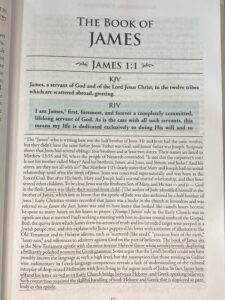
Renner starts by introducing James, which lays a foundation for our reading. He then moves on to a parallel of the KJV and RIV, accompanied by extensive footnotes. I kid you not; James 1:1 affected me so deeply that I had to stop and head to my journal to record my thoughts. And then I couldn’t go on any further until I came here to share with you.

Yes, I’m writing this review even though I’ve not even read past page 18! This is unheard of for me, but I don’t want you to have to wait on me and this is a book with which I plan to take my time.

See for yourself.

So we have James 1:1 in the KJV, and immediately below it, shaded in blue, the first part of verse 1 in the RIV. As you can see, Renner has gone to great lengths to share helpful background information in this book. In his more than 1,200 footnotes, the man leaves me feeling like he’s sitting here talking directly to me.

So what sent me to my journal in the middle of my reading? It was seeing, for the first time, the full impact of “servant of God” or, as Paul referred to himself, “bond servant.” I’ve known what it meant to become a bond servant. It’s beautiful, really. It was common for someone to sign a contract to serve a “master” for a set number of years. When that time was up, he was given his wages and was free to leave. However, if he loved his master and couldn’t imagine being happier anywhere else, he could choose to make a lifetime commitment, to bind himself to that master permanently. I, in similar manner, have chosen to bind myself to Christ. But look at how the significance of calling oneself His servant is expressed in the RIV!

…this means my life is dedicated exclusively to doing His will and to faithfully carrying out any assignment He will ever entrust to me.

Too frequently, we gloss over things we see all the time. We may know, on an intellectual level, what words like these mean, but how often do we stop and genuinely think about them as applied to the writers or, vitally important, to ourselves? The writers of the New Testament were deadly serious when they used these expressions. In truth, considering how most of them died, “deadly serious” is pretty literal. These men had committed their entire lives to putting His will before their own. There was no room for them to disagree with their Master or fail to carry out any assignment He gave them.

So yes, I “knew” all of this but, using his understanding of the nuances of the language as well as the culture of the original readers, Renner has crafted a version that forced me to halt in my tracks and think about it, to apply it to my own life. I want to be able to say these same words, that my life is dedicated exclusively to doing His will and to faithfully carrying out any assignment He will ever entrust to me. God is my number 1, but I’d be lying if I didn’t admit that too often self likes to slide up into that higher position, to nudge God to the side for just a little while.

So yes, I find that even in this tiny sample the RIV is proving to be every bit as powerful and impactful as I had expected it to be. James and Jude just became my next focus and this time around this book will be one of my primary references in my studies.

But that’s not all. One feature I very much appreciate is that Renner chose to include two versions of each book. The first is what I’ve described. Immediately following this heavily footnoted copy of James is another copy of the full text without footnotes. In my case, I will start by reading straight through the book of James in this second section, and then I’ll go back to the beginning for my in-depth study including all the footnotes. Once I’ve completed James, I’ll approach Jude the same way.

I’m a big believer in reading and referring to a variety of translations and paraphrases as I experience the Bible. It helps give me a fresh vision, eyes that see things from a different perspective. This book is definitely a treasure to add to my Bible shelf.

The Renner Interpretive Version: James & Jude
is 7.28 x 0.91 x 10.24 inches, and 288 pages

You can purchase it at
Renner.org and Amazon

Celebrating Jesus!
Tammy C

Who am I to be reviewing Bibles? I’m the author of Experiencing the Bible, which is available in paperback, ebook, and audiobook on Amazon.

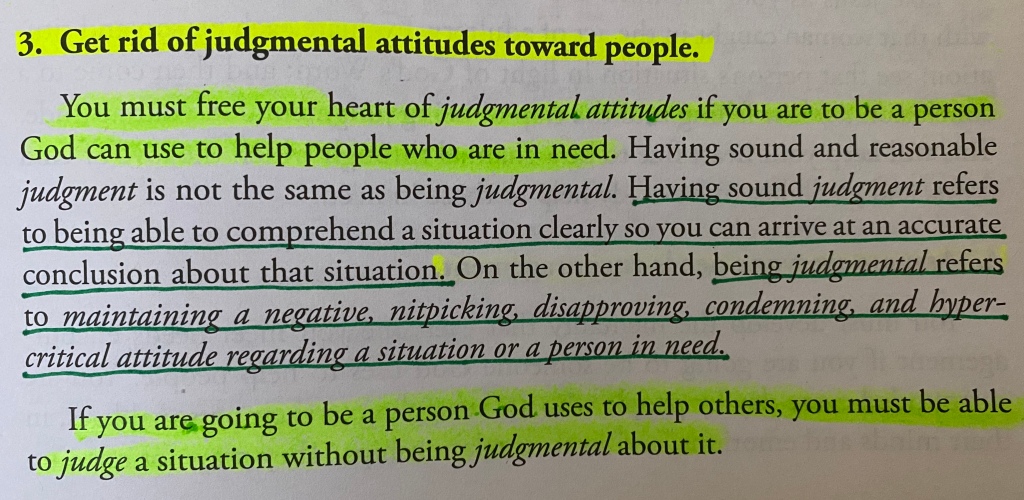
Ditch the Judgmental Attitudes

from Last-days Survival Guide, by Rick Renner

The above quote is from chapter two of Rick Renner’s Last-days Survival Guide (phenomenal book), and I shouted when I read it. I used to be a judgmental person, and let me tell you…I’m a lot happier and more productive since I got a grip.

There’s not really any need for me to add to this. As he says, “You must free your heart of judgmental attitudes if you are to be a person God can use to help people who are in need.”

Celebrating Jesus!
Tammy C