Eat It, Stow It, or Sow It?

Three portions of wheat labeled “Food,” “For Later,” and “A Harvest” against a snowy farm landscape, illustrating the choice to eat, stow, or sow seed.

In The Long Winter, Laura Ingalls Wilder’s fictionalized account of her family’s experiences during the winter of 1880-1881, Almanzo Wilder goes to great lengths to hide his seed wheat because the people in town are running out of food and are in serious trouble. He has understandable concerns that his merchant brother will decide to sell his seed wheat to their potentially starving neighbors, leaving him with the very real possibility of having nothing to plant come spring.

In today’s world, that may seem excessive, but in 1880-1881 in what is now South Dakota, they were in the midst of such a hard winter that repeated blizzards kept the supply trains from getting through. And there were so many trains backed up that it was entirely possible no wheat would arrive until it was too late to plant that spring.

In point of fact, the trains didn’t start running again until May of 1881.

Despite his caution, Almanzo is not heartless. In fact, he and a friend choose to risk their lives by heading out into the open prairie between blizzards, knowing another could strike at any time, on a rumor of a farmer somewhere out there who has wheat. They find the farmer, who reluctantly agrees to sell them sixty bushels of his own seed wheat, and head straight back to town with enough to keep everyone alive until the next supply train manages to come through.

It was this story that made me understand the vital importance of not eating your seed. Almanzo’s seed wheat looks like food to those who are hungry. Laura’s Pa even manages to obtain a bucketful of that very seed. He is a man of integrity, but seeing his wife and children go hungry makes him desperate enough to insist that Almanzo sell him some. And that encounter forces Almanzo to face the question he can no longer avoid: What will happen when the town runs completely out of food, including wheat?

His answer is to follow the rumor about the other farmer. To go looking for more wheat.

One question I remember having the first time I read Laura’s books is, “What’s the difference between regular wheat and seed wheat?”

The basic answer is, “Its purpose.”

So, foundationally, wheat is wheat, but when a farmer sets aside a specific portion of wheat with the intention of planting it, it becomes seed wheat.

So yes, when the townspeople see wheat, especially that winter, they see food.

But when the two farmers see their seed wheat, they see harvests.
With no wheat to sow, they will have no harvest.
And a farmer with no harvest is in serious trouble.
So is the town, because if the farmer has no harvest, the people have no food.

And for Almanzo, this isn’t just any seed wheat or harvest.

This is high-quality seed wheat that he raised himself in Minnesota and then hauled across country by wagon with the express purpose of planting it on his homestead. He is protecting a precious future harvest.

This is the story I remembered recently when thinking about how, in Genesis 26, God told Isaac to stay right where he was during a famine. A famine! “Don’t go to Egypt,” God said. Isaac obeyed, and during that famine he sowed. Then, during that famine, he reaped a hundred-fold harvest.

A hundred-fold harvest during a famine.

You’ve likely heard it preached dozens of times as a powerful example of the benefits of walking by faith, but did you ever think about how everyone else survived that famine?

Were they eating their seed?

We don’t know, but we do know that Isaac sowed when his circumstances argued against it. Even if he’d chosen not to eat his seed, he could have locked it away, saved it until a more promising season. He did not. Instead, he trusted God to come through for him no matter what.

This is exactly what we should do when God puts seed in our hands, giving us instructions on how to handle it (and I’m not just talking money here). How does God see the seed we hold? Is He giving us food to eat, seed to stow away and keep safe for the future, or seed to plant today so that He can multiply it and give us a harvest in due season?

Like Isaac, we need to choose the path of obedience and faith. The issue isn’t whether we eat the seed, stow it, or sow it. The issue is whether we do with it what God intends. When our mentality is, “I can’t afford to plant this because this is all I’ve got!”—when we allow fear to rule us instead of trusting God and doing it His way, we actively choose to put limits on our own future.

If God says, “Eat the seed,” then eat it. If He tells you to stow it, to keep it safe for later, then tuck it away. But if He says to sow it, even in a time of famine, don’t let fear talk you into doing anything else.

Celebrating Jesus!
Tammy C

Lets Talk About the Jews

I haven’t talked much about October 7 and the mass insanity that has flooded the world since that day, but I’ve done a lot of watching, praying, and hurting for Israel and the Jews around the world as well as those I know personally. Even now, I’m hesitant to start this post because there is so much on my heart that I’m concerned it’s all going to spill out in a jumbled mess of words and emotions.

First, to make myself clear,
I fully support Israel in this war and in general.
If you believe in replacement theology,
you and I are not on the same page.

Here are some of the reasons why:

Genesis 12:3: “I will bless those who bless you, And I will curse him who curses you; And in you all the families of the earth shall be blessed.”

Psalm 94:24: ” For the LORD will not cast off His people, Nor will He forsake His inheritance.”

Psalm 122:6: “Pray for the peace of Jerusalem: May they prosper who love you.”

Ezekiel 37:21: “Then say to them, ‘Thus says the Lord GOD: “Surely I will take the children of Israel from among the nations, wherever they have gone, and will gather them from every side and bring them into their own land;”‘”

Zechariah 12:9: “It shall be in that day that I will seek to destroy all the nations that come against Jerusalem.”

Bottom Line: If God were to change His mind about the covenant He made with Israel, He would immediately become a God you couldn’t trust not to change his mind about you. It’s ridiculous to even think about God in the same way as you would a cheating husband. You know what I mean: The other woman is just sure he’d never cheat on her, but if he cheated once… No. That’s not my God.

So, again, I have a heart for Jews, those I know and those I don’t, and for the nation of Israel, so seeing her vilified is beyond painful. I can’t even fully express how the rampant Anti-semitism hurts. How a world of people can choose to utterly ignore the reality of what happened on October 7th and what is being revealed in Gaza in favor of the carefully orchestrated…

No, I can’t even go there. I simply cannot comprehend the insanity.

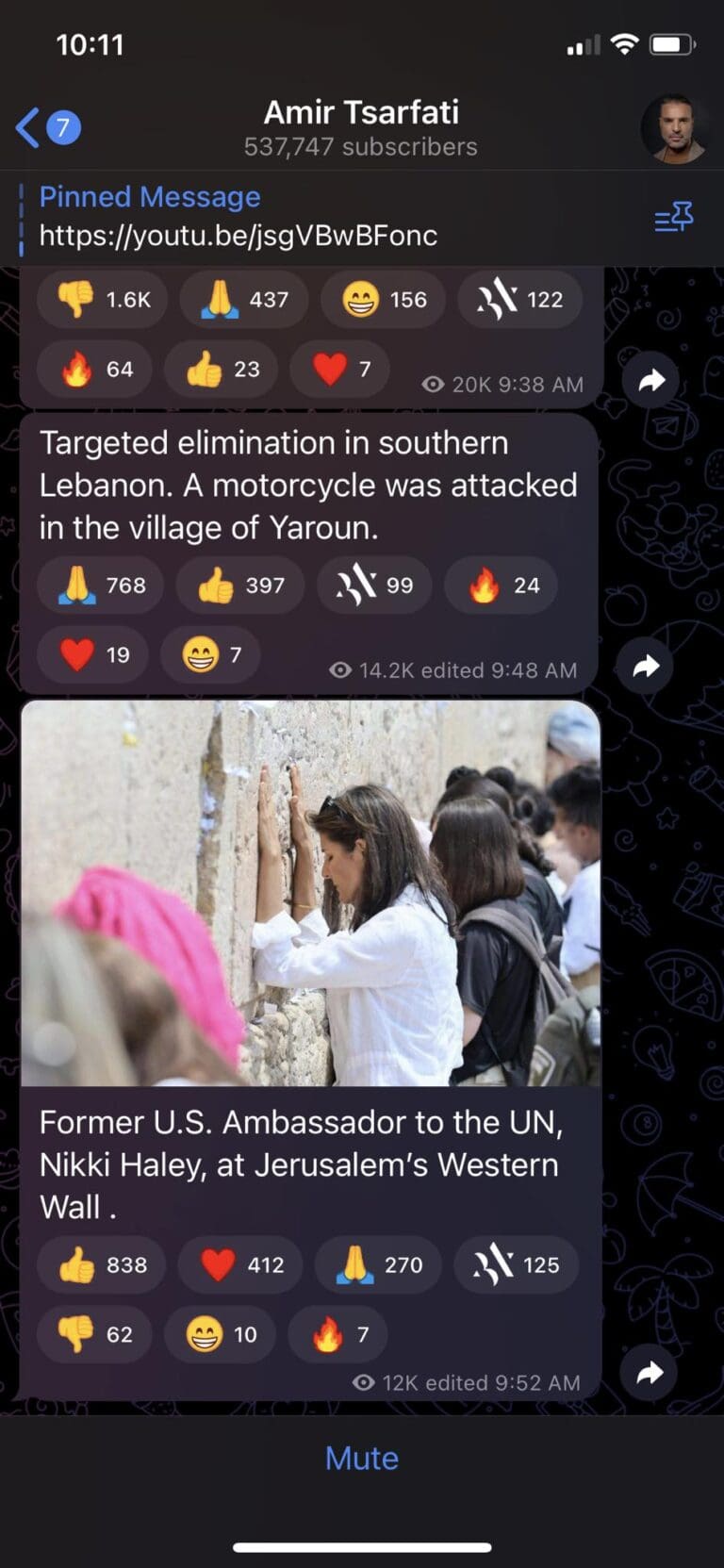
If all you listen to is regular media and celebrities, you may think I’m nuts. If this is the case, I challenge you to download the Telegram app, subscribe to Amir Tsarfati’s channel, and pay attention to what he shares. I actually encourage everyone to do this. He’s a Messianic Jew living in Israel. He was a Major in the IDF, so he understands military campaigns, and he presents information in a way that makes sense. Just make sure you subscribe to his real channel, not one of the endless list of fakes. You can see in this picture that he has over 500,000 subscribers, so that’s the Amir Tsarfati you’re looking for.

Amir is someone I’ve trusted for years. He’s also an expert in End Times Prophecy and has several excellent books, both non-fiction and fiction, that are well worth checking out.

Ok, I’m determined to control my potential rambling, so I’ll say one more thing.

This is a spiritual war.

I’m not talking about the war in Gaza right now. I’m talking about the devil’s war on Jews everywhere. He hates the people God called His own, and we’re seeing that hatred exposed like never before, even in the church, which is heartbreaking. What’s happening isn’t natural; it’s supernatural, backed by demonic forces. What I’ve realized recently is that it’s also not limited to Jews who lives in “dangerous” areas.

True, I’ve spoken with a limited number of friends about this (talking about both practicing and Messianic Jews), but what I’m seeing leads me to believe that a full-blown demonic attack has been launched against all Jews everywhere. People who have been doing ok are suddenly fighting battles they never dreamed they would face, battle after battle in a seemingly never-ending cycle.

They need our prayers. Wherever they are, whoever they are, they all need our prayers.

I stand with Israel, and I stand with the Jews.

Celebrating Jesus!
Tammy C

God Tells Secrets

On the Saturday before Resurrection Sunday (AKA Easter), I “happened” to be studying Genesis 22. The word happened is in quotation marks here because I don’t for one minute think it was coincidence. I’d been trying to study this chapter for a couple of weeks, but hadn’t had enough cell signal in my apartment to run the Through the Word app. (Awesome app: If you don’t have it, get it. Use it.)

So, on the day before one of my favorite days of the year, I read one of the most challenging chapters in God’s Word, and the timing was perfect.

You probably know the story. God makes a request of Abraham, asking him to sacrifice his only son. You can tell going in that something isn’t quite right, because God has a clear stance on human sacrifice. (He’s totally opposed.) So… God’s up to something. Right?

This chapter is so full of rich details that it’s easy to miss some things. Like the fact that it’s God who speaks to Abraham in verse 1, but after Abraham proves himself it’s God’s Son, Jesus, who does the talking. I can’t go into all the details, though. Let’s just look at this.

Obviously, Abraham was convinced God was up to something too. He knew God well enough, and so completely trusted God’s promise to give him countless descendants through Isaac, that he dared obey. As Hebrews 11:18-19 (NET) tells us, “God had told him, ‘Through Isaac descendants will carry on your name,’ and he reasoned that God could even raise him from the dead, and in a sense he received him back from there.”

Sound familiar? It should. In writing, it’s called foreshadowing when something is a warning or indication of some future event.

When Abraham told Isaac that God would provide the offering, he wasn’t just speaking about their personal sacrifice. He didn’t realize it, of course, but looking from this side of the cross we know he was also prophesying about the Ultimate Sacrifice. Abraham didn’t withhold his only son, his child of promise, and God didn’t withhold His only Son, His child of Promise.

Perhaps my favorite detail in Genesis 22 is one I had either never noticed before or hadn’t recalled. In verse 14 it says, “And Abraham called the name of that place ‘The Lord provides.’ It is said to this day, ‘In the mountain of the Lord provision will be made.’”

And it was. On that very same mountain, Mount Moriah, outside of Jerusalem, IT – Salvation – was provided when God gave up His only Son. A proverb spoken for about 2,000 years in the future tense was fulfilled when Jesus shouted (SHOUTED, my friends! Have you ever noticed that?!) “It is finished!”

Like I said, God’s timing is perfect. Due to weak cell signal, I’d been unable to do the Through the Word study for this chapter until the very day I needed to see it. It’s such a timely reminder of how completely God has everything planned out, and how wholly we can trust Him.

He is risen!
He is risen indeed!

Celebrating Jesus!
Tammy C