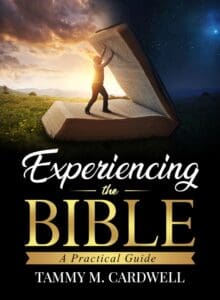
Experiencing the Bible is available in print, eBook, and audiobook.
A new year is the perfect time to build a fresh Bible habit—but it doesn’t have to be overwhelming.
Experiencing the Bible was written to help everyday believers move beyond “checking a box” and into truly engaging with God’s Word in a meaningful, sustainable way.
Sometimes following Jesus begins with one step—one invitation Photo Credit: Judy Keenan
I recently realized something interesting while reading John’s account of how Jesus called His first disciples. Check it out.
Andrew and most likely John, the son of Zebedee, were essentially sent to Jesus by John the Baptist (John 1:35-37)
Simon Peter was brought to Jesus by Andrew (John 1:40-42)
Philip was called by Jesus (John 1:45-48)
Nathanael(Bartholomew) was brought to Jesus by Philip (John 1:45-48)
John (who had likely already met Jesus) & James, the sons of Zebedee, were officially called by Jesus (Matthew 4:22)
Matthew was called by Jesus (Matthew 9:9)
I’m visual and love lists, so now let’s look at how the disciples came to Jesus another way.
Sent to Jesus
Andrew
John, the son of Zebedee (probably)
Brought to Jesus by another disciple
Simon Peter
Nathanael
Called first by Jesus
Philip
James, the son of Zebedee
Matthew
We always refer to Jesus calling the disciples, which He obviously did. But when you look at it broken down like this you see something we tend to overlook. Two men were sent to Jesus by John the Baptist. Two others were brought to Jesus by someone who had already met Him.
Only three of the first seven disciples were first approached by Jesus Himself.
Think about that for a moment.
Of the first seven disciples, only three weren’t either sent to Jesus or brought to Jesus by someone else.
That matters.
As Christians, we tend to think of soul winning, witnessing, and sharing the Gospel as the minister’s job. As a whole, we’re pretty slow to reach out—to invite people to come to know our Jesus, to experience this miraculous relationship.
We pass the buck.
But when you look at this “disciple math,” it’s clear we’ve got it all wrong. From the very beginning, God used people to bring people. John the Baptist sent two of his own disciples to Jesus. Andrew went and found Simon. Philip sought out Nathanael.
They didn’t wait for someone else to do it.
They went to those they cared about and shared what they’d found.
We should follow that example. More than that, we should be so excited about this new life we live that we can’t wait to share it, especially with those we care about, but really with whomever God puts in our path.
But if I’m honest, we often don’t.
We know time is short. Whether it’s because all the signs say the Rapture is imminent, or because we understand that no one is guaranteed tomorrow, we know the time is short. And when I look at myself, I see a failure you may recognize in your own life.
My relationship with God is something I say I want to shout from the rooftops, but do I? Really? Not like I should.
I look at the importance of these men drawing others to Jesus and I know I’ve fallen short. Good intentions are great. Failing to follow through on good intentions is not.
It’s time to be like Andrew and find our Simons.
Oh wow. Think about that.
What would early Christianity have looked like if Andrew hadn’t gone to Simon? Would we have been without the Apostle Peter?
Maybe it starts small, with one conversation, one invitation, one name God brings to mind. But it needs to start.
Someone posted, this morning, that their local Books A Million was completely sold out of Bibles. It shouldn’t have surprised me, considering the reaction to Charlie Kirk’s assassination. I’d already been wondering how many would start digging into the Word. That they are seeking God like this is phenomenal news!
If you are one who is just picking up the Bible (or you know someone who is) I suggest you grab a copy of my book, Experiencing the Bible. I wrote it with you in mind.
Seriously. My thought, as I worked on it, was, “How can I help those who are being told, ‘Pick up your Bible’ or ‘Get into the Word,’ but they’re not being told how?” In Experiencing the Bible, explain.
Yes, I am the author, but I’m not ashamed to say it’s a great book that will be a real help!
Celebrating Jesus! Tammy C
I’ve included the Amazon link above, but the ebook version is also available in most popular ebook markets.
Every time I read James 3:1, I pause and examine my heart and motives.
I’ve never claimed to be a teacher; I’m not one. I’m merely someone who shares what she learns as she learns it – what God shows me as He helps me understand it.
James 3:1 is a strong warning:
“My brethren, be not many masters, knowing that we shall receive the greater condemnation.” (KJV)
Most modern translations use the word “teacher” instead of “master,” which is another reason I don’t claim to be a teacher. I’ve certainly not mastered Scripture well enough to teach it!
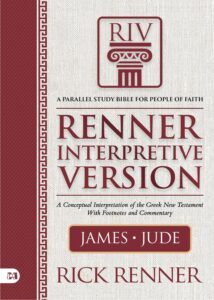
This verse hits me harder now than it ever has. Reading Rick Renner’s Renner Interpretive Version: James & Jude has given me a deeper understanding of this verse than I anticipated.
The one verse warrants two whole pages in his book. He has a lot to say and it’s all important. For brevity’s sake, I’m limiting myself to sharing just two points here. They’re things we should already know, but still…
There is no room for ego and pride in ministry. At any level. Period.
Whether one is a Christian or not, ego and pride are the most common culprits when it comes to desiring labels, titles, and recognition. Actually, let’s get real; they are the culprits. Whether we admit it or not.
Renner writes, “Humility serves as an unmistakable hallmark of any great teacher, and all genuine ‘masters’ have first been mastered by their own submission to truth.”
I saw this humility in action once when a guest minister arrived early and saw us setting up tables in the foyer. He didn’t miss a beat but immediately jumped in to help in spite of our efforts to stop him. He was our special guest! That didn’t matter to him. I wish I could remember exactly what he said as he picked up his end of a table. All I can tell you is that it made a huge impact on us.
Like Jesus did when He washed the disciples’ feet, this man demonstrated true servant leadership. He wasn’t chasing acclaim – he was living his calling with humility. Even those who rarely see him could tell it, and you know God noticed! Because…
God is always watching.
If someone sets themselves up and declares, “I’m a Christian teacher,” they really need to consider the magnitude of their decision. God, who cannot be deceived, sees every word, every motive, everything we hide in our hearts. We may fool man, but we can’t put anything over on God.
James doesn’t pull punches. In the NET this verse reads:
“…because you know that we will be judged more strictly.”
That’s heavy! Imagine James – the brother of Jesus – saying, “If I mess this up God is going to come down on me – HARD.”
But James didn’t write this to scare his readers. He wrote it because he cared. He wanted to protect them from false prophets and teachers; he also wanted to protect them from the self-deception of pride. He was trying to help them count the cost of leadership.
Renner’s notes unpack what it meant, in that culture, to be a teacher, master, or revelator. It required a level of preparation and knowledge that few were willing to pursue – study that took years, even decades. It still requires such effort today.
Do you feel called to the ministry?
Then prepare your heart. Study like never before. Live close to Jesus. And check your pride at the door.
I’ve been waiting years for Rick Renner to release his interpretive version of the Bible, and at last we have James and Jude. I am thrilled!
For those unfamiliar with him, Rick Renner is not only an anointed Bible scholar and teacher, but he also has a tremendous grasp of Koine Greek, which was the form commonly spoken pretty much everywhere in the Roman Empire in Jesus’ time. Add to this technical knowledge his understanding of the culture of the New Testament period, and you have someone uniquely poised to help readers better comprehend this part of the Bible as its original readers would have.
This isn’t a task he took on of his own volition. It developed out of him exegeting the Greek New Testament for himself so that he would understand it better. Not surprisingly, God didn’t let him stop there and even today he’s working on expanding on and sharing what he’s learned. The result, which we have a small part of here, is the Renner Interpretive Version (RIV). Here’s an excerpt from page 1 to help you better understand the book’s intent.
The RIV is a conceptual interpretation of the New Testament that draws on concepts in the Greek language and brings them into the text in a contemporary way to provide a broader comprehension of what is being communicated through Scripture. To be clear, the RIV is not meant to be viewed as a word-for-word translation, but, rather as a conceptual interpretation of the Greek text.
If you are one who generally skips all front matter in favor of leaping directly into a book, I highly suggest you alter your actions for this one. “A Word About the Renner Interpretive Version” not only shares the hows and whys, but also pulls together some facts I’ve never considered before. One paragraph I have highlighted, on page 6, points out that Jesus came at a unique time in history when the Gospel would be able to be preached with relative ease throughout the known world. Why? Because, thanks to the Romans, Koine Greek was spoken by pretty much everyone at least as their second language. As Renner points out, this was the first time since the Tower of Babel that such communication was possible.
Now to the primary text.
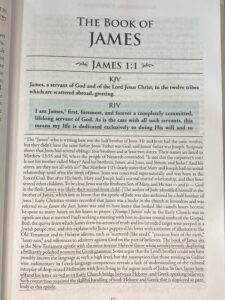
Renner starts by introducing James, which lays a foundation for our reading. He then moves on to a parallel of the KJV and RIV, accompanied by extensive footnotes. I kid you not; James 1:1 affected me so deeply that I had to stop and head to my journal to record my thoughts. And then I couldn’t go on any further until I came here to share with you.
Yes, I’m writing this review even though I’ve not even read past page 18! This is unheard of for me, but I don’t want you to have to wait on me and this is a book with which I plan to take my time.
See for yourself.
So we have James 1:1 in the KJV, and immediately below it, shaded in blue, the first part of verse 1 in the RIV. As you can see, Renner has gone to great lengths to share helpful background information in this book. In his more than 1,200 footnotes, the man leaves me feeling like he’s sitting here talking directly to me.
So what sent me to my journal in the middle of my reading? It was seeing, for the first time, the full impact of “servant of God” or, as Paul referred to himself, “bond servant.” I’ve known what it meant to become a bond servant. It’s beautiful, really. It was common for someone to sign a contract to serve a “master” for a set number of years. When that time was up, he was given his wages and was free to leave. However, if he loved his master and couldn’t imagine being happier anywhere else, he could choose to make a lifetime commitment, to bind himself to that master permanently. I, in similar manner, have chosen to bind myself to Christ. But look at how the significance of calling oneself His servant is expressed in the RIV!
…this means my life is dedicated exclusively to doing His will and to faithfully carrying out any assignment He will ever entrust to me.
Too frequently, we gloss over things we see all the time. We may know, on an intellectual level, what words like these mean, but how often do we stop and genuinely think about them as applied to the writers or, vitally important, to ourselves? The writers of the New Testament were deadly serious when they used these expressions. In truth, considering how most of them died, “deadly serious” is pretty literal. These men had committed their entire lives to putting His will before their own. There was no room for them to disagree with their Master or fail to carry out any assignment He gave them.
So yes, I “knew” all of this but, using his understanding of the nuances of the language as well as the culture of the original readers, Renner has crafted a version that forced me to halt in my tracks and think about it, to apply it to my own life. I want to be able to say these same words, that my life is dedicated exclusively to doing His will and to faithfully carrying out any assignment He will ever entrust to me. God is my number 1, but I’d be lying if I didn’t admit that too often self likes to slide up into that higher position, to nudge God to the side for just a little while.
So yes, I find that even in this tiny sample the RIV is proving to be every bit as powerful and impactful as I had expected it to be. James and Jude just became my next focus and this time around this book will be one of my primary references in my studies.
But that’s not all. One feature I very much appreciate is that Renner chose to include two versions of each book. The first is what I’ve described. Immediately following this heavily footnoted copy of James is another copy of the full text without footnotes. In my case, I will start by reading straight through the book of James in this second section, and then I’ll go back to the beginning for my in-depth study including all the footnotes. Once I’ve completed James, I’ll approach Jude the same way.
I’m a big believer in reading and referring to a variety of translations and paraphrases as I experience the Bible. It helps give me a fresh vision, eyes that see things from a different perspective. This book is definitely a treasure to add to my Bible shelf.
The Renner Interpretive Version: James & Jude is 7.28 x 0.91 x 10.24 inches, and 288 pages
I have enjoyed this book, and I’m sharing some images from pages I haven’t written on to give you an idea of the various entries.
But…let me start with the beginning. Not only does the author take the time to introduce herself, but she also shares about her life as a Christian. Her comments about reading through the WHOLE Bible have inspired me to start reading through the whole Bible, too, because it feels like I tend to reread only certain books. She explains how reading the WHOLE Bible helps you see a bigger picture of what God is doing and how the books come together to tell His Story. She also shares the way she first read through it in 90 days.
I immensely enjoyed the intro; it made me think about how much I read and study the Bible.
I really like the portions of scripture she has chosen for this book because, with each one, she shares from sermons, study notes, and her own experiences. Half of the page is blank for you to write your own study notes, cross-references, or whatever you choose to do with the page. It’s there for you to interact with the scriptures and comments on that page.
I hope she does more books, but I wish she would do them on whole books of the Bible. For instance, I’d love to see a book on just the book of Ephesians or James (probably the two books I read the most).
However, whatever she writes – I will read it because I find her notes thought-provoking, and they encourage me to learn more.
I have multiple projects running simultaneously today, so my bed has officially become part of my desk.
I’m particularly excited about what’s on the bed, because it represents a definite start on my next book. I’ve been asked repeatedly if I would write something else, and I’ve had a few ideas I wanted to pursue, but none were quite right.
Until now.
Those of you who appreciate my reactions to scripture in Experiencing the Bible will be happy to know this is going to be similar. Note: Not the same, but similar. At this point it’s looking like it might be a devotional, though it’s too early to know that for sure.
I’m so excited about it that I’m seriously considering starting a newsletter so I can keep those who are interested up to date on the progress. If you would like to receive it, probably twice a month at most, email me at tammymcardwell@gmail.com so I can notify you when I open subscriptions.
And now I need to get back to work. I pray you have an amazing day!
I’m excited to announce that the ebook version of Experiencing the Bible is now available pretty much anywhere you buy ebooks. This JUST happened, so if you’ve looked for it before on Kobo or any of the other sources, go do a search. You should find me!
If you know me at all, you know I’m serious about the Bible. My current “readthrough” Bible is filled, almost cover to cover, with extensive notes like the ones you see here. My original plan was to give this Bible to one of my grandchildren as soon as I finish the readthrough, and get started on the next Bible right away, intending it for another grandchild. (It’s funny; I had never even heard the phrase “Legacy Bible” until after I decided I would pass it along.) The thing is, once I really thought about how long it has taken me to work my way through this Bible, I knew it would take too many years to accomplish what I’d been considering.
So, after backing up and thinking it through, I devised a new plan. Instead, I would purchase three journaling Bibles and start transferring my notes from scratch. Doing this had one distinct advantage: I could make a point of printing instead of writing in cursive, since cursive seems to have fallen by the wayside and at least one of the “kids” is unable to read it. (Yep, as you can see in the above photo, much of what I’ve written is in cursive.)
During my research, I stumbled across this treasure.
This is the Interleaved edition of the New King James Version (NKJV) of the Bible. Interleaved means they’ve inserted blank sheets of paper between the printed pages. I’ve heard of Bibles being done this way historically but had no idea any publisher was offering them today. When I found it, I got seriously excited! This Bible has enough journaling space to hold not only my notes, but those of my grandkids as well, so it can continue to serve them throughout their lives.
I ordered the Bibles in leather, because I truly do want them to last, and while waiting for them to arrive I purchased a specific set of pens (Papermate Inkjoy) that I will use in all three Bibles. I don’t color code, exactly, or not consistently. I use the various colors more to mark different sections as well as to create a clearer indication of which notes go with which verses.
I also created guide sheets like the ones I used a hundred years ago when I did calligraphy. These sheets, when placed under the page I’m writing on, help me maintain consistency in my writing.
I speak as if I’m actively working on this. I’m not yet; I’ve actually managed all of two pages at this point.
I still have a little bit of both the Old and New Testament studies to complete in my current Bible, and I’ve decided to wait until I finish them before I officially start the project. Looking at what I’ve managed so far while working on these three all at once (because I want consistency and it saves time), I calculate it’s going to take me about three years to finish them, but that’s a lot less than if I’d followed my original plan.
I’m trying to ignore the fact that, since he’s already engaged, my grandson could conceivably have presented me with a great-grandchild by the time I hand him his copy. That’s just too much for me to handle.
But yeah, I’m excited about working on what will be the single most valuable gift I give three of my favorite people.
And here are your Amazon Affiliate links for both the Bible and pens. As an associate, I may make money off qualified purchases.