How to Lead a Small Group Using “Exploring Ezekiel” by Amir Tsarfati

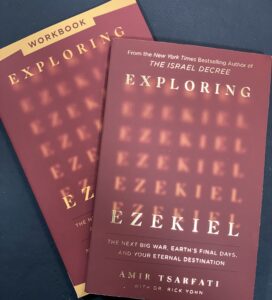
Exploring Ezekiel Book and Workbook
by Amir Tsarfati and Dr. Rick Yohn

I had a reader ask, in a comment,
how I would use this pair in a small group Bible study.
I decided you deserved to see my answer. So here you go!

My answer is assuming you purchased at least one copy of the workbook.

If I were doing the study…

Week 1 would be introducing the material. 

I would either read (or have a few people read) the introduction of Exploring Ezekiel: “Who Is This God?”

Then we’d discuss what we’ve just read. I’d suggest the leader read it ahead of time to come up with prompts in case no one jumps in with their thoughts right away. (normal)

In the second hour, or at least the last half hour, I’d head over to the workbook and really look at “How to Use This Workbook.” 

It lays out a study path that many/most may not be familiar with, so it would be good to consider going over it, helping everyone understand it, and then perhaps practice applying this technique to a familiar passage of Scripture.

Ideally, everyone bought both the book and workbook. If this is the case, I’d suggest having everyone spend each week reading the chapter in Exploring Ezekiel and working in the corresponding chapter in the workbook.

Then, when you come back the next week, you have two hours in which you can discuss everyone’s thoughts and conclusions in depth. This is one of the most powerful aspects of group Bible study, because you never know when something someone else says will turn on a neon sign for you.

And, although you do want to keep things running properly and under control, don’t be surprised when you encounter the occasional rabbit trail. I’d suggest you be flexible enough that you can judiciously explore at least a little ways down those trails as you feel the Spirit lead you.

I’m excited for you and your friends!

If you decide to have a Bible study with these books,
I’m excited for you too! And I’d love to hear how it goes!

Celebrating Jesus!
Tammy C

Hungry for God? Bought a Bible? This is for You.

Someone posted, this morning, that their local Books A Million was completely sold out of Bibles. It shouldn’t have surprised me, considering the reaction to Charlie Kirk’s assassination. I’d already been wondering how many would start digging into the Word. That they are seeking God like this is phenomenal news!

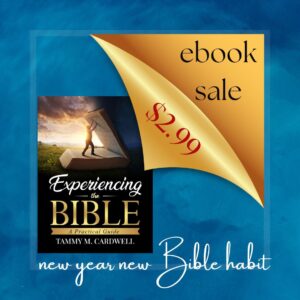
If you are one who is just picking up the Bible (or you know someone who is) I suggest you grab a copy of my book, Experiencing the Bible. I wrote it with you in mind.

Seriously. My thought, as I worked on it, was, “How can I help those who are being told, ‘Pick up your Bible’ or ‘Get into the Word,’ but they’re not being told how?” In Experiencing the Bible, explain.

Yes, I am the author, but I’m not ashamed to say it’s a great book that will be a real help!

Celebrating Jesus!
Tammy C

I’ve included the Amazon link above,
but the ebook version is also available in most popular ebook markets.

How Readers are Experiencing the Bible in a Whole New Way

Available in Paperback, Audiobook, and Ebook

When I first released Experiencing the Bible, my prayer was that it wouldn’t be just another book on the shelf, but would instead become a companion that would inspire believers to fall in love with the Word of God. I wanted it to feel practical, personal, and encouraging, like I was sitting down with you letting you know that, “You can do this! Here’s how.”

The most humbling thing has been hearing back from readers about how it has impacted them. Today I’d like to share some of their words with you.

Inspired to Go Deeper

Peg wrote:
Her comments about reading through the WHOLE Bible have inspired me to start reading through the whole Bible, too, because it feels like I tend to reread only certain books. She explains how reading the WHOLE Bible helps you see a bigger picture of what God is doing and how the books come together to tell His Story.

This is exactly the sort of thing I was hoping to hear, that my readers would be nudged toward a bigger view of Scripture and a richer relationship with God.

Practical and Easy to Use

Yvonne shared:
Tammy Cardwell does a great job of explaining things in an easy to understand way. She gives you her thoughts and also gives you room for you to write yours. I really like the fact she lists different Bible types & different resources to help you in your walk with the Lord.

And Charlotte wrote:
I received this book as a gift for Christmas. I’m blown away! I appreciate the space to journal right here in the book. Knowledge and insight from the author is powerful. I am delighted to read and write about Gods promises for me.

I love hearing this, because a huge purpose in the book’s layout was to provide you the space to interact with Scripture in your own words!

Unputdownable!

Sherri said:
I found while reading your book that once I started reading it, I had a hard time putting it down. It is very much worth the read.

Sheri kept it simple:
Love this study!

I can’t tell you how much it blesses me to learn that people not only start the book, but want to keep going. I feel like I’ve helped friends along a life-changing journey.

Life Impact Beyond the Page

One of the most unexpected, and moving, testimonies came from Nancy Higgins, my audiobook producer. While recording and editing, she discovered something powerful.
Although I have often prayed Scripture out loud, something in my home shifted as I read your book out loud. God moved. Then every time the Word was played back out loud while I was editing, it cleared the air again. Wow, so thankful to have had the privilege of working on this project!!

Hearing how God used His Word, simply spoken aloud for my audiobook, to bring peace to a home… That’s priceless!

Readers are Sharing it with Others

Finally, I loved this encouragement from Tab:
For anyone looking to read and learn about the Bible I’m telling you now this is one book you will want to read. You should get one for you and a friend.

That’s the heartbeat of this project: helping people walk closer to God through His Word, and encouraging them to share that journey with others.

Ready to Experience the Bible for Yourself?

If you’ve ever felt like reading the Bible was hard or confusing, if you don’t know where to start, or if you simply want read the Word with fresh eyes, Experiencing the Bible was written with you in mind. It’s available now in paperback, audiobook, and ebook.

Get your copy on Amazon.

The ebook is also available in most of your favorite ebook markets.

If you’ve already read it, I’d love to hear your story. Your testimony may well inspire someone else to dive into the richness of God’s Word!

Celebrating Jesus!
Tammy C

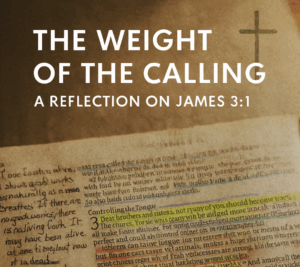
The Weight of the Calling: A Reflection on James 3:1

Every time I read James 3:1, I pause and examine my heart and motives.

I’ve never claimed to be a teacher; I’m not one. I’m merely someone who shares what she learns as she learns it – what God shows me as He helps me understand it.

James 3:1 is a strong warning:

“My brethren, be not many masters, knowing that we shall receive the greater condemnation.” (KJV)

Most modern translations use the word “teacher” instead of “master,” which is another reason I don’t claim to be a teacher. I’ve certainly not mastered Scripture well enough to teach it!

This verse hits me harder now than it ever has. Reading Rick Renner’s Renner Interpretive Version: James & Jude has given me a deeper understanding of this verse than I anticipated.

The one verse warrants two whole pages in his book. He has a lot to say and it’s all important. For brevity’s sake, I’m limiting myself to sharing just two points here. They’re things we should already know, but still…

There is no room for ego and pride in ministry.
At any level.
Period.

Whether one is a Christian or not, ego and pride are the most common culprits when it comes to desiring labels, titles, and recognition. Actually, let’s get real; they are the culprits. Whether we admit it or not.

Renner writes, “Humility serves as an unmistakable hallmark of any great teacher, and all genuine ‘masters’ have first been mastered by their own submission to truth.”

I saw this humility in action once when a guest minister arrived early and saw us setting up tables in the foyer. He didn’t miss a beat but immediately jumped in to help in spite of our efforts to stop him. He was our special guest! That didn’t matter to him. I wish I could remember exactly what he said as he picked up his end of a table. All I can tell you is that it made a huge impact on us.

Like Jesus did when He washed the disciples’ feet, this man demonstrated true servant leadership. He wasn’t chasing acclaim – he was living his calling with humility. Even those who rarely see him could tell it, and you know God noticed! Because…

God is always watching.

If someone sets themselves up and declares, “I’m a Christian teacher,” they really need to consider the magnitude of their decision. God, who cannot be deceived, sees every word, every motive, everything we hide in our hearts. We may fool man, but we can’t put anything over on God.

James doesn’t pull punches. In the NET this verse reads:

“…because you know that we will be judged more strictly.”

That’s heavy! Imagine James – the brother of Jesus – saying, “If I mess this up God is going to come down on me – HARD.”

But James didn’t write this to scare his readers. He wrote it because he cared. He wanted to protect them from false prophets and teachers; he also wanted to protect them from the self-deception of pride. He was trying to help them count the cost of leadership.

Renner’s notes unpack what it meant, in that culture, to be a teacher, master, or revelator. It required a level of preparation and knowledge that few were willing to pursue – study that took years, even decades. It still requires such effort today.

Do you feel called to the ministry?

Then prepare your heart. Study like never before. Live close to Jesus. And check your pride at the door.

Celebrating Jesus!
Tammy C

If you haven’t read it already, you may want to check out my review of the Renner Interpretive Version: James & Jude.

Reading Scripture in Context: A Guide for Growing Faith

Ronnie Trice, my pastor’s father, often said about reading the Word, “When you see ‘therefore,’ you need to see what it’s there for.”

I’ve never forgotten this instruction, but I must confess I sometimes forget to act on it. Little transition words like “so,” “then,” and “for” might seem insignificant, but they carry a lot of weight. And, sad to say, they’re all too easy to ignore.

Take the word “if.” It indicates conditions. That’s important when we’re talking about the promises of God. We get excited about God’s promises, and we should! But we too often overlook the conditions that come attached.

Let me give you a few examples.

John 15:7 (KJV)
Promise: “…ye shall ask what ye will, and it shall be done unto you.”
Condition: “If ye abide in me, and my words abide in you…”

2 Chronicles 7:14 (KJV)
Promise: “…will I hear from heaven, and will forgive their sin, and will heal their land.”
Condition: “If my people, which are called by my name, shall humble themselves, and pray, and seek my face, and turn from their wicked ways then…”

1 John 1:9 (KJV)
Promise: “… he is faithful and just to forgive us our sins, and to cleanse us from all unrighteousness.”
Condition: “If we confess our sins…”

These aren’t hidden messages. They’re right in front of us in black and white (or red and white, if it’s Jesus talking), but we miss them when we skim the words or focus only on the parts we want to see.

Recently, I was reading from the Renner Interpretive Version: James & Jude (RIV). In this version, Rick Renner takes the original Greek and brings out the meaning in a way that is both faithful to the text and alive with first century understanding. It made me appreciate transition words all over again.

Take a look at James 1:23. In the KJV it reads:

For if any be a hearer of the word, and not a doer, he is like unto a man beholding his natural face in a glass.”

The word “for” is small, easy to skip over, but it’s crucial to the message. It ties everything back to what James has just finished saying and leads into what he has to say next. In the RIV, that same passage begins like this:

You need to understand that if — as I’m certain is the case concerning what I’m about to say — anyone finds himself among those who merely show up to hear the Word but are not committed to putting it into practice…”

In other words, James was alerting his readers to the urgency of both what he had to say and how it all fit together.

What had he just said?

The end of verse 22 (still in the RIV) makes it crystal clear.

“These kinds of people make the grave miscalculation of thinking they’ve done all that is required by just showing up. Don’t trick yourselves into thinking that merely showing up and listening is all that’s required.”

Then come verses 23-24 where he talks about a man who looks in a mirror, sees things in his reflection that need to be fixed, then turns and walks away, forgetting all about what he’s seen. James is saying, “Don’t be that person!”

That’s a big “for.”

Of course, this truth holds up no matter which translation you choose. Transition words are like important signposts. They remind us of where the author has been and where he’s going. But here’s the thing: We’ve grown accustomed to reading the Bible in bits and pieces, chapter by chapter or even verse by verse, usually without thinking about how it was originally written.

Did you even know the Bible didn’t always have chapter and verse numbers?

It’s true. The Bible was originally written as continuous text. The chapter divisions we know today were first introduced in the 1200s, and verse numbering came even later. While they undeniably help us find things quickly, these divisions can also lead us to read verses in isolation, and this causes us to miss much of the flow and intent of the text.

Take Romans 8:1 for example.

“There is therefore now no condemnation to them which are in Christ Jesus, who walk not after the flesh, but after the Spirit.”

That “therefore” is a clue. It tells us to back up and see what led to this beautiful conclusion. When we start at Romans 7:21 and then read through Romans 8:4, we get the full context. In sharing his personal struggles with sin as well as the triumph we have through Christ Paul gives us a message that is only hinted at in Romans 8:1.

And then there’s Hebrews 12:1.

Wherefore seeing we also are compassed about with so great a cloud of witnesses…”

Wherefore? Which witnesses? To answer these questions, you need to back up to the Hall of Fame of Faith found in Hebrews 11. Read about these heroes of the faith, see how they stood through everything in their lives, and you will be encouraged that you too can “run the race set before you.” And to truly grasp the full impact of Hebrews 12:1, I urge you to keep reading through 12:3. It’s all connected.

Experiencing the Bible is about more than reading a verse or two here and there. Don’t get me wrong: Cards and calendars that offer a scripture a day are good, but they are no substitute for truly diving into the Bible. If you want to let His words live in you as Jesus said in John 15:7, slow down, read in context, take it in fully, act on it, and watch it change you from the inside out.

That’s one reason I believe reading the Bible from cover to cover is one of the most powerful things you can do to grow in your relationship with God. When you follow the flow of Scripture, those little words — if, for, therefore, then, wherefore — become keys that unlock deeper understanding.

So next time you’re reading and come across one of them, pause.

Ask what it’s there for.

You might just discover it’s pointing to something life-changing.

Celebrating Jesus!
Tammy C

PS: If my references to the RIV intrigued you, you might want to check out my review of The Renner Interpretive Version: James & Jude.

My Bible Shelf Spotlight: The One Year Chronological Bible

Here you have all of the Bibles I currently own.

My second, third, and fourth Bible readthroughs were in the New Living Translation (NLT) Chronological Bible. A chronological Bible differs from a traditional one in that, instead of following the standard book order, it arranges events in the order in which they occurred—or as closely as theologians can determine.

This particular combination of translation and timeline was a revelation to me. Though my second readthrough took a year, the third took three months, and the fourth only six weeks. I was like a child who had just discovered the joy of real food; I couldn’t get enough.

The New Living Translation spoke to me in a way I understood and, to this day, it remains my favorite for everyday reading. However, where my suddenly open eyes were concerned, chronology was key.

The Bible is often referred to as the greatest story ever told. I hesitate to use the word “story” because many associate it with fiction, but the idea of a grand narrative fits in this case.

This collection of 66 books is packed with the most awe-inspiring and life-changing accounts ever recorded. When rearranged into historical order, your experience with the text shifts. Rather than reading 66 individual books, you engage with one epic account, where each event leads into the next. Your eyes widen as you make connections you had never imagined. For example, by the time I reached the end of Leviticus in my 90-day readthrough, I understood its purpose like never before.

Leviticus was the book where I had previously stumbled in my attempts to read the Bible from Genesis to Revelation. Now, I grasped the necessity of its detailed laws and instructions. The Israelites, though enslaved for hundreds of years, were destined to become a mighty nation. Leviticus served as their crash course in how to function as a healthy, well-governed people. Of course, there is much more to Leviticus, and I have come to genuinely love it, but at that point, I was simply grateful to understand at least one reason why it was included in the Bible.

The Bible is available in chronological order in several translations. The one pictured here was actually my ninth readthrough Bible, structured with selections that, if read without stopping to study, would take about 15 minutes a day. Regardless of the translation, this remains true—you can read through the Bible in a year by consistently committing even that small amount of time.

Now that we’ve covered chronology, let’s talk about translation. The New Living Translation is a thought-for-thought or dynamic equivalence translation. This means it focuses on conveying the meaning behind sentences and paragraphs rather than adhering strictly to a word-for-word approach. By allowing the original thought to guide the translation, the NLT stays true to scripture’s meaning while making it more accessible to contemporary readers. Idioms and cultural expressions that were clear to the original audience are rendered in ways we can better appreciate today.

Here’s an example of the difference between the King James Version (KJV) and the NLT:

Proverbs 26:18-19

KJV:
As a mad man who casteth firebrands, arrows, and death, So is the man that deceiveth his neighbour, and saith, Am not I in sport?

NLT:
Just as damaging as a madman shooting a deadly weapon is someone who lies to a friend and then says, “I was only joking.”

I had growing boys when I first read this verse in the NLT, and the words hit me hard. How many times had I heard my sons do exactly this—lie to one another and then try to smooth it over by saying, “I was only joking”? I had never seen these verses in such a light before, nor realized how dangerous and damaging such lies could be. The phrases “deadly weapon” and “only joking” resonated deeply, slipping into my heart in a new way and affecting my parenting.

And isn’t that what the Bible is meant to do? It changes us and how we interact with those around us. If it doesn’t, we’re missing something and I try hard to avoid that mistake. When reading the Bible, I strive to remain open to anything the Holy Spirit wants me to see and to be quick to put it into practice in my life.

Until next time, I’m still…

Celebrating Jesus!
Tammy C

Review: Renner Interpretive Version: James & Jude 

RIV: James & Jude Cover

I’ve been waiting years for Rick Renner to release his interpretive version of the Bible, and at last we have James and Jude. I am thrilled!

For those unfamiliar with him, Rick Renner is not only an anointed Bible scholar and teacher, but he also has a tremendous grasp of Koine Greek, which was the form commonly spoken pretty much everywhere in the Roman Empire in Jesus’ time. Add to this technical knowledge his understanding of the culture of the New Testament period, and you have someone uniquely poised to help readers better comprehend this part of the Bible as its original readers would have.

This isn’t a task he took on of his own volition. It developed out of him exegeting the Greek New Testament for himself so that he would understand it better. Not surprisingly, God didn’t let him stop there and even today he’s working on expanding on and sharing what he’s learned. The result, which we have a small part of here, is the Renner Interpretive Version (RIV). Here’s an excerpt from page 1 to help you better understand the book’s intent.

The RIV is a conceptual interpretation of the New Testament that draws on concepts in the Greek language and brings them into the text in a contemporary way to provide a broader comprehension of what is being communicated through Scripture. To be clear, the RIV is not meant to be viewed as a word-for-word translation, but, rather as a conceptual interpretation of the Greek text.

If you are one who generally skips all front matter in favor of leaping directly into a book, I highly suggest you alter your actions for this one. “A Word About the Renner Interpretive Version” not only shares the hows and whys, but also pulls together some facts I’ve never considered before. One paragraph I have highlighted, on page 6, points out that Jesus came at a unique time in history when the Gospel would be able to be preached with relative ease throughout the known world. Why? Because, thanks to the Romans, Koine Greek was spoken by pretty much everyone at least as their second language. As Renner points out, this was the first time since the Tower of Babel that such communication was possible.

Now to the primary text.

Renner starts by introducing James, which lays a foundation for our reading. He then moves on to a parallel of the KJV and RIV, accompanied by extensive footnotes. I kid you not; James 1:1 affected me so deeply that I had to stop and head to my journal to record my thoughts. And then I couldn’t go on any further until I came here to share with you.

Yes, I’m writing this review even though I’ve not even read past page 18! This is unheard of for me, but I don’t want you to have to wait on me and this is a book with which I plan to take my time.

See for yourself.

So we have James 1:1 in the KJV, and immediately below it, shaded in blue, the first part of verse 1 in the RIV. As you can see, Renner has gone to great lengths to share helpful background information in this book. In his more than 1,200 footnotes, the man leaves me feeling like he’s sitting here talking directly to me.

So what sent me to my journal in the middle of my reading? It was seeing, for the first time, the full impact of “servant of God” or, as Paul referred to himself, “bond servant.” I’ve known what it meant to become a bond servant. It’s beautiful, really. It was common for someone to sign a contract to serve a “master” for a set number of years. When that time was up, he was given his wages and was free to leave. However, if he loved his master and couldn’t imagine being happier anywhere else, he could choose to make a lifetime commitment, to bind himself to that master permanently. I, in similar manner, have chosen to bind myself to Christ. But look at how the significance of calling oneself His servant is expressed in the RIV!

…this means my life is dedicated exclusively to doing His will and to faithfully carrying out any assignment He will ever entrust to me.

Too frequently, we gloss over things we see all the time. We may know, on an intellectual level, what words like these mean, but how often do we stop and genuinely think about them as applied to the writers or, vitally important, to ourselves? The writers of the New Testament were deadly serious when they used these expressions. In truth, considering how most of them died, “deadly serious” is pretty literal. These men had committed their entire lives to putting His will before their own. There was no room for them to disagree with their Master or fail to carry out any assignment He gave them.

So yes, I “knew” all of this but, using his understanding of the nuances of the language as well as the culture of the original readers, Renner has crafted a version that forced me to halt in my tracks and think about it, to apply it to my own life. I want to be able to say these same words, that my life is dedicated exclusively to doing His will and to faithfully carrying out any assignment He will ever entrust to me. God is my number 1, but I’d be lying if I didn’t admit that too often self likes to slide up into that higher position, to nudge God to the side for just a little while.

So yes, I find that even in this tiny sample the RIV is proving to be every bit as powerful and impactful as I had expected it to be. James and Jude just became my next focus and this time around this book will be one of my primary references in my studies.

But that’s not all. One feature I very much appreciate is that Renner chose to include two versions of each book. The first is what I’ve described. Immediately following this heavily footnoted copy of James is another copy of the full text without footnotes. In my case, I will start by reading straight through the book of James in this second section, and then I’ll go back to the beginning for my in-depth study including all the footnotes. Once I’ve completed James, I’ll approach Jude the same way.

I’m a big believer in reading and referring to a variety of translations and paraphrases as I experience the Bible. It helps give me a fresh vision, eyes that see things from a different perspective. This book is definitely a treasure to add to my Bible shelf.

The Renner Interpretive Version: James & Jude
is 7.28 x 0.91 x 10.24 inches, and 288 pages

You can purchase it at
Renner.org and Amazon

Celebrating Jesus!
Tammy C

Who am I to be reviewing Bibles? I’m the author of Experiencing the Bible, which is available in paperback, ebook, and audiobook on Amazon.

My Bible Shelf Spotlight: The Message Bible

Here you have all of the Bibles I currently own.

A friend recently asked for a photo of my Bible shelf along with input on my favorite Bibles. I’ve been meaning to do this very thing for my readers for nearly a year. My apologies for the delay!

So here begins a tour. As you can see, my Bibles are shelved more by height than anything else. We’re “reading” from left to right, beginning with The Message, which is an excellent paraphrase.

I had been hearing about The Message for quite a while when I stumbled across a copy in the most unique “resale shop” I’ve ever seen. Everything was literally piled, and you crawled around and climbed over said piles in search of gems. My first copy of The Message was one of those gems, and it instantly went on my readthrough list. By this I mean I read it through from Genesis to Revelation. This is, as the publisher is quick to point out in the introduction, a fantastic “reading” Bible.

Unlike most Bibles, this one bears only one translator’s name: Eugene H. Peterson. His story is exceptional, and a little heartbreaking for people like me. Here’s an excerpt from the introduction that answers the question, “Why him?”

“I began my work life as a teacher and for several years taught the biblical languages of Hebrew and Greek in a theological seminary. I expected to live the rest of my life as a professor and scholar, teaching and writing and studying. But then my life took a sudden turn to pastoring in a congregation.

“I was now plunged into quite a different world. The first noticeable difference was that nobody seemed to care much about the Bible, which so recently people had been paying me to teach them. Many of the people I worked with now knew virtually nothing about it, had never read it, and weren’t interested in learning. Many others had spent years reading it but for them it had gone flat through familiarity, reduced to cliches. Bored, they dropped it. And there weren’t many people in between. Very few were interested in what I considered my primary work, getting the words of the Bible into their heads and hearts, getting the message lived. They found newspapers and magazines, videos and novels more to their taste.”

Sadly, I see the same thing in the church today. It’s one of the reasons I keep coming back to this one topic, leaning hard into the fact that we cannot afford to disregard the Word of God. We CANNOT!

As a pastor, Peterson learned to meld the old with the new – the original, common-man languages of the Bible (Hebrew and Greek) with the common language of today. He made the Bible come alive in such a way that the difference in his congregation was noticed by an editor, and he ended up spending ten years creating The Message, a Bible with a specific purpose.

It is meant to be read. Or, as the publisher expresses it, it is a reading Bible, not a study Bible. It’s a Bible designed specifically to get people into and invested in the Word of God. With this purpose in mind, Peterson crafted it very carefully. Not only did he select just the right words to make God’s Word available to modern readers, he also chose to list verse numbers alongside each paragraph rather than presenting verses individually. This can take getting used to but historically the Bible didn’t even have chapter numbers until early in the 13th century and verse numbers waited another 300 or so years to show up.

While chapters and verses are helpful when seeking specific text, they can also lead to reading passages out of context and, as a result, losing part of their richness and meaning. Not interrupting trains of thought with verse numbers, The Message enables us to grasp a more complete picture and, at times, see what the Bible is really saying as opposed to what we thought it said. This is one of my favorite things about quality, modern translations and paraphrases. They take verses that have become so familiar that, as he pointed out, they’ve reached cliche status and put them into words that wake us up and make us start thinking again.

One more note and I’ll move on. Although it’s not a study Bible, Peterson does offer helpful introductions to sections (i.e., The Books of Moses) and chapters. If you’re one who tends to pass over such introductions, I suggest you make an exception. It often helps to begin a journey, even into a new book, with an idea of what’s to come.

Finally, I do realize there are people who have a problem with any and all modern translations, especially paraphrases, but the intention is to make the text available to the reader. As beautiful as the King James is, and most of the scriptures I’ve memorized come from the KJV, it’s not really the language we speak today. As a result, it can be seriously challenging for modern readers. High quality translations and paraphrases like The Message can make a huge difference in understanding and appreciation.

Until next time, I’m…

Celebrating Jesus!
Tammy C

My Legacy Bibles Plan

The Inspire Bible

If you know me at all, you know I’m serious about the Bible. My current “readthrough” Bible is filled, almost cover to cover, with extensive notes like the ones you see here. My original plan was to give this Bible to one of my grandchildren as soon as I finish the readthrough, and get started on the next Bible right away, intending it for another grandchild. (It’s funny; I had never even heard the phrase “Legacy Bible” until after I decided I would pass it along.) The thing is, once I really thought about how long it has taken me to work my way through this Bible, I knew it would take too many years to accomplish what I’d been considering.

So, after backing up and thinking it through, I devised a new plan. Instead, I would purchase three journaling Bibles and start transferring my notes from scratch. Doing this had one distinct advantage: I could make a point of printing instead of writing in cursive, since cursive seems to have fallen by the wayside and at least one of the “kids” is unable to read it. (Yep, as you can see in the above photo, much of what I’ve written is in cursive.)

During my research, I stumbled across this treasure.

This is the Interleaved edition of the New King James Version (NKJV) of the Bible. Interleaved means they’ve inserted blank sheets of paper between the printed pages. I’ve heard of Bibles being done this way historically but had no idea any publisher was offering them today. When I found it, I got seriously excited! This Bible has enough journaling space to hold not only my notes, but those of my grandkids as well, so it can continue to serve them throughout their lives.

I ordered the Bibles in leather, because I truly do want them to last, and while waiting for them to arrive I purchased a specific set of pens (Papermate Inkjoy) that I will use in all three Bibles. I don’t color code, exactly, or not consistently. I use the various colors more to mark different sections as well as to create a clearer indication of which notes go with which verses.

I also created guide sheets like the ones I used a hundred years ago when I did calligraphy. These sheets, when placed under the page I’m writing on, help me maintain consistency in my writing.

I speak as if I’m actively working on this. I’m not yet; I’ve actually managed all of two pages at this point.

I still have a little bit of both the Old and New Testament studies to complete in my current Bible, and I’ve decided to wait until I finish them before I officially start the project. Looking at what I’ve managed so far while working on these three all at once (because I want consistency and it saves time), I calculate it’s going to take me about three years to finish them, but that’s a lot less than if I’d followed my original plan.

I’m trying to ignore the fact that, since he’s already engaged, my grandson could conceivably have presented me with a great-grandchild by the time I hand him his copy. That’s just too much for me to handle.

But yeah, I’m excited about working on what will be the single most valuable gift I give three of my favorite people.

And here are your Amazon Affiliate links for both the Bible and pens. As an associate, I may make money off qualified purchases.

NKJV, Interleaved Bible, Journal Edition, Genuine Leather, Brown, Red Letter, Comfort Print: The Ultimate Bible Journaling Experience

Paper Mate InkJoy 100RT Retractable Ballpoint Pens, Medium Point (1.0mm), Assorted, 20 Count

Celebrating Jesus!
Tammy C