Wake up, Church! The Alarm Has Already Sounded

Imagine you’re the boss of a large company and one day while walking around the jobsite you discover some of your employees asleep. Perhaps you’re a merciful person and, after waking them up and warning them not to repeat the offense, you move on.

But they don’t stop taking naps while they’re supposed to be working.

Someone else catches them at it again, sleeping right out in the open as if it were perfectly acceptable and they had no reason to be concerned about anything. But once more they get off with a warning.

Then a day comes when something goes wrong in their area and a raging fire breaks out. Perhaps it happens because of their inattention, perhaps not. Regardless, they’re so sound asleep they never hear any alarms, never have a clue until it’s too late, and they perish.

Because they were asleep.

Does it sound like something from a movie script? Maybe, but I’m sure similar things have occurred. Probably more than once. If, like me, you happen to live surrounded by chemical plants, you know what I mean. I’ve heard stories all my life.

I was thinking about one such story this morning and, as He often does, the Holy Spirit led me in a spiritual direction. Consider the same scenario…not in a company, but in the Church.

I thought about those sleeping employees and how they had been lulled into complacency. I mean, if you’re obviously sleeping on the job and not trying to hide it, you must feel like such behavior is ok. Why? Who did you see doing the same thing? Have you convinced yourself you’re above the rules? Or have you just stopped paying attention?

The truth is, we see the very same thing happening in the Church today. I’m not talking about sleeping in the pews; yes, this happens but is nowhere near as dangerous as what I’m referring to. I’m talking about the large percentage of the Church that has been lulled into complacency and is asleep on the job.

How many think they’ve “got it covered” just because they showed up? They fill their pews on Sunday morning and believe that’s good enough. But it’s not!

Romans 13:11 (NKJV) warns us,

“And do this, knowing the time, that now it is high time to awake out of sleep; for now our salvation is nearer than when we first believed.”

In Revelation 3:1-3, to the church at Sardis Jesus says,

“…I know your works, that you have a name that you are alive, but you are dead… Be watchful, and strengthen the things which remain…”

And in 1 Thessalonians 5:6 we see the clear warning,

“Therefore let us not sleep, as others do, but let us watch and be sober.”

Complacency is from the devil. I mean that literally. God leads us in peace. The devil can’t copy peace. The closest he can get is complacency, and he uses it skillfully. He distracts the Christian from what he needs to be doing, encourages him to get comfortable, and drapes a shroud of complacency over him to lull him to sleep.

When I had that thought this morning, alarm bells went off: The Ten Virgins!

In sharing this parable in Matthew 25:1-13, Jesus made it clear that we can’t be complacent. In verse 13, He says,

“Watch therefore, for you know neither the day nor the hour in which the Son of Man is coming.”

Unlike the five foolish virgins, we must be prepared so that we’re ready to move the instant we hear the alarm. The consequences of failure in the parable were huge to those women.

And they can be huge to us.

The parable of the ten virgins has long been thought to be a reference to the Rapture of the Church, a warning that we must stay prepared if we don’t want to miss that call. Those who study End Time prophecy are well aware that Jesus’ return is unimaginably close, especially given the most recent events in the Middle East.

Don’t let the devil drape you in complacency. Put on the cloak of a warrior and stand up. Keep your eyes on our Lord and go where He leads.

Stay in the Word, stay in prayer, and keep sharing Jesus with everyone you can. Pray for the salvation of those around you. Yes, even pray for your enemies. God doesn’t want anyone to go to Hell, and neither should we.

2 Peter 3:9

“The Lord is not slack concerning His promise… but is longsuffering toward us, not willing that any should perish but that all should come to repentance.”

1 Timothy 2:3-4

“…God our Savior, who desires all men to be saved and to come to the knowledge of the truth.”

Don’t let complacency be your downfall.
Stay awake. Stay prepared. Stay in step with the Spirit.
The time is short – and Eternity doesn’t wait.

Celebrating Jesus!
Tammy C

Amir Tsarfati’s Biblical Case for Israel: My Take

Given the global tension regarding Israel,
Amir Tsarfati’s new book couldn’t be more timely.

I have questions…

Do you believe the church replaced Israel in God’s plan?
Do you believe Israel shouldn’t even exist?
Do you believe Israel is God’s chosen nation?

Regardless of your answers, The Israel Decree may be just the book you need – even if you’d rather not risk being swayed in your thinking.

I don’t generally review books I’ve not finished, and I’m only about 2/3 of the way through this one. However, I’ve studied the topic before and can confirm that everything I’ve read so far is accurate and comes with a depth and clarity that can’t be denied. In fact, I’m so impressed with this book that I’ve already ordered several copies personally.

The Israel Decree’s subtitle is “Understanding God’s Unbreakable Covenant with His People and Their Land,” and understanding is exactly what it provides. In less than 120 pages, Amir Tsarfati answers every challenge that has been offered against Israel’s right to exist as a nation.

Tsarfati tackles every challenge head-on, whether it regards modern politics or ancient prophecy. His arguments are meticulously documented and scholarly, but highly readable; you are left with the impression that he’s speaking to you personally.

If you have a question about Israel’s relationship with God and her right to exist as a modern-day nation, I can almost guarantee he answers it here.

Will those who oppose Israel take time to read it with an open heart? I can only hope.

God told Abraham, regarding his descendants, “I will make you a great nation; I will bless you and make your name great; and you shall be a blessing. I will bless those who bless you, and I will curse him who curses you; and in you all the families of the earth shall be blessed.” (Genesis 12:1-3)

Those verses alone are enough for me to support Israel, but they just scratch the surface.

Whether you lean toward replacement theology, question Israel’s right to exist, or simply want to deepen your understanding of God’s covenant with His chosen people, this short book will challenge and equip you.

Pick up a copy of The Israel Decree today and come away with a greater understanding of and appreciation for God’s unbreakable promises.

Celebrating Jesus!
Tammy C

Reading Scripture in Context: A Guide for Growing Faith

Ronnie Trice, my pastor’s father, often said about reading the Word, “When you see ‘therefore,’ you need to see what it’s there for.”

I’ve never forgotten this instruction, but I must confess I sometimes forget to act on it. Little transition words like “so,” “then,” and “for” might seem insignificant, but they carry a lot of weight. And, sad to say, they’re all too easy to ignore.

Take the word “if.” It indicates conditions. That’s important when we’re talking about the promises of God. We get excited about God’s promises, and we should! But we too often overlook the conditions that come attached.

Let me give you a few examples.

John 15:7 (KJV)
Promise: “…ye shall ask what ye will, and it shall be done unto you.”
Condition: “If ye abide in me, and my words abide in you…”

2 Chronicles 7:14 (KJV)
Promise: “…will I hear from heaven, and will forgive their sin, and will heal their land.”
Condition: “If my people, which are called by my name, shall humble themselves, and pray, and seek my face, and turn from their wicked ways then…”

1 John 1:9 (KJV)
Promise: “… he is faithful and just to forgive us our sins, and to cleanse us from all unrighteousness.”
Condition: “If we confess our sins…”

These aren’t hidden messages. They’re right in front of us in black and white (or red and white, if it’s Jesus talking), but we miss them when we skim the words or focus only on the parts we want to see.

Recently, I was reading from the Renner Interpretive Version: James & Jude (RIV). In this version, Rick Renner takes the original Greek and brings out the meaning in a way that is both faithful to the text and alive with first century understanding. It made me appreciate transition words all over again.

Take a look at James 1:23. In the KJV it reads:

For if any be a hearer of the word, and not a doer, he is like unto a man beholding his natural face in a glass.”

The word “for” is small, easy to skip over, but it’s crucial to the message. It ties everything back to what James has just finished saying and leads into what he has to say next. In the RIV, that same passage begins like this:

You need to understand that if — as I’m certain is the case concerning what I’m about to say — anyone finds himself among those who merely show up to hear the Word but are not committed to putting it into practice…”

In other words, James was alerting his readers to the urgency of both what he had to say and how it all fit together.

What had he just said?

The end of verse 22 (still in the RIV) makes it crystal clear.

“These kinds of people make the grave miscalculation of thinking they’ve done all that is required by just showing up. Don’t trick yourselves into thinking that merely showing up and listening is all that’s required.”

Then come verses 23-24 where he talks about a man who looks in a mirror, sees things in his reflection that need to be fixed, then turns and walks away, forgetting all about what he’s seen. James is saying, “Don’t be that person!”

That’s a big “for.”

Of course, this truth holds up no matter which translation you choose. Transition words are like important signposts. They remind us of where the author has been and where he’s going. But here’s the thing: We’ve grown accustomed to reading the Bible in bits and pieces, chapter by chapter or even verse by verse, usually without thinking about how it was originally written.

Did you even know the Bible didn’t always have chapter and verse numbers?

It’s true. The Bible was originally written as continuous text. The chapter divisions we know today were first introduced in the 1200s, and verse numbering came even later. While they undeniably help us find things quickly, these divisions can also lead us to read verses in isolation, and this causes us to miss much of the flow and intent of the text.

Take Romans 8:1 for example.

“There is therefore now no condemnation to them which are in Christ Jesus, who walk not after the flesh, but after the Spirit.”

That “therefore” is a clue. It tells us to back up and see what led to this beautiful conclusion. When we start at Romans 7:21 and then read through Romans 8:4, we get the full context. In sharing his personal struggles with sin as well as the triumph we have through Christ Paul gives us a message that is only hinted at in Romans 8:1.

And then there’s Hebrews 12:1.

Wherefore seeing we also are compassed about with so great a cloud of witnesses…”

Wherefore? Which witnesses? To answer these questions, you need to back up to the Hall of Fame of Faith found in Hebrews 11. Read about these heroes of the faith, see how they stood through everything in their lives, and you will be encouraged that you too can “run the race set before you.” And to truly grasp the full impact of Hebrews 12:1, I urge you to keep reading through 12:3. It’s all connected.

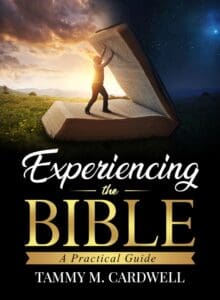
Experiencing the Bible is about more than reading a verse or two here and there. Don’t get me wrong: Cards and calendars that offer a scripture a day are good, but they are no substitute for truly diving into the Bible. If you want to let His words live in you as Jesus said in John 15:7, slow down, read in context, take it in fully, act on it, and watch it change you from the inside out.

That’s one reason I believe reading the Bible from cover to cover is one of the most powerful things you can do to grow in your relationship with God. When you follow the flow of Scripture, those little words — if, for, therefore, then, wherefore — become keys that unlock deeper understanding.

So next time you’re reading and come across one of them, pause.

Ask what it’s there for.

You might just discover it’s pointing to something life-changing.

Celebrating Jesus!
Tammy C

PS: If my references to the RIV intrigued you, you might want to check out my review of The Renner Interpretive Version: James & Jude.

Hard-Fought Hallelujah: Choosing Praise in Pain

The first time I heard these words…

I’ll bring my hard-fought, heartfelt been-through-hell hallelujah
And I’ll bring my storm-tossed, torn-sail story-to-tell hallelujah, oh, oh
‘Cause God, You’ve been patient 
God, You’ve been gracious, faithful, whatever I’m feeling or facing
So, I’ll bring my hard-fought, heartfelt it-is-well hallelujah

I knew I was hearing a song that spoke to my life, perhaps more deeply than any other. Brandon Lake’s Hard Fought Hallelujah has touched countless hearts, but in that first listening I felt heard – in a way I’m not sure I ever had before.

If you know me, you know I’ve been there!
During some of the darkest days of our marriage – when I knew that, as soon as we got home from church, he would head out to meet the other woman – choosing to worship God with the congregation gave me strength to breathe, to keep standing, to keep showing up.

Once, when one of my sons was heading in a completely wrong direction and I was alone in the house with the pain, I cranked up the worship and poured my heart out to God.
That was my, “storm-tossed, torn-sail story to tell hallelujah.”
And it got me through.

Here’s the thing.
Thanksgiving, praise, and worship aren’t just for the good times. Anyone can offer up a “thank God” when something goes their way. Unbelievers do it all the time. But when you offer up a hallelujah while walking through hell barefoot in the dark? That’s different.

That kind of worship releases something powerful.
Choosing to worship God not because of what we see, but because of Who He is transforms us.
It alters how we see Him.
It alters how we see the storm.
It deepens our relationship with The One who is always there.

Does the storm leave? Maybe. Maybe not. But we rise above it regardless.

I encourage you:
Bring it!
No matter where you are, no matter what you’re walking through today – bring God your hallelujah!
Let your worship be more than a song. Make it your lifestyle.

If you’ve not heard the song for yourself, you can watch Brandon Lake sing it with Jelly Roll on YouTube.

Celebrating Jesus!
Tammy C

PS: Here is an eye-opening video of Brandon Lake and Jelly Roll being interviewed by KLove.

“Why Have You Forsaken Me?” A Hidden Message from the Cross

This morning, I heard a minister say something that stopped me in my tracks.

He reminded me that the Bible’s chapters and verses are very new additions. In that era, if you wanted to draw someone’s attention to a particular passage, you’d quote the first words – similar to how we often mistake a song’s first line for its title today.

During Jesus’ days, the Bible was shared orally, and memorization was important. The psalms would have been well known by those who stood watching. According to this minister, and the idea rings true, when Jesus cried out, “My God, my God, why have you forsaken me?,” He wasn’t merely crying out to God in anguish: He was intentionally pointing their hearts towards Psalm 22, a song that begins in devastation but ends in victory and a changed world.

Psalm 22 is written by David and ostensibly about him, but it is definitely prophetic and depicts the Crucifixion in astounding detail.

Anyone who, on that day, went in their thoughts to that particular psalm, and paid honest attention to its words, saw it playing out before their eyes.

But here’s the beautiful thing.

This psalm begins with suffering, with the devastation of being without God’s presence, but it ends in hope, in victory, in redemption.

Here is Psalm 22:27-31 in the NET version.

Let all the people of the earth acknowledge the LORD and turn to him! Let all the nations worship you! For the LORD is king and rules over the nations. All of the thriving people of the earth will join the celebration and worship; all those who are descending into the grave will bow before him, including those who cannot preserve their lives. A whole generation will serve him; they will tell the next generation about the sovereign Lord. They will come and tell about his saving deeds; they will tell a future generation what he has accomplished.

When at last Jesus shouted, “It is finished!” He knew the best part of our story was just beginning. Or, as I noted in the margin of my Bible, “The Cross was unimaginably horrific for Jesus to face, but He faced it knowing what would come as a result.”

And that’s why Good Friday is truly good.

Celebrating Jesus!
Tammy C

PATRIOTISM OF 1770.

The following is an excerpt from the book Noble Deeds of American Women from the Patriotic Series for Boys and Girls. Though printed for American's youth in 1851, this is no children's book!

In conduct, as in courage, you excel,
Still first to act what you advise so well.
                                                Pope’s Homer

In the early part of February, 1770, the women of Boston publicly pledged themselves to abstain from the use of tea, “as a practical execution of the non-importation agreement of their fathers, husbands and brothers.” We are credibly informed, writes the editor of the Boston Gazette of February ninth, “that upwards of one hundred ladies at the north part of the town, have, of their own free will and accord, come into and signed an agreement, not to drink any tea till the Revenue Acts are passed.” At that date three hundred matrons had become members of the league.

Three days after the above date, the young women followed the example of their mothers, multitudes signing a document which read as follows : “We, the daughters of those patriots who have and do now appear for the public interest, and, in that, principally regard their posterity, -as such do with pleasure engage with them in denying ourselves the drinking of foreign tea, in hopes to frustrate a plan which tends to deprive the whole community of all that is valuable in life.

Multitudes of females in New York and Virginia, and, if we mistake not, some in other states, made similar movements; and it is easy to perceive, in the tone of those early pledges of self-denial for honor, liberty, country’s sake, the infancy of that spirit which, quickly reaching its manhood, planned schemes of resistance to oppression on a more magnanimous scale, and flagged not till a work was done which filled half the world with admiration and the whole with astonishment.

______
Excerpted from Noble Deeds of American Women
(Patriotic Series for Boys and Girls)
Edited by J. Clement
——
With an Introduction by Mrs. L. H. Sigourney
Illustrated
BOSTON: Lee and Shepard, Publishers
Entered by Act of Congress, in the year of 1851,
by E. H. Derby and Co., in the Clerk’s Office of the Northern District of New York
______

The Breath of Heaven: Lessons From the Deep

Image Copyright Clarissa Pardue

Ever think about how a creature that lives its entire life in water can drown…or suffocate?

Like us, whales and dolphins must breathe air, which of course requires rising to the surface. Unlike us, they have a voluntary respiratory system. Some part of their brain must always be on the alert to prepare for and trigger each breath. It’s fascinating, really. I did a “quick” web search that turned into a deep dive into what it means to be a marine mammal and how, even when they’re sleeping, part of the brain is always alert to what’s going on around them. These amazing creatures are constantly aware of any potential dangers as well as the state of their own bodies.

Studies have shown that when a bottlenose dolphin sleeps, half of its brain sleeps while the eye on that side is “awake.” You’ve heard the expression “sleeping with one eye open”? This is it, literally. I tell you, the more you think about it, the more you study, the more fascinating it gets; and as usual my reading opened my spiritual eyes. I came here to post, because I’ve realized something: Marine mammals live their whole lives in water but, in a sense, they are not of the water.

Did that sentence trigger a memory? How many times have I heard it said that we are “in this world, but not of it”? Too many to count, for sure. John 17:14-16 makes it clear that this is not our home; we do not belong to this world. With that in mind, the more I think about whales and dolphins the more I see those of us who believe reflected in the way God designed them. They paint a beautiful picture of what it means to not just live but thrive in a place you’re not ultimately made for.

We were created to spend eternity with Him; this life is merely a training ground, our opportunity to get a taste of, and prepare for, what’s to come.

We are so much like these animals. Spiritual speaking, we too must be conscious about our very breath. It takes intentional effort to get into God’s presence, to receive the breath of the Holy Spirit. We must live ever aware of our spiritual condition, where we are in our walk with God. If we dive too deeply into the world, drawing further away from Him, we can be like a dolphin that gets disoriented and fails to surface. That way leads to death for the dolphin and spiritual death for us.

While we live here, hopefully thriving and reproducing – drawing others to Christ, we must remember that we were created for a different life, one where we dwell constantly in His presence. In the here and now, sensitivity to what is going on around us, the company we keep, the examples we set, and where we are in our relationship with God… These are necessities we cannot ignore.

May we live like these glorious creatures – with our spiritual eyes wide open and regularly rising into His presence where we can inhale the breath of Heaven.

Celebrating Jesus!
Tammy C

SUSANNA WRIGHT.

The following is an excerpt from the book Noble Deeds of American Women from the Patriotic Series for Boys and Girls. Though printed for American's youth in 1851, this is no children's book!

Work for some good, be it ever so slowly;
Cherish some flower, be it ever so lowly;
Labor – all labor is noble and holy.
                                                Mrs. Osgood.

Susanna Wright removed to this country with her parents from Warrington, in Great Britain, in the year 1714. The family settled in Lancaster county, Pennsylvania. Susanna was then about seventeen. “She never married; but after the death of her father, became the head of her own family, who looked up to her for advice and direction as a parent, for her heart was replete with every kind affection.”

She was a remarkable economist of time, for although she had the constant management of a large family, and, at times, of a profitable establishment, she mastered many of the sciences; was a good French, Latin and Italian scholar; assisted neighbors the settlement of estates, and was frequently consulted as a physician.

“She took great delight in domestic manufacture, and had constantly much of it produced in her family. For many years she attended to the rearing of silk worms, and with the silk, which she reeled and prepared herself, made many articles both of beauty and utility, dying the silk of various colors with indigenous materials. She had at one time upwards of sixty yards of excellent mantua returned to her from Great Britain, where she had sent the raw silk to be manufactured.

This industrious and pious Quakeress, who seems to have possessed all the excellencies defined in Solomon’s inventory of the virtuous woman, lived more than four score years, and ornament to her sex and blessing to the race.

                                    “There was no need,
In those good times, of trim callisthenics,-
And there was less of gadding, and far more
Of home-bred, heart-felt comfort, rooted strong
In industry, and bearing such rare fruit
As wealth may never purchase.”

______
Excerpted from Noble Deeds of American Women
(Patriotic Series for Boys and Girls)
Edited by J. Clement
——
With an Introduction by Mrs. L. H. Sigourney
Illustrated
BOSTON: Lee and Shepard, Publishers
Entered by Act of Congress, in the year of 1851,
by E. H. Derby and Co., in the Clerk’s Office of the Northern District of New York
______

BOLD EXPLOIT OF A YOUNG GIRL.

The following is an excerpt from the book Noble Deeds of American Women from the Patriotic Series for Boys and Girls. Though printed for American's youth in 1851, this is no children's book!

Some god impels with courage not thy own.
                                                            Pope’s Homer.

Robert Gibbes was the owner of a splendid mansion on John’s Island, a few miles from Charleston, South Carolina, known, during the Revolution, as the “Peaceful Retreat.” On his plantation the British encamped on a certain occasion; and the American authorities sent two galleys up the Stono river, on which the mansion stood, to dislodge them. Strict injunctions had been given to the men not to fire on the house, but Mr. Gibbes not being aware of this fact, when the firing commenced, thought it advisable to take his family to some remote place for shelter. They accordingly started in a cold and drizzly rain and in a direction ranging with the fire of the American guns. Shot struck the trees and cut the bushes beside their path for some distance. When about a mile from the mansion, and out of danger, reaching the huts occupied by the negroes on the plantation, Mrs. Gibbes, being chilled and exhausted, was obliged to lie down. Here, when they supposed all were safe, and began to rejoice over their fortunate escape, to their great astonishment, they discovered that a boy named Fenwick, a member of the family, had been left behind.* It was still raining, was very dark, and imminent danger must attend an effort to rescue the lad. And who would risk life in attempting it? The servants refused. Mr. Gibbes was gouty and feeble, and prudence forbade him to again venture out. At length, the oldest daughter of the family, Mary Ann, only thirteen years old, offers to go alone. She hastens off; reaches the house, still in possession of the British; begs the sentinel to let her enter; and though repeatedly repulsed, she doubles the earnestness of her entreaties, and finally gains admittance. She finds the child in the third story; clasps him in her arms; hastens down stairs, and, passing the sentry, flees with the shot whizzing past her head; and herself and the child are soon with the rest of the family.

* In addition to her own family, Mrs. Gibbes had the care of the seven orphan children of Mrs. Fenwick, her sister-in-law, and two other children. It is not surprising, that, in the confusion of a sudden flight from the house, one of the number should be left behind.

______
Excerpted from Noble Deeds of American Women
(Patriotic Series for Boys and Girls)
Edited by J. Clement
——
With an Introduction by Mrs. L. H. Sigourney
Illustrated
BOSTON: Lee and Shepard, Publishers
Entered by Act of Congress, in the year of 1851,
by E. H. Derby and Co., in the Clerk’s Office of the Northern District of New York
______

THE WIFE OF GOVERNOR GRISWOLD.

The following is an excerpt from the book Noble Deeds of American Women from the Patriotic Series for Boys and Girls. Though printed for American's youth in 1851, this is no children's book!

Happy the man, and happy sure he was,
So wedded.
                                    Hurdis.

The residence of the first Governor of Connecticut, was at Blackhall, near Long Island Sound. While British ships were lying at anchor in these waters on a certain occasion, a party of marines in pursuit of his Excellency, presented themselves at the door. It being impossible for him to escape by flight, his affectionate and thoughtful wife secreted him in a large new meat barrel or tierce — for although he was somewhat corpulent, he could not vie in physical rotundity with the early and honored Knickerbocker magistrates. He was cleverly packed away in the future home of doomed porkers, just as the soldiers entered and commenced their search. Not finding him readily, they asked his quick-witted wife one or two hard questions, but received no very enlightening answer. The Legislature had convened a day or two before at Hartford, and she intimated that he was or ought to be at the capital. Unsuccessful in their search, the soldiers took their boat and returned to the ship. Before they had reached the latter, his unpacked Honor was on a swift steed, galloping to Gubernatorial head-quarters

______
Excerpted from Noble Deeds of American Women
(Patriotic Series for Boys and Girls)
Edited by J. Clement
——
With an Introduction by Mrs. L. H. Sigourney
Illustrated
BOSTON: Lee and Shepard, Publishers
Entered by Act of Congress, in the year of 1851,
by E. H. Derby and Co., in the Clerk’s Office of the Northern District of New York
______