God Doesn’t Want Volunteers Part 3

Copyright Jennifer Jones Manley

What DOES God Want?

Ephesians 2:10

For we are God’s masterpiece. He has created us anew in Christ Jesus, so that we can do the good things he planned for us long ago.

We have been created anew in Christ Jesus to do good things. Other translations say “good works.”

When being encouraged to do good works, some people answer by quoting Ephesians 2:8-9. (KJV For by grace you have been saved through faith, and that not of yourselves; it is the gift of God, not of works, lest anyone should boast.) Yes, we are saved by grace, through faith and not by our works; salvation is a gift. Now, if those who quote verses 8 and 9 would only continue to verse 10, they would see why God gave us the gift— “to do the good things he planned for us long ago”. God doesn’t give useless gifts; He gives gifts with a purpose. Knowing this, we realize we are responsible to find out what His plans for us are and to follow through and do what He expects us to do. As Ephesians 5:17 puts it, “Don’t act thoughtlessly, but try to understand what the Lord wants you to do.”

God prepared these works in advance, expecting us to do them. How much clearer can it get? God had a plan in mind, works lined out for each one of us, even before we accepted His gift of salvation. Now it’s our turn. Now it’s time for us to learn what those works are, pull ourselves together, and go get them done.

This is not merely something we can do; it is something we must do if we are to be pleasing to Him. After all, His Word says repeatedly that faith without works is dead. (James 2:17, 20, 26; KJV; Thus also faith by itself, if it does not have works, is dead… But do you want to know, O foolish man, that faith without works is dead?… For as the body without the spirit is dead, so faith without works is dead also.) Too, without faith it is impossible to please God. (Hebrews 11:6, KJV, But without faith it is impossible to please Him…)

Celebrating Jesus!
Tammy C

God Doesn’t Want Volunteers

What is a Volunteer?

Jesus often used illustrations a gardener could easily understand. In looking at volunteers it seems particularly appropriate to follow His example. So, let’s imagine the life of a certain volunteer plant.

There was once a volunteer plant. Like all volunteer plants, it popped up in an unexpected location. Some animal carried a seed into a side yard and dropped it, and there it grew. When the gardener found it, he had to make some decisions.

Should he move it to the garden where it could grow as he’d intended and receive all the right care? No, the plant had set its roots firmly right where it was; it would not be shifted to a more appropriate location.

Would it be best for him to cut this plant down so that it would not hinder the growth of the plants he had selected specifically for this area? He did not like this idea at all, for it was a nice enough plant and there was some hope that it would bear decent fruit even here, where it wasn’t supposed to be.

So the gardener chose not to cut it down, but to watch and ensure that it did not too greatly hinder the growth of the plants around it. If it proved too much of a danger, if the fruit it might one day produce seemed not to be enough to outweigh the damage it could cause, he would remove it.

So it remained where it had planted itself, though the gardener was never fully happy and kept a cautious eye on it always. He watched as it grew. He watched as it flowered. He watched as it produced fruit. He watched as it died.

The gardener had managed to minimize the damage this volunteer plant did to its companions. He had also harvested the fruit it produced, though this fruit was disappointing when compared to the fruit of similar plants that flourished in the other part of his garden. The gardener was sad as he disposed of its dead remains and considered what this plant could have been, what fruit it would have produced and how much better off both sections of his yard would have been, if it had only put its roots down where it belonged.

The gardener, of course, is God. The volunteer plant is the Christian who is a mere volunteer, one who does not understand the call of God, one who chooses where he will go and how he will serve instead of letting God plant him in the proper spot and serving as God calls him.

A mere volunteer goes where he wishes to go, offers only such assistance as he is inclined to offer, and remains only as long as he wants to stay. He may choose to plant himself in the very place God would have put him, but if his heart is not right or if his chosen place of service is not what God has planned for him, there will be problems. He may be of some benefit in this area where he chooses to plant himself, but he will never be all God wants him to be.

The Christian who plants himself in a location other than the one God has chosen for him will have, and cause, special problems because he is not where God wants him to be—in that place set aside for him where he can do the special work God has already prepared for him to do. (Ephesians 4:16, KJV, from whom the whole body, joined and knit together by what every joint supplies, according to the effective working by which every part does its share, causes growth of the body for the edifying of itself in love.)

He cannot help this alternate location as well as one who is called to it, and it is entirely possible that his presence will eventually prove harmful—to himself, to those around him, perhaps to both. He may manage to live the entirety of his days in this one, wrong spot and he may be happy, but he will never be fulfilled because he will never become all God has ordained him to be. Worse, the body will never be all it is supposed to be, because he is out of place.

When you consider plants, there is really only one difference between a volunteer plant and a weed. The volunteer plant is a cultured plant, one that is designed to serve a purpose. God obviously doesn’t want weeds in His garden. He also doesn’t want His cultivated plants putting their roots down in places not of His choosing.

A volunteer, according to the dictionary, is one who enters into an activity of his own free will. A mere volunteer not only enters of his own free will, but retains the right to free will, the right to say, “You can’t expect me to do that; I’m only a volunteer!” He will work only as hard as he pleases, do only the jobs he chooses to do and stay only as long as it suits him. He persists in thinking that it’s all about him, when in reality it’s all about HIM.

What DOES God Want?

Ephesians 4:16
Under his direction, the whole body is fitted together perfectly. As each part does its own special work, it helps the other parts grow, so that the whole body is healthy and growing and full of love.

Under his direction
These first three words are the key. We must submit to Him as part of His body, completely under His direction. If we won’t be under HIS direction, totally submitted to HIM, why do we call ourselves Christians? To be called a Christian is to be called Christ Like, and Jesus Christ was so completely submitted to His heavenly father that He willingly took the unimaginably horrendous path to the cross.

So, as we are under His direction

the whole body
the whole body, every part of it, is “fitted together perfectly.”

is fitted together
“is fitted”
This phrase is in the passive voice, which shows that it isn’t the body that is doing the fitting together. The “fitting together” is being done to the body by God. (I Corinthians 12:18, KJV But now hath God set the members every one of them in the body, as it hath pleased Him.)

When we are under His direction, allowing Him to fit us together—letting Him put us where He wants us instead of insisting on putting ourselves where we want to be—we will be fitted together perfectly.

as each part does
Every part of the body has work to do. If a part of the human body refuses to work, the whole body suffers. The same is true of Christ’s body. We are not just here to be. We are here to do. (Ephesians 2:10, KJV, For we are His workmanship, created in Christ Jesus for good works, which God prepared beforehand that we should walk in them.)

its own special work
God gives each of us work to do and we can either do that work or not do it. If we choose to do our work, we are free to choose whether to do it well or poorly. If we choose not to do our work, we are free to choose whether to do nothing or to do someone else’s work instead.

We’ve a world of choices and only one is acceptable—to do that special work that God has set aside specifically for us. To do anything else is to fail Him, the body, and ourselves.

This even holds true when we decide to do ‘extra’ work. While being faithful to our own special work, we might still have enough time that we choose to go help another part of the body as well. This can be a wonderful thing, but if we move against His direction, stepping out on our own accord, the whole body will suffer.

This is not to say a man cannot be active in more than one ministry. If God directs him to serve in multiple areas, God will also orchestrate his service. If, however, he chooses to serve in multiple ministries against God’s direction, he is asking for trouble to visit not only him, but every ministry he touches.

We each have our own special work to do and He expects us to do it and do it with excellence!

it helps the other parts grow
What a gift! Can anything greater be said of a man than that he helps others grow? No. Here is a promise, a result, worth working toward!

And, to consider this from the other side, if this member of Christ’s body chooses not to be under His direction, not to fit in his assigned spot perfectly, not to do the special work God has assigned specifically to him, then he will inevitably hinder the other parts in their growth.

How much better it is to do what we know to do and do it in the way God intends!

so that the whole body is healthy
This is one third of what should be our goal, and is God’s goal, for the body of Christ—that we as the body be healthy and growing and full of love.

Unfortunately, though many individual churches are healthy, this cannot be said of the church as a whole, at least not here in the United States. Many churches have experienced splits and too often church members are not surprised when they learn of other members’ immorality. One can also find church buildings for sale in this nation that are available for purchase not because the churches have grown too large for them, but rather because they’ve died.

and growing
Obviously, if the church as a whole is not healthy, it is also not growing. I was somewhat surprised at one point, though I wasn’t too very shocked, to hear my pastor say in a sermon that the church in the U.S. has not grown since the 1970s. If this is true, something is obviously wrong.

and full of love
This, perhaps, is the saddest thing of all. God is love; you would think that His church would necessarily be full of love, but in how many churches will you find no gossip, nomurmuring, no backbiting, no complaining… If a church is truly full of love, there is no room for these things.

So we, the body, fail the test. We are not fitted together perfectly, with each part doing its own special work. Why?

Because too many of us have never learned the difference between being a volunteer and being a called out, chosen one—the difference between one who casually offers, “I’ll do it,” knowing he has the option of quitting later, and the one who answers the call of his Lord, fully prepared to do anything and everything he is told to do. If the church is to be healthy, to grow and to be full of love, we as individuals must grow up first, moving beyond “I’m only a volunteer!” and into “I am a called out child of God who will fulfill my destiny!”

Ephesians 2:10
For we are God’s masterpiece. He has created us anew in Christ Jesus, so that we can do the good things he planned for us long ago.

We have been created anew in Christ Jesus to do good things. Other translations say “good works.”

When being encouraged to do good works, some people answer by quoting Ephesians 2:8-9. (KJV For by grace you have been saved through faith, and that not of yourselves; it is the gift of God, not of works, lest anyone should boast.) Yes, we are saved by grace, through faith and not by our works; salvation is a gift. Now, if those who quote verses 8 and 9 would only continue to verse 10, they would see why God gave us the gift— “to do the good things he planned for us long ago”. God doesn’t give useless gifts; He gives gifts with a purpose. Knowing this, we realize we are responsible to find out what His plans for us are and to follow through and do what He expects us to do. As Ephesians 5:17 puts it, “Don’t act thoughtlessly, but try to understand what the Lord wants you to do.”

God prepared these works in advance, expecting us to do them. How much clearer can it get? God had a plan in mind, works lined out for each one of us, even before we accepted His gift of salvation. Now it’s our turn. Now it’s time for us to learn what those works are, pull ourselves together, and go get them done.

This is not merely something we can do; it is something we must do if we are to be pleasing to Him. After all, His Word says repeatedly that faith without works is dead. (James 2:17, 20, 26; KJV; Thus also faith by itself, if it does not have works, is dead… But do you want to know, O foolish man, that faith without works is dead?… For as the body without the spirit is dead, so faith without works is dead also.) Too, without faith it is impossible to please God. (Hebrews 11:6, KJV, But without faith it is impossible to please Him…)

Ephesians 4:1
Therefore I, a prisoner for serving the Lord, beg you to lead a life worthy of your calling, for you have been called by God.

The question is not, “Am I called?” but rather, “What is my calling?” Speaking specifically in the realm of the church, we must ask, “To which local church has God called me? To which ministry or ministries within that church has God called me?” We are to seek the answers to these questions and, having found them, lead lives worthy of His calling.

The Word is specific here as it refers to “your calling.” So first we are called with a specific calling. No man should walk in another man’s calling; God expects each man to walk in his own. A man’s flesh may declare that it wants to work in one ministry, but if God has called him to work elsewhere he would be walking in disobedience if he chose to follow his flesh’s lead—this would certainly not be an act of a life that was being lived worthily.

And we must consider carefully what it is to lead a life worthy of one who is called by HIM.

If one were called by the President—that is, if the President of the United States were to call on a man to do something—one assumes that he would not only do it, but do it to the very best of his ability. Who in their right mind would consider giving the President of the United States anything less than work of the highest quality? But we are not called by the President. We are not called by any mere man. Rather, we are called by GOD.

How is it, then, that we too often offer Him second or even third best…or nothing at all? Do we consider Him to be less important than the President? Do we subconsciously take advantage of His quickness to forgive? Do we find that, since we can’t see Him with our physical eyes, it is easier to ignore the fact that He is there and waiting for us to move, waiting for us to do (and do well) what He has called us to do?

When God calls us to a local church, He expects us to be active in that church. (Hebrews 10:25, KJV, …not forsaking the assembling of ourselves together, as is the manner of some, but exhorting one another, and so much the more as you see the Day approaching.) When He calls us to a specific ministry, He expects us to serve actively in that ministry—being where we are supposed to be when we are supposed to be there and doing all we are supposed to do to the best of our ability, with the right heart.

He has given us the great honor of calling us; it is also our honor to live lives worthy of this calling.

What Does God Want?

            God wants children who love Him above all else, children who obey Him completely, children who walk with Him—following His lead instead of choosing their own paths and expecting Him to bless them anyway—children who not only know Jesus as Savior, but also as Lord.

God wants children who understand the truth of the words spoken to King Saul, that obedience is better than sacrifice, that He will not condone us doing things our way even if our way does look good in man’s eyes and seems to result in great things for the church.

God wants children who follow in the footsteps of Jesus, the One who did and said, and only did and said, what the Father wanted, who obeyed all the way to the cross and beyond when His Father called.

God wants children who don’t say, “I have decided I want to…,” but say instead, “I have decided to do what God wants me to do.”

God wants
sons and daughters
who understand what it means to be CALLED.

Scriptures Referenced
I Corinthians 12:18
Ephesians 2:8-10
Ephesians 2:10
Ephesians 4:1
Ephesians 4:16
Ephesians 5:17
Hebrews 10:25
Hebrews 11:6
James 2:17, 20, 26

Celebrating Jesus!
Tammy C

(Initially published in booklet format, then as a series of 5 blog posts in 2015.)

The Gift of Forgiveness

I don’t often share my devotions outside of my newsletter, especially when they’re destined for publication, but in considering what to post this week I felt led to share this one.

Forgiveness is the key that unlocks
the door of resentment and the handcuffs of hatred.

Corrie ten Boom

Corrie ten Boom knew first-hand the cost of unforgiveness – and the freedom to be found on the other side of it. Her words remind us that resentment doesn’t only weigh us down; it restrains us, keeps us from moving forward. Hatred and unforgiveness bind us to the very pain we long to escape.

Spend five minutes with a search engine and you discover countless proofs of the damage unforgiveness does to your soul and body, how it wounds your spirit. Spend five minutes in Matthew 6:9-13 and you discover something even more important.

During the Sermon on the Mount, Jesus tells His disciples to pray “…forgive us our debts as we forgive our debtors.” Those are powerful words! When I pray them, I am literally saying, “God, you know how I’m forgiving those who have wronged me. Forgive me in the exact same way.”

“What?!” you ask?
That is what the Bible says.

When you pray those words, you are telling God, “If I forgive begrudgingly, forgive me begrudgingly.” Worse yet, you may be telling Him, “I refuse to forgive, so refuse to forgive me.”

“But I can’t forgive!” you may cry.
Yes. Yes, you can.

We all think we can’t, but forgiveness is like love in that, regardless of what we all grew up believing, it’s not just a feeling – it’s a choice.

I spent decades married to an abusive narcissist, and much of that time I walked in unforgiveness toward him. But a day came when God finally got through my thick walls and pierced my heart with the revelation of what my refusal to forgive was doing to me. To ME.

Learning to forgive – not only Jack, but the man who sexually violated me as a child as well as a few other people (Including myself, which was hard!) – impacted me spiritually, mentally, and even physically in ways I could never have anticipated.

Forgiveness set me free.
Forgiveness gave me peace where there had been no peace.
Forgiveness reduced my stress load.
Forgiveness changed my life.

So yes, you can forgive if you choose to.

Are you unwilling?
Then pray this prayer: “Lord, help me be willing to be made willing.”
God understands such prayers, and He delights in answering them.

Consider this

Do you have a list of people you feel you can’t forgive? Write their names down and take the list to God. Ask Him to help you forgive them so you can be set free. Then destroy the list.

Any time unforgiveness tries to rise, treat it like the enemy it is. Rebuke it. Cast it down. It is not your friend; don’t treat it like one.

And remember: The God who calls you to forgive is ready to help you learn how.

Celebrating Jesus!
Tammy C

This devotion was recently shared with my monthly newsletter readers. If you’d like to receive future devotionals and updates, you’re always welcome to subscribe here.

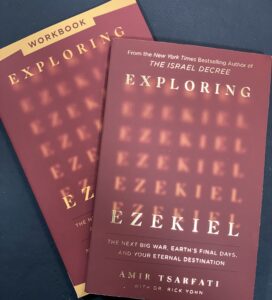
How to Lead a Small Group Using “Exploring Ezekiel” by Amir Tsarfati

Exploring Ezekiel Book and Workbook
by Amir Tsarfati and Dr. Rick Yohn

I had a reader ask, in a comment,
how I would use this pair in a small group Bible study.
I decided you deserved to see my answer. So here you go!

My answer is assuming you purchased at least one copy of the workbook.

If I were doing the study…

Week 1 would be introducing the material. 

I would either read (or have a few people read) the introduction of Exploring Ezekiel: “Who Is This God?”

Then we’d discuss what we’ve just read. I’d suggest the leader read it ahead of time to come up with prompts in case no one jumps in with their thoughts right away. (normal)

In the second hour, or at least the last half hour, I’d head over to the workbook and really look at “How to Use This Workbook.” 

It lays out a study path that many/most may not be familiar with, so it would be good to consider going over it, helping everyone understand it, and then perhaps practice applying this technique to a familiar passage of Scripture.

Ideally, everyone bought both the book and workbook. If this is the case, I’d suggest having everyone spend each week reading the chapter in Exploring Ezekiel and working in the corresponding chapter in the workbook.

Then, when you come back the next week, you have two hours in which you can discuss everyone’s thoughts and conclusions in depth. This is one of the most powerful aspects of group Bible study, because you never know when something someone else says will turn on a neon sign for you.

And, although you do want to keep things running properly and under control, don’t be surprised when you encounter the occasional rabbit trail. I’d suggest you be flexible enough that you can judiciously explore at least a little ways down those trails as you feel the Spirit lead you.

I’m excited for you and your friends!

If you decide to have a Bible study with these books,
I’m excited for you too! And I’d love to hear how it goes!

Celebrating Jesus!
Tammy C

When God Grows Your Faith

I’ve been thinking a lot about this quote from Hudson Taylor lately.

“There are three stages to every great work of God;
first it is impossible, then it is difficult, then it is done.”

God has been asking me to do things, lately, that seem impossible, so I guess it’s no surprise that this quote came to mind.

“What do you mean by ‘impossible,’ Tammy?”

I mean that, when you look at my circumstances and experience, God is literally asking me to do things I cannot possibly do. 

Have you ever considered something and, even as you thought, “No,” you undeniably heard God speak to your spirit a solid, “Yes”? I did earlier this month. On the outside I looked calm and collected. On the inside a battle raged. My flesh, which was being told to step out of the way, was in a heated argument with my spirit.

But my spirit was leaping up and down. God had spoken to me, clearly, about this specific situation. And when God speaks that clearly, not only am I limited to one option – obedience – but I also have a guarantee that He’s not going to let me fail.

My flesh didn’t believe a word of it.

Flesh: “But you know how you get when learning new things frustrates you; you shut down.”

Spirit: “Not this time! God’s standing right here assuring me I won’t!”

Flesh: “What about the financial commitment you’re making? You haven’t budgeted for anything like this!”

Spirit: “God has, obviously, or He wouldn’t be telling me to do it.”

During the battle I was reminded of both Hudson Taylor’s quote and something a character in a book once said. I can’t remember what he said, exactly, but it was along the lines of, “Of course I don’t know how God is going to work it out. That’s what makes it so exciting!”

Even then, the battle wasn’t over.

The next morning, I was still struggling, doubting that I was truly hearing from God, so I fell back on my tried-and-true decision making strategy. It’s a principle my pastor taught many years ago: God always leads with peace.

So, when faced with a hard decision, I decide. In this case (because I had a feeling it was the wrong choice), I first decided I wasn’t going to do it; I was going to pass up the opportunity I was being given. And I was filled with…complacency.

I will interject here that I’ve advised people about this process many times and I always explain that only God can give you peace; the closest the devil can get is complacency. I’ve never experienced it like this before, however. Generally, the wrong choice has resulted in a churning stomach.

But yeah, I felt total and complete complacency, like a sleeper who chooses to roll over and go back to sleep because he isn’t in the mood to face the day. It disturbed me so that I quickly decided to obey God.

Not only did peace instantly flood my soul when I said, “Yes,” to God: I got excited!

And then something occurred to me. Actually, I’m going to say God revealed it to me, because this is a thought I’ve never had.

We are to live by faith. We know this. Scripture after scripture tells us we’re to walk by faith, to grow and strengthen our faith, that we’re to have works associated with our faith, that we can’t please God without faith…

I’ll stop. But you get the idea.

My faith is as strong as it is because living with my husband required it. When you’re moving essentially from one crisis to another, either you’ll build your faith up or you’ll let yourself be torn down – and I was not going to let myself be torn down!

Even in the year after he passed, my faith grew as it was stretched by my financial and housing situations, but in the past year or so…not so much. And I didn’t realize it until recently, but that steady season had quietly allowed my faith muscles to relax. 

But, again, that’s not what we’re called to do. I have come to believe that, if we’re not consciously choosing to stretch and work our faith, which is what is required for it to grow, God will lead us into situations where stretching and building up our faith is a necessity.

Now that I think about it, this is the second time He’s done that in recent months. Something else happened a few months ago that demanded I put my faith out there and trust Him, and I was excited to find I was able, that I was looking forward to seeing how He would take care of things. I still am.

So…yeah… Faith – trusting God – is not just important; it’s essential. We can’t just say we trust Him; our lives have to show it. And when they do, He’ll often lead us straight into the impossible.

But once our focus is fully on Him, we’ll realize it was never impossible after all. It may be difficult, yes, but at some point…it will be done.

Celebrating Jesus!
Tammy C

The Victor’s Crown: Why Our Struggles Matter

“Why does life have to be so hard?”

Now there’s a question we’ve all asked more than once. Clearly, I don’t have the whole answer, but I saw something in the Word today that reminded me of one of the reasons life is hard.

Everyone goes through hard seasons. Mine may look different from yours, but they are hard nonetheless. This is a good fact to remember: Everyone around you is dealing with something, probably many somethings. Never assume your neighbor has it easy, because it’s highly likely they don’t.

Everyone goes through tests, trials, and temptations. How we respond to them matters. I’m speaking to Christians here, so I’ll leap right into temptation. Have you felt God prompt you to give up a habit and you’ve tried, but you just couldn’t do it – or did it for a time and then went right back to it?

I’m not even talking about outright sin here. My point is that any time God asks us to do something, or to stop doing something, and we are tempted to disobey, that is a test. Our flesh may be testing us, or demonic influences might be pushing the temptation our way. Regardless, it’s a test.

Now look at James 1:12 in the New Living translation:
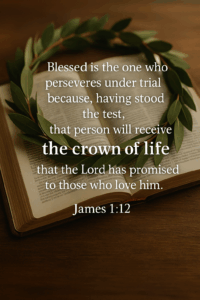
“God blesses those who patiently endure testing and temptation. Afterward they will receive the crown of life that God has promised to those who love him.”

I went to the Renner Interpretive Version: James & Jude for Rick Renner’s notes on this crown of life and he explains that “crown,” the word James used here, referred to a victor’s crown such as those given to winning athletes. These crowns made of laurel wreaths marked them as people to be esteemed and honored; they also guaranteed the winner would be provided for for the rest of his life. 

But James didn’t stop there. He called it the crown of life or, properly translated, the victor’s crown of zoe life which, according to Renner, “brings a physical and spiritual reward, both in life now and for all eternity.”

This is clearly something that is not to be taken lightly!

But we have to remember where we started.
“God blesses those who patiently endure testing and temptation.”

Now let’s look at this verse in two other translations.

James 1:12 (NKJV) – “Blessed is the man who endures temptation; for when he has been approved, he will receive the crown of life which the Lord has promised to those who love Him.”

James 1:12 (NET) – “Happy is the one who endures testing, because when he has proven to be genuine, he will receive the crown of life that God promised to those who love him.”

How we deal with test/trials/temptations is what determines whether or not we are approved, whether or not we have proven ourselves to be true lovers of God.

Am I saying those who fail aren’t saved? Not necessarily, no. I’m saying that when a runner enters a race he goes in with his eyes wide open, knowing he will be tested to his limits. He may face distractions, bumps in the road, weather issues, interference by other runners, and major objections from his own body.

He will face the temptation to slow down, with a voice whispering that second or third place wouldn’t be so bad. He will face the temptation to throw up his hands and quit. But if he wants to win, he determines in his heart that we will press on through to the end no matter what obstacles are in his way.

This is what the Apostle Paul did. In 2 Timothy 4:7 he explains to Timothy that he knows his time is up, that he won’t be alive much longer, and he assures this one who was like a son to him that:

“I have fought the good fight, I have finished the race, I have kept the faith.”

We know from his own accounts and history that Paul faced more trials, tribulations, and temptations than most of us can conceive, but he ran his whole race determined that, no matter what he faced, he and God would win.

Those tests, trials, and temptations give us the opportunity to prove that our love for God is real, not just something we feel when life looks good. They also, according to James 1:2, help us grow into maturity.

Yes, life can be hard, but we can be strong. If Paul did it, we can too.

Celebrating Jesus!
Tammy C

Hungry for God? Bought a Bible? This is for You.

Someone posted, this morning, that their local Books A Million was completely sold out of Bibles. It shouldn’t have surprised me, considering the reaction to Charlie Kirk’s assassination. I’d already been wondering how many would start digging into the Word. That they are seeking God like this is phenomenal news!

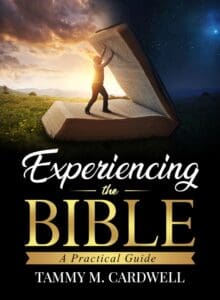
If you are one who is just picking up the Bible (or you know someone who is) I suggest you grab a copy of my book, Experiencing the Bible. I wrote it with you in mind.

Seriously. My thought, as I worked on it, was, “How can I help those who are being told, ‘Pick up your Bible’ or ‘Get into the Word,’ but they’re not being told how?” In Experiencing the Bible, explain.

Yes, I am the author, but I’m not ashamed to say it’s a great book that will be a real help!

Celebrating Jesus!
Tammy C

I’ve included the Amazon link above,
but the ebook version is also available in most popular ebook markets.

How Readers are Experiencing the Bible in a Whole New Way

Available in Paperback, Audiobook, and Ebook

When I first released Experiencing the Bible, my prayer was that it wouldn’t be just another book on the shelf, but would instead become a companion that would inspire believers to fall in love with the Word of God. I wanted it to feel practical, personal, and encouraging, like I was sitting down with you letting you know that, “You can do this! Here’s how.”

The most humbling thing has been hearing back from readers about how it has impacted them. Today I’d like to share some of their words with you.

Inspired to Go Deeper

Peg wrote:
Her comments about reading through the WHOLE Bible have inspired me to start reading through the whole Bible, too, because it feels like I tend to reread only certain books. She explains how reading the WHOLE Bible helps you see a bigger picture of what God is doing and how the books come together to tell His Story.

This is exactly the sort of thing I was hoping to hear, that my readers would be nudged toward a bigger view of Scripture and a richer relationship with God.

Practical and Easy to Use

Yvonne shared:
Tammy Cardwell does a great job of explaining things in an easy to understand way. She gives you her thoughts and also gives you room for you to write yours. I really like the fact she lists different Bible types & different resources to help you in your walk with the Lord.

And Charlotte wrote:
I received this book as a gift for Christmas. I’m blown away! I appreciate the space to journal right here in the book. Knowledge and insight from the author is powerful. I am delighted to read and write about Gods promises for me.

I love hearing this, because a huge purpose in the book’s layout was to provide you the space to interact with Scripture in your own words!

Unputdownable!

Sherri said:
I found while reading your book that once I started reading it, I had a hard time putting it down. It is very much worth the read.

Sheri kept it simple:
Love this study!

I can’t tell you how much it blesses me to learn that people not only start the book, but want to keep going. I feel like I’ve helped friends along a life-changing journey.

Life Impact Beyond the Page

One of the most unexpected, and moving, testimonies came from Nancy Higgins, my audiobook producer. While recording and editing, she discovered something powerful.
Although I have often prayed Scripture out loud, something in my home shifted as I read your book out loud. God moved. Then every time the Word was played back out loud while I was editing, it cleared the air again. Wow, so thankful to have had the privilege of working on this project!!

Hearing how God used His Word, simply spoken aloud for my audiobook, to bring peace to a home… That’s priceless!

Readers are Sharing it with Others

Finally, I loved this encouragement from Tab:
For anyone looking to read and learn about the Bible I’m telling you now this is one book you will want to read. You should get one for you and a friend.

That’s the heartbeat of this project: helping people walk closer to God through His Word, and encouraging them to share that journey with others.

Ready to Experience the Bible for Yourself?

If you’ve ever felt like reading the Bible was hard or confusing, if you don’t know where to start, or if you simply want read the Word with fresh eyes, Experiencing the Bible was written with you in mind. It’s available now in paperback, audiobook, and ebook.

Get your copy on Amazon.

The ebook is also available in most of your favorite ebook markets.

If you’ve already read it, I’d love to hear your story. Your testimony may well inspire someone else to dive into the richness of God’s Word!

Celebrating Jesus!
Tammy C

Living Your Witness: The Quiet Power of Influence

Do you ever think about those who have especially impacted your life?

For me, while untold numbers of people have helped me grow, three people stand out, people who have left eternal marks on my soul and had a definite impact on the direction my spiritual walk has taken. What strikes me about all three is that they weren’t preaching at me. They were simply living their witness.

Three People Who Changed My Walk

The Best Friend – Joy in the Spirit
Marilyn, my best friend, never tried to “sell” me on anything. She simply shared her excitement about what God was doing in her life. I’d been saved years earlier but wasn’t actively living like a Christian. I was what I call a “cultural Christian” at that point.

Her joy stirred a hunger that made me face my mostly in name only Christianity and recognize its inadequacy, how little it satisfied me. She expected me to get excited too, and I did.

The Stranger – Baptism in the Holy Ghost
At a Christian Student Union meeting Ms. Jeannie, a woman I’d never met, taught me about and led me into the baptism in the Holy Ghost. She was our speaker that night and I could tell she was like my best friend in that she had “it.” In spite of my introversion and insecurity, I’d gathered my courage and asked her, “What is the baptism in the Holy Ghost?”

The conversation we had, and the prayer we prayed, changed my life forever. And I’m happy to be able to report that she became a dear friend and is still a vital influence in my life.

The Evangelist – Intimacy with God
The last of my three, Jesse Duplantis, is an evangelist. His messages are always great, but his almost casual references to his conversations with God made me hunger for that kind of walk:

“I want that type of relationship with You, God!
You’re no respecter of persons.
I want that intimate relationship too!”

So I got in the Word more, prayed more, and focused on listening for His “voice,” God speaking directly to my spirit. Over time, that intimacy became my reality – and I love how we talk to each other all day long.

The 1 Thessalonians 5:17 command to pray without ceasing? This is it. Yes, I have a set time that I know I’ll be praying, talking to God about things that matter to us both, but the conversation doesn’t stop there.

The Quiet Power of Living Faith

Other than Brother Jesse, these are normal people you’ll most likely never meet, but their influences in my life still affect how I live and what I share with others.

And those key people reached me not through preaching at me, but by letting me see the reality of God in their lives, by giving me glimpses of possibilities I’d not imagined.

They also taught me one of the most important things about sharing the Gospel.

We start by living it.

Marilyn, Ms. Jeannie, Brother Jesse…
“I thank my God upon every remembrance of you.”
Philippians 1:3

Celebrating Jesus!
Tammy C

The Bondservant’s Choice: A Deeper Look at Commitment to Christ

Many years ago, when it first became fashionable for men to get ear piercings, I was told it was an ungodly practice because, “In the Bible, only slaves got their ears pierced.” I don’t remember having had an opinion one way or the other at that point, but once the Bible had been brought into the conversation so definitely, I decided to check it out for myself. What I found was truly fascinating.

This person was correct about the piercing of the ear marking someone as a slave, but their surface level interpretation was lacking. In Exodus 21:2-6 we learn what it meant to become a permanent slave or bondservant. One who had worked his full six years as a slave would be set free in the seventh year. However, if this man loved his master and wanted to continue serving him permanently, he could choose to do so. When he did, he was taken before the judges to testify to his wish and then his ear was pierced as a permanent mark of his freewill choice.

So yes, his ear was pierced to mark him as a slave or bondservant, but it was by choice and a decision made out of love for someone he wanted to devote his life to. This all reminded me of New Testament authors referring to themselves as slaves or bondservants of Jesus Christ. Thinking back to the person’s statement, I had to laugh because, by their reasoning, every man who has genuinely committed to serve Jesus should be required to get his ear pierced.

No, I did not seek them out to correct their wrong assumption. It seemed pointless.

So fast forward to today, or recently when I began reading from Rick Renner’s new offering, the Renner Interpretive Version: James & Jude. If you’re unfamiliar with Renner and this first step towards a complete Renner Interpretive Version of the New Testament, know that this man has a firm grasp not only on the Koine Greek, but on the cultural significance and application of the original language. Where I could technically look up the Greek word and its literal meaning, Rick Renner’s knowledge goes deeper, into how the original reader would have received the words.

So let’s look at the first part of James 1:1.
In the King James, it reads, “James, a servant of God…” But in the RIV we get…

I am James, first, foremost, and forever a completely committed, lifelong servant of God. As is the case with all such servants, this means my life is dedicated exclusively to doing His will and to faithfully carrying out any assignment He will ever entrust to me.

I only thought I understood what it meant to be a bondservant when I read Exodus 21 all those years ago. I mean, I did understand it in a sense. Everything James says here is included in what I had learned intellectually. I knew it was the servant’s choice. I knew it was a lifelong commitment. I also knew such a servant had one primary purpose in life, and that was to fulfill the will of his master. Seeing it expressed in such a new way, however, and from James, who didn’t believe his brother’s claims until after the Resurrection, hit me firmly in the heart. Can I say the same? Could I honestly speak the words James penned?

I’ve maintained for years that for a man to call himself a Christian while living a life that is not truly dedicated to Christ is a violation of the commandment, “Thou shalt not take the name of the Lord thy God in vain.” Looking at Christianity in light of the way this version presents this verse makes my conviction even stronger. Let’s break it down.

first, foremost, and forever

Is my commitment to God, to Jesus, the first thing I think about? Is it always foremost in my mind, and what inspires all my actions? Is it unconditionally forever? Absolutely yes to the last question; I’m in this for eternity! However, I must really examine myself when it comes to “first and foremost.” I say God is my #1 and He is, but I would be lying if I implied that my flesh doesn’t rise up on occasion, that self never demands to be first in line. Unfortunately, I’m not perfect and I battle self on an ongoing basis. When I lose the battle what do I do? Repent, and determine to do better next time.

a completely committed, lifelong servant of God

I am committed. I am completely committed to squash self and the flesh. I sometimes fail, but the commitment is there, and it is eternal. As we’ve already established, my heart is set to serve God throughout this life and forever.

Next he goes deeper. “As is the case with all such servants,” he says, “this means…”

my life is dedicated exclusively to doing His will

Here we go. All bondservants choose in advance to dedicate their lives to doing the will of their master and only the will of their master. There is no picking and choosing. I can’t say, “God, that other thing you told me to do? I am all in on that, but please don’t expect me to do this!” Well, I can say it. In fact, I have said it during some of our honest and occasionally gut-wrenching conversations. It’s at times like this that I truly appreciate the fatherhood of God, because He has an ability to be loving and merciful while also being decisive and firm that earthly fathers could really learn from. Generally, He sets me right and, when I obey, I see joy in that obedience. When I don’t obey, that’s when He calls me to repentance and, occasionally, gives me an opportunity to make things right. (At other times, I have to face the natural consequences of my disobedience, but that’s a topic for another day.)

and to faithfully carrying out any assignment He will ever entrust to me

I really appreciate the way this is phrased, because it reiterates the fact that I made the decision in advance when I chose to accept Jesus as my Lord and Savior. As my Lord, He has the right to give me any assignment, to tell me to do anything. As one who has, of my own free will, accepted His lordship, I have the responsibility to do anything He ever asks of me at any point today or in the future. In thinking about this, I’m reminded of Abraham’s reaction when God told him to go to the mountain and offer Isaac up as a sacrifice. Talk about a stomach-churning command! But Abraham had already established his relationship with God and wasn’t about to disobey. God, of course, provided the substitute sacrifice once Abraham demonstrated his commitment – and this proved to be a foreshadowing of what would transpire later at Calvary. What would have happened if Abraham had refused?

So yes, I too am a servant of God, a bondservant of Jesus Christ. An imperfect servant? Oh yeah, but I strive to keep my heart right at all times and I look forward to an eternity of carrying out any assignment He will ever entrust to me.

What about you?

Celebrating Jesus!
Tammy C

You may wish to read my review of the Renner Interpretive Version: James & Jude.