Why the Word? It Restores the Soul

Open Bible with ribbon bookmark, titled “Why the Word? It Restores the Soul,” representing a Christian teaching series on staying in Scripture.

The Law of the LORD is perfect, restoring the soul;
The testimony of the LORD is sure, making wise the simple.
Psalm 19:7 (NASB2020)

Your soul is what makes you you. Generally referred to as the “mind, will, and emotions,” your soul is one third of who you are: Spirit, Soul, and Body.

And I have a true example to share that illustrates just how well the Word of God restores the soul.

There is a man I’ve known about 40 years. I met him at church, and it became quickly apparent that he was quick witted and highly intelligent. In conversation, he once explained that this hadn’t always been the case.

According to him, when he got saved he’d been so destroyed by drugs that he didn’t have two brain cells to rub together. But he heard that the Word of God has the power to restore the soul and he took that promise literally. He dove headfirst into the Bible and has never left it.

The Word of God restored—repaired, revived, converted, refreshed, renewed (depending on your translation)—his soul. It also “made wise the simple,” as it declares at the end of Psalm 19:7.

His is a dramatic account, but yours can be too. If you feel like you’re not smart enough or don’t have the brainpower to read the Bible, remember that he didn’t either. Sometimes you simply have to step out in faith and ask God to teach you as you read.

It does help to find a translation you can relate to. I have sixteen Bibles in eleven different translations, and each of those translations serves a purpose.

  • Most of the scriptures I have memorized are from the King James Version, because its poetic nature makes memorization easier—for me anyway.
  • If I’m doing a straight readthrough, my go-to is the New Living Translation, because it’s the closest to the way I think and talk.
  • If I want a better grasp of how an Israelite would have read a passage, I grab either my Complete Jewish Study Bible or The One New Man Bible.

Intimidated yet?
Don’t be.

My first Bible, or the first one I really used, was a New American Standard, and I can tell you that the 2020 edition of that Bible (NASB2020) is one of the best. That might be the prime choice for you. 

My point is that, if you’re new to the Bible, you’ll find it easier to understand if you choose the right translation. With internet access, that’s a piece of cake. All you need to do is head to blueletterbible.org and use their tools to start comparing Bible translations.

It seems almost too simple to say the Bible restores your ability to think and reason, but I’ve seen proof of this truth time and time again. And it does a lot more, as we’ll see while working through this series.

Truly getting into God’s Word is a life-changing experience. The more time I spend with my Bible, the more I grow in every way—and the hungrier I get.

Stay in the Word—and let the Word stay in you.

Celebrating Jesus!
Tammy C

Why the Word? Series Introduction

Open Bible with ribbon bookmark, titled “Why the Word? Series Introduction,” representing a Christian teaching series on staying in Scripture.

Can we get real for a minute?

Most of us don’t have a problem with owning a Bible; we may even have several. What we can find challenging is making the time to actually open it up and dig in. 

I used the phrase “making the time” intentionally, because this isn’t about finding the time for something we want to do; it’s about intentionally setting aside the time for something that is essential to our spiritual health.

“I know I should, but…”

How many times have I heard a diabetic use these words in reference to watching their sugar intake? Eating excessive sugar could kill them, and yet many struggle to stop.

The same principle applies in all areas of life.
“I know I should exercise, but…”
“I know I should call my mom regularly, but…”
“I know I should study, but…”

Don’t exercise—hurt your body.
Don’t call your mom—hurt your relationship.
Don’t study—hurt your GPA.

Don’t spend regular, intentional time in God’s Word and you hurt your spirit man—the part of you that is meant to be alive and responsive to God. How can we expect to successfully fight our flesh (which, honestly, is our worst enemy) if we consistently starve our spirits?

I mean that seriously. If you wonder why you keep fighting the same old battles with your flesh, you need to take a good hard look at what you’ve been feeding your spirit. And if you’ve been thinking sitting in a church pew was enough to keep your spirit man alive, you are sadly mistaken.

And I am officially at risk of launching into the series right here and now. I can’t do that, but I will do this. There are myriad scriptures that talk about the importance of being in God’s Word and having it live in you, and there’s no time like the present to get started.

You can study up on why you should be studying.
And here’s a list of pertinent references to get you started.

You don’t need to read these all at once.
Choose a section, read thoughtfully,
and ask God to speak to you through His Word.


The Value & Power of God’s Word
Psalm 19:7–11
Psalm 119:105
Psalm 119:160
Proverbs 30:5
Isaiah 55:10–11
Hebrews 4:12


Loving, Meditating on, and Delighting in the Word
Joshua 1:8
Psalm 1:1–3
Psalm 119:15–16
Psalm 119:97
Psalm 119:103
Colossians 3:16


Learning, Teaching, and Passing on the Word
Deuteronomy 6:6–9
Deuteronomy 11:18–21
Psalm 78:5–7
Proverbs 4:1–7
Matthew 28:19–20
2 Timothy 2:2


Hearing and Receiving the Word
Nehemiah 8:1–3, 8
Matthew 4:4
Matthew 11:15
Luke 8:15
Romans 10:17
1 Thessalonians 2:13


Abiding, Remaining, and Staying in the Word
John 8:31–32
John 15:7
Acts 2:42
1 Timothy 4:13
2 Timothy 3:14–17
1 John 2:14


Obeying and Living Out the Word
Deuteronomy 30:14
Psalm 119:9
Matthew 7:24–27
Luke 11:28
James 1:22–25
1 John 5:3


The Word as Protection, Guidance, and Strength
Psalm 119:11
Psalm 119:130
Proverbs 2:1–6
Ephesians 6:17
Colossians 1:9–10


Warnings Against Neglecting the Word
Hosea 4:6
Amos 8:11
Matthew 13:19–23
Hebrews 2:1
Hebrews 5:11–14
2 Timothy 4:3–4


Scripture About Scripture
Psalm 119 (entire chapter)
Romans 15:4
1 Corinthians 10:11
2 Peter 1:19–21
Revelation 1:3


I’ll see you next week with the next installment!

Stay in the Word—and let the Word stay in you.

Celebrating Jesus!
Tammy C

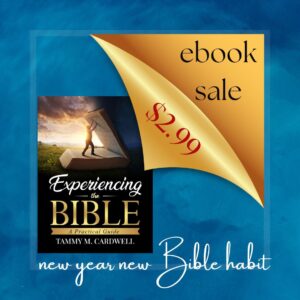
New Year, New Bible Habit-Experiencing the Bible eBook on Sale

Experiencing the Bible is available in
print, eBook, and audiobook.

A new year is the perfect time to build a fresh Bible habit—but it doesn’t have to be overwhelming.

Experiencing the Bible was written to help everyday believers move beyond “checking a box” and into truly engaging with God’s Word in a meaningful, sustainable way.

For a limited time, the eBook is on sale for just $2.99 (regularly $4.99).

If you’ve been longing for a deeper, more consistent time in Scripture, this is a great place to start.
New year. New habit. Same faithful God.

Grab your copy today!

Celebrating Jesus!
Tammy C

Trust the Process

DIY shelving unit reminding us to trust the process step by step

Sometimes things don’t look right mid-process,
but that doesn’t mean they won’t fit in the end.

Have you ever assembled a piece of boxed furniture?

I have, several times. It’s amusing, I suppose; I don’t have the patience required to refinish the beautiful wood pieces I instinctively love, but I can sit down with a couple screwdrivers and “build” these pieces without a problem.

The funny thing is that, with pretty much everything I’ve ever assembled, I’ve hit a spot where I honestly thought it wasn’t going to come together right. It happened again yesterday, while building the unit in this picture. I sat staring at it, debating whether I could safely move ahead.

I was following the instructions to the letter (and the diagrams). I even went back through to ensure I’d not skipped something somewhere, but it looked like the next step was going to throw off the fit.

And I heard God whisper, “Trust the process.”

So that’s what I did. I chose to trust that I’d done everything correctly and what I saw as an issue would correct itself when I made the next move. It did, of course, and now I have better organization in my makeup area as well as room for more books in my primary bookcase.

And I have another object lesson to add to my collection–another reminder that all I have to do is follow the directions God gives me, step by step, and trust the process. Proverbs 3:5-6 has served me well for years.

Trust in the LORD with all your heart, and do not rely on your own understanding. Acknowledge him in all your ways, and he will make your paths straight.

We instinctively want advance warning about what’s around the next corner, detailed directions from our current location to our destination. But God isn’t like GPS apps, and our ultimate destination is so far down the road that we’d be overwhelmed.

The most important part of our relationship with Him is trust (AKA faith), and He will allow us to go through various experiences so we can build our faith and come out stronger. Our spiritual growth is a process, and as His kids we need to trust Him–and trust that process.

When we do, everything fits together perfectly. The final product may not be what we were expecting, but it will always be what He wanted for us.

Trust the process. Trust Him.

Celebrating Jesus!
Tammy C

God Doesn’t Want Volunteers Part 3

Copyright Jennifer Jones Manley

What DOES God Want?

Ephesians 2:10

For we are God’s masterpiece. He has created us anew in Christ Jesus, so that we can do the good things he planned for us long ago.

We have been created anew in Christ Jesus to do good things. Other translations say “good works.”

When being encouraged to do good works, some people answer by quoting Ephesians 2:8-9. (KJV For by grace you have been saved through faith, and that not of yourselves; it is the gift of God, not of works, lest anyone should boast.) Yes, we are saved by grace, through faith and not by our works; salvation is a gift. Now, if those who quote verses 8 and 9 would only continue to verse 10, they would see why God gave us the gift— “to do the good things he planned for us long ago”. God doesn’t give useless gifts; He gives gifts with a purpose. Knowing this, we realize we are responsible to find out what His plans for us are and to follow through and do what He expects us to do. As Ephesians 5:17 puts it, “Don’t act thoughtlessly, but try to understand what the Lord wants you to do.”

God prepared these works in advance, expecting us to do them. How much clearer can it get? God had a plan in mind, works lined out for each one of us, even before we accepted His gift of salvation. Now it’s our turn. Now it’s time for us to learn what those works are, pull ourselves together, and go get them done.

This is not merely something we can do; it is something we must do if we are to be pleasing to Him. After all, His Word says repeatedly that faith without works is dead. (James 2:17, 20, 26; KJV; Thus also faith by itself, if it does not have works, is dead… But do you want to know, O foolish man, that faith without works is dead?… For as the body without the spirit is dead, so faith without works is dead also.) Too, without faith it is impossible to please God. (Hebrews 11:6, KJV, But without faith it is impossible to please Him…)

Celebrating Jesus!
Tammy C

God Doesn’t Want Volunteers

What is a Volunteer?

Jesus often used illustrations a gardener could easily understand. In looking at volunteers it seems particularly appropriate to follow His example. So, let’s imagine the life of a certain volunteer plant.

There was once a volunteer plant. Like all volunteer plants, it popped up in an unexpected location. Some animal carried a seed into a side yard and dropped it, and there it grew. When the gardener found it, he had to make some decisions.

Should he move it to the garden where it could grow as he’d intended and receive all the right care? No, the plant had set its roots firmly right where it was; it would not be shifted to a more appropriate location.

Would it be best for him to cut this plant down so that it would not hinder the growth of the plants he had selected specifically for this area? He did not like this idea at all, for it was a nice enough plant and there was some hope that it would bear decent fruit even here, where it wasn’t supposed to be.

So the gardener chose not to cut it down, but to watch and ensure that it did not too greatly hinder the growth of the plants around it. If it proved too much of a danger, if the fruit it might one day produce seemed not to be enough to outweigh the damage it could cause, he would remove it.

So it remained where it had planted itself, though the gardener was never fully happy and kept a cautious eye on it always. He watched as it grew. He watched as it flowered. He watched as it produced fruit. He watched as it died.

The gardener had managed to minimize the damage this volunteer plant did to its companions. He had also harvested the fruit it produced, though this fruit was disappointing when compared to the fruit of similar plants that flourished in the other part of his garden. The gardener was sad as he disposed of its dead remains and considered what this plant could have been, what fruit it would have produced and how much better off both sections of his yard would have been, if it had only put its roots down where it belonged.

The gardener, of course, is God. The volunteer plant is the Christian who is a mere volunteer, one who does not understand the call of God, one who chooses where he will go and how he will serve instead of letting God plant him in the proper spot and serving as God calls him.

A mere volunteer goes where he wishes to go, offers only such assistance as he is inclined to offer, and remains only as long as he wants to stay. He may choose to plant himself in the very place God would have put him, but if his heart is not right or if his chosen place of service is not what God has planned for him, there will be problems. He may be of some benefit in this area where he chooses to plant himself, but he will never be all God wants him to be.

The Christian who plants himself in a location other than the one God has chosen for him will have, and cause, special problems because he is not where God wants him to be—in that place set aside for him where he can do the special work God has already prepared for him to do. (Ephesians 4:16, KJV, from whom the whole body, joined and knit together by what every joint supplies, according to the effective working by which every part does its share, causes growth of the body for the edifying of itself in love.)

He cannot help this alternate location as well as one who is called to it, and it is entirely possible that his presence will eventually prove harmful—to himself, to those around him, perhaps to both. He may manage to live the entirety of his days in this one, wrong spot and he may be happy, but he will never be fulfilled because he will never become all God has ordained him to be. Worse, the body will never be all it is supposed to be, because he is out of place.

When you consider plants, there is really only one difference between a volunteer plant and a weed. The volunteer plant is a cultured plant, one that is designed to serve a purpose. God obviously doesn’t want weeds in His garden. He also doesn’t want His cultivated plants putting their roots down in places not of His choosing.

A volunteer, according to the dictionary, is one who enters into an activity of his own free will. A mere volunteer not only enters of his own free will, but retains the right to free will, the right to say, “You can’t expect me to do that; I’m only a volunteer!” He will work only as hard as he pleases, do only the jobs he chooses to do and stay only as long as it suits him. He persists in thinking that it’s all about him, when in reality it’s all about HIM.

What DOES God Want?

Ephesians 4:16
Under his direction, the whole body is fitted together perfectly. As each part does its own special work, it helps the other parts grow, so that the whole body is healthy and growing and full of love.

Under his direction
These first three words are the key. We must submit to Him as part of His body, completely under His direction. If we won’t be under HIS direction, totally submitted to HIM, why do we call ourselves Christians? To be called a Christian is to be called Christ Like, and Jesus Christ was so completely submitted to His heavenly father that He willingly took the unimaginably horrendous path to the cross.

So, as we are under His direction

the whole body
the whole body, every part of it, is “fitted together perfectly.”

is fitted together
“is fitted”
This phrase is in the passive voice, which shows that it isn’t the body that is doing the fitting together. The “fitting together” is being done to the body by God. (I Corinthians 12:18, KJV But now hath God set the members every one of them in the body, as it hath pleased Him.)

When we are under His direction, allowing Him to fit us together—letting Him put us where He wants us instead of insisting on putting ourselves where we want to be—we will be fitted together perfectly.

as each part does
Every part of the body has work to do. If a part of the human body refuses to work, the whole body suffers. The same is true of Christ’s body. We are not just here to be. We are here to do. (Ephesians 2:10, KJV, For we are His workmanship, created in Christ Jesus for good works, which God prepared beforehand that we should walk in them.)

its own special work
God gives each of us work to do and we can either do that work or not do it. If we choose to do our work, we are free to choose whether to do it well or poorly. If we choose not to do our work, we are free to choose whether to do nothing or to do someone else’s work instead.

We’ve a world of choices and only one is acceptable—to do that special work that God has set aside specifically for us. To do anything else is to fail Him, the body, and ourselves.

This even holds true when we decide to do ‘extra’ work. While being faithful to our own special work, we might still have enough time that we choose to go help another part of the body as well. This can be a wonderful thing, but if we move against His direction, stepping out on our own accord, the whole body will suffer.

This is not to say a man cannot be active in more than one ministry. If God directs him to serve in multiple areas, God will also orchestrate his service. If, however, he chooses to serve in multiple ministries against God’s direction, he is asking for trouble to visit not only him, but every ministry he touches.

We each have our own special work to do and He expects us to do it and do it with excellence!

it helps the other parts grow
What a gift! Can anything greater be said of a man than that he helps others grow? No. Here is a promise, a result, worth working toward!

And, to consider this from the other side, if this member of Christ’s body chooses not to be under His direction, not to fit in his assigned spot perfectly, not to do the special work God has assigned specifically to him, then he will inevitably hinder the other parts in their growth.

How much better it is to do what we know to do and do it in the way God intends!

so that the whole body is healthy
This is one third of what should be our goal, and is God’s goal, for the body of Christ—that we as the body be healthy and growing and full of love.

Unfortunately, though many individual churches are healthy, this cannot be said of the church as a whole, at least not here in the United States. Many churches have experienced splits and too often church members are not surprised when they learn of other members’ immorality. One can also find church buildings for sale in this nation that are available for purchase not because the churches have grown too large for them, but rather because they’ve died.

and growing
Obviously, if the church as a whole is not healthy, it is also not growing. I was somewhat surprised at one point, though I wasn’t too very shocked, to hear my pastor say in a sermon that the church in the U.S. has not grown since the 1970s. If this is true, something is obviously wrong.

and full of love
This, perhaps, is the saddest thing of all. God is love; you would think that His church would necessarily be full of love, but in how many churches will you find no gossip, nomurmuring, no backbiting, no complaining… If a church is truly full of love, there is no room for these things.

So we, the body, fail the test. We are not fitted together perfectly, with each part doing its own special work. Why?

Because too many of us have never learned the difference between being a volunteer and being a called out, chosen one—the difference between one who casually offers, “I’ll do it,” knowing he has the option of quitting later, and the one who answers the call of his Lord, fully prepared to do anything and everything he is told to do. If the church is to be healthy, to grow and to be full of love, we as individuals must grow up first, moving beyond “I’m only a volunteer!” and into “I am a called out child of God who will fulfill my destiny!”

Ephesians 2:10
For we are God’s masterpiece. He has created us anew in Christ Jesus, so that we can do the good things he planned for us long ago.

We have been created anew in Christ Jesus to do good things. Other translations say “good works.”

When being encouraged to do good works, some people answer by quoting Ephesians 2:8-9. (KJV For by grace you have been saved through faith, and that not of yourselves; it is the gift of God, not of works, lest anyone should boast.) Yes, we are saved by grace, through faith and not by our works; salvation is a gift. Now, if those who quote verses 8 and 9 would only continue to verse 10, they would see why God gave us the gift— “to do the good things he planned for us long ago”. God doesn’t give useless gifts; He gives gifts with a purpose. Knowing this, we realize we are responsible to find out what His plans for us are and to follow through and do what He expects us to do. As Ephesians 5:17 puts it, “Don’t act thoughtlessly, but try to understand what the Lord wants you to do.”

God prepared these works in advance, expecting us to do them. How much clearer can it get? God had a plan in mind, works lined out for each one of us, even before we accepted His gift of salvation. Now it’s our turn. Now it’s time for us to learn what those works are, pull ourselves together, and go get them done.

This is not merely something we can do; it is something we must do if we are to be pleasing to Him. After all, His Word says repeatedly that faith without works is dead. (James 2:17, 20, 26; KJV; Thus also faith by itself, if it does not have works, is dead… But do you want to know, O foolish man, that faith without works is dead?… For as the body without the spirit is dead, so faith without works is dead also.) Too, without faith it is impossible to please God. (Hebrews 11:6, KJV, But without faith it is impossible to please Him…)

Ephesians 4:1
Therefore I, a prisoner for serving the Lord, beg you to lead a life worthy of your calling, for you have been called by God.

The question is not, “Am I called?” but rather, “What is my calling?” Speaking specifically in the realm of the church, we must ask, “To which local church has God called me? To which ministry or ministries within that church has God called me?” We are to seek the answers to these questions and, having found them, lead lives worthy of His calling.

The Word is specific here as it refers to “your calling.” So first we are called with a specific calling. No man should walk in another man’s calling; God expects each man to walk in his own. A man’s flesh may declare that it wants to work in one ministry, but if God has called him to work elsewhere he would be walking in disobedience if he chose to follow his flesh’s lead—this would certainly not be an act of a life that was being lived worthily.

And we must consider carefully what it is to lead a life worthy of one who is called by HIM.

If one were called by the President—that is, if the President of the United States were to call on a man to do something—one assumes that he would not only do it, but do it to the very best of his ability. Who in their right mind would consider giving the President of the United States anything less than work of the highest quality? But we are not called by the President. We are not called by any mere man. Rather, we are called by GOD.

How is it, then, that we too often offer Him second or even third best…or nothing at all? Do we consider Him to be less important than the President? Do we subconsciously take advantage of His quickness to forgive? Do we find that, since we can’t see Him with our physical eyes, it is easier to ignore the fact that He is there and waiting for us to move, waiting for us to do (and do well) what He has called us to do?

When God calls us to a local church, He expects us to be active in that church. (Hebrews 10:25, KJV, …not forsaking the assembling of ourselves together, as is the manner of some, but exhorting one another, and so much the more as you see the Day approaching.) When He calls us to a specific ministry, He expects us to serve actively in that ministry—being where we are supposed to be when we are supposed to be there and doing all we are supposed to do to the best of our ability, with the right heart.

He has given us the great honor of calling us; it is also our honor to live lives worthy of this calling.

What Does God Want?

            God wants children who love Him above all else, children who obey Him completely, children who walk with Him—following His lead instead of choosing their own paths and expecting Him to bless them anyway—children who not only know Jesus as Savior, but also as Lord.

God wants children who understand the truth of the words spoken to King Saul, that obedience is better than sacrifice, that He will not condone us doing things our way even if our way does look good in man’s eyes and seems to result in great things for the church.

God wants children who follow in the footsteps of Jesus, the One who did and said, and only did and said, what the Father wanted, who obeyed all the way to the cross and beyond when His Father called.

God wants children who don’t say, “I have decided I want to…,” but say instead, “I have decided to do what God wants me to do.”

God wants
sons and daughters
who understand what it means to be CALLED.

Scriptures Referenced
I Corinthians 12:18
Ephesians 2:8-10
Ephesians 2:10
Ephesians 4:1
Ephesians 4:16
Ephesians 5:17
Hebrews 10:25
Hebrews 11:6
James 2:17, 20, 26

Celebrating Jesus!
Tammy C

(Initially published in booklet format, then as a series of 5 blog posts in 2015.)

How to Lead a Small Group Using “Exploring Ezekiel” by Amir Tsarfati

Exploring Ezekiel Book and Workbook
by Amir Tsarfati and Dr. Rick Yohn

I had a reader ask, in a comment,
how I would use this pair in a small group Bible study.
I decided you deserved to see my answer. So here you go!

My answer is assuming you purchased at least one copy of the workbook.

If I were doing the study…

Week 1 would be introducing the material. 

I would either read (or have a few people read) the introduction of Exploring Ezekiel: “Who Is This God?”

Then we’d discuss what we’ve just read. I’d suggest the leader read it ahead of time to come up with prompts in case no one jumps in with their thoughts right away. (normal)

In the second hour, or at least the last half hour, I’d head over to the workbook and really look at “How to Use This Workbook.” 

It lays out a study path that many/most may not be familiar with, so it would be good to consider going over it, helping everyone understand it, and then perhaps practice applying this technique to a familiar passage of Scripture.

Ideally, everyone bought both the book and workbook. If this is the case, I’d suggest having everyone spend each week reading the chapter in Exploring Ezekiel and working in the corresponding chapter in the workbook.

Then, when you come back the next week, you have two hours in which you can discuss everyone’s thoughts and conclusions in depth. This is one of the most powerful aspects of group Bible study, because you never know when something someone else says will turn on a neon sign for you.

And, although you do want to keep things running properly and under control, don’t be surprised when you encounter the occasional rabbit trail. I’d suggest you be flexible enough that you can judiciously explore at least a little ways down those trails as you feel the Spirit lead you.

I’m excited for you and your friends!

If you decide to have a Bible study with these books,
I’m excited for you too! And I’d love to hear how it goes!

Celebrating Jesus!
Tammy C

Healing Takes Time

One of my TikTok videos resulted in a strong response from victims of narcissist abuse. That response led me to take my Surviving Narcissism series, at least in part, to the app.

My goal in life, and on TikTok (@tmcardwell), is to help people grow in their relationships with God and the Bible. While I’d planned to focus primarily on things like Bible study and growing closer to God, I’ve discovered that being there for domestic abuse victims is part of God’s plan. Some of the responses I’ve received are heartbreaking; there are so many out there who have had no hope.

Interestingly, recording this series has made me aware of something I hadn’t fully realized. I think it’s human nature to want to simply put the past behind us and move forward. To an extent that’s exactly what I had done.

God and I have covered a lot of ground in the three years since Jack passed away. But I realized this past week that we’ve definitely not covered it all. Why?

Because healing takes time.

As I talked about how my attempts to “protect” my sons by keeping the family together actually exposed them to their own life-altering trauma, those old wounds I thought were healed opened right back up. Yeah. They were still there, waiting to be dealt with.

So I pulled out a book I reviewed for this series in April of last year. You can read my review of Hope for Healing from Domestic Abuse if you like. I recommend you do if you’re dealing with the results of domestic abuse of any sort. I’ll just say here that this book is helping me all over again as I reread it.

The fact is, healing from any trauma takes time. Recovering from this type of trauma can take a very long time. We can try to ignore our pain, issues, and triggers. Sometimes we can even get away with it for a while. But until we deal with the damage, we’re being held back.

I’ve wondered, at times, if I should seek counseling. I haven’t, because I know I’ve definitely made progress. God has faithfully brought up my issues as I reach the place where I can deal with them.

If you’re still recovering, though – or trying to – know that there is absolutely no shame in seeking professional help. God gave us counselors and therapists for a reason, and sometimes they have the very support we need.

Whatever path you choose to take towards healing, please hear me: There is hope. Real healing is possible. I’m living proof.

Be patient with yourself and give every part of the process to God. Every part: especially the unforgiveness and bitterness that only poison us, no matter how justified they feel. Take it one step at a time.

And celebrate those steps. They matter. And those of us who have also walked this road will happily celebrate with you.

Celebrating Jesus!
Tammy C

The following is a complete list of the articles in this series.

Exploring Ezekiel by Amir Tsarfati

My Current Read

Amir Tsarfati’s Exploring Ezekiel just released and if you are at all interested in understanding that Old Testament book I HIGHLY recommend you get this one. (Given how much of its prophecy applies to today…)

Amir follows the same format with Exploring Ezekiel that he did with Revealing Revelation and Discovering Daniel. He walks through the book of Ezekiel in a straight line from beginning to end, drawing in other scriptures and references as appropriate. He also shares pertinent history, which is a big help.

For those who aren’t familiar with Amir, he is a Christian Jew who lives in Israel and is the head of Behold Israel. He has a firm grasp on End Time prophecy specifically as well as the Scriptures in general. I without hesitation recommend all of his books, even those I’ve not read. (For instance, he has a series of thrillers, and I don’t do that kind of stress. 😆)

This is the first time I’ve purchased the associated workbook and I can see I’ve been missing out. I’m only on lesson 2 and am thoroughly enjoying this excellent Bible study. It parallels Exploring Ezekiel, taking you deeper as you ask and answer questions about what you’re seeing, what it means, which other scriptures support what is said, and how the scriptures you’re studying affect your life.

Get yours today!

Celebrating Jesus!
Tammy C

How God Talked Me Into TikTok

After Charlie Kirk was assassinated, I witnessed what can only be called a spiritual revolution on TikTok. Between posts and comments, I saw hundreds of people who hadn’t even had God on their radar suddenly coming to Jesus.

Something supernatural was happening – still is.

I’ve tried to support and comment on these posts as much as I could, and I’ve prayed. Oh, how I’ve prayed. I’ve been concerned for these newborn Christians because those are ones the devil so likes to attack, to draw into deception.

At some point last month, it seemed like God was asking me, “So how are you going to help them?”

Um…

I’ve been a lurker on the clock app for years. Well, not really a lurker, because as I said I comment and support. I’ve come to appreciate a great many of these creators. But becoming one of them – putting myself out there and making TikToks – was another thing entirely.

I couldn’t conceive of it. Oh, I could in theory like the idea, but when it came to seriously considering following through and doing it… That was a different story. Besides, God hadn’t come out and told me to start creating; He’d just asked how I was going to help.

Then it happened. Suddenly my FYP was filled with creators talking about creating. One explained that you don’t always have to do videos; you can post text and photos too. So I did one – a picture of my book with a brief explanation – and felt pretty good about it. So I did another. And another.

Don’t get too excited: As of right now I’ve only done five TikTok posts and about as many stories.

If you read yesterday’s article, When God Grows Your Faith, you know God has asked me to do some things lately that seemed impossible. This was one of them. He eventually did ask me to start creating on TikTok. For real.

So for real, if you’re interested, you can find me @tmcardwell. I post as Tammy M. Cardwell Author.

But back to my story. God was merciful on this one, leading me into this new thing gently and not giving me my assignment until I was at least relatively comfortable. But there is an assignment, and I am working on it. 

I’ve ordered my light, and I’m waiting for my video expert friend to recommend the right mic for my budget. He won’t be able to come help me stage for these videos until after the first of the year, I don’t think, but once I have the tools and know how to use them, I’ll start working with what I’ve got.

In the meantime, I’m working on ideas.

Like I said yesterday, the Christian life is all about walking by faith. It’s trusting that when God tells you to do something He’s already got the road mapped out in front of you. All you have to do is listen and, as Isaiah 30:21 tells us:

“You will hear a word spoken behind you, saying,
‘This is the correct way, walk in it,’ whether you
are heading to the right or the left.”

Random Note: I can never read those words without flashing back to Gandalf with his hand on Frodo’s shoulder, telling him which way to go.

Each step may seem uncertain, but with each step I take I see God proving Himself faithful. He’s turning what once felt impossible into “done.”

Celebrating Jesus!
Tammy C